
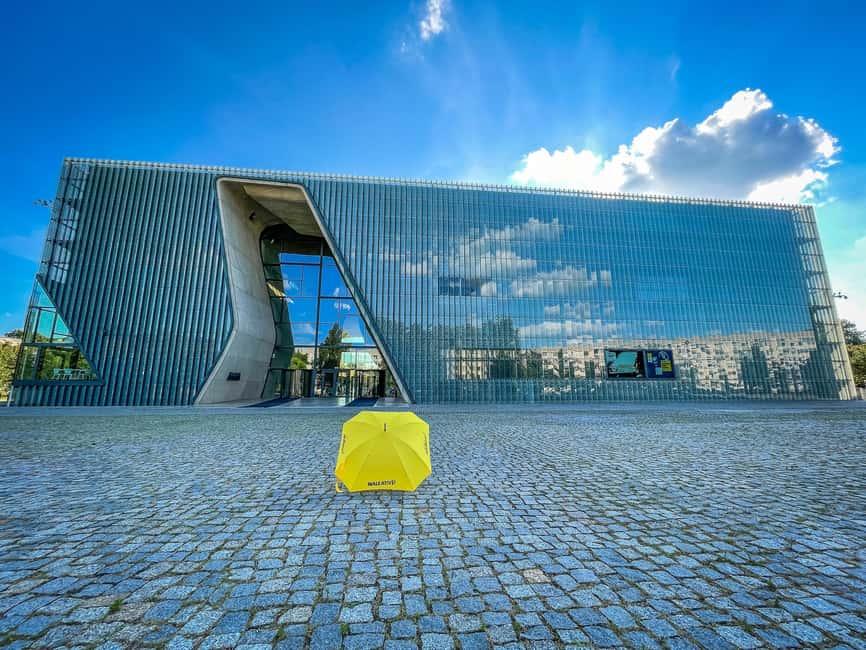
Reviewed · HISTORICAL TOURS
Warsaw: Jewish History Guided Walking Tour in English
Warsaw’s Jewish past is not confined to a museum. It is under your feet, along ordinary streets where almost nothing remains to mark what once stood there. This 150-minute walking tour helps you read those absences, linking the Nożyk Synagogue, Chłodna Street, Waliców Street, and the former ghetto area to the people who lived, worked, created, resisted, and died here.
I like the tour’s effort to begin before the Holocaust, when Warsaw was the second-largest Jewish city in the world and home to artists, actors, writers, and journalists. I also like the guides’ reported habit of welcoming questions and adding practical Warsaw tips at the end. The main drawback is simple: you stay outdoors for the entire two and a half hours, and large groups can make it harder to hear every word.
Key points at a glance

- Nożyk Synagogue: See Warsaw’s only surviving pre-war synagogue, though entry inside is not guaranteed.
- Chłodna Street: Learn how a bridge once connected two sections of the wartime ghetto above the street.
- Waliców Street: Follow a former ghetto border and connect the area to the Warsaw Uprising.
- History before 1939: Hear about Jewish life, culture, and political activity across centuries, not only wartime suffering.
- Thoughtful English guidance: Guides such as Andrzej, Jacek, Luke, Anna, and Christopher have been praised for clear explanations, humor, and compassion.
- Outdoor planning matters: Bring suitable clothing, especially in cold or wet weather, since there is no planned café break.
Starting at Grzybowski Square
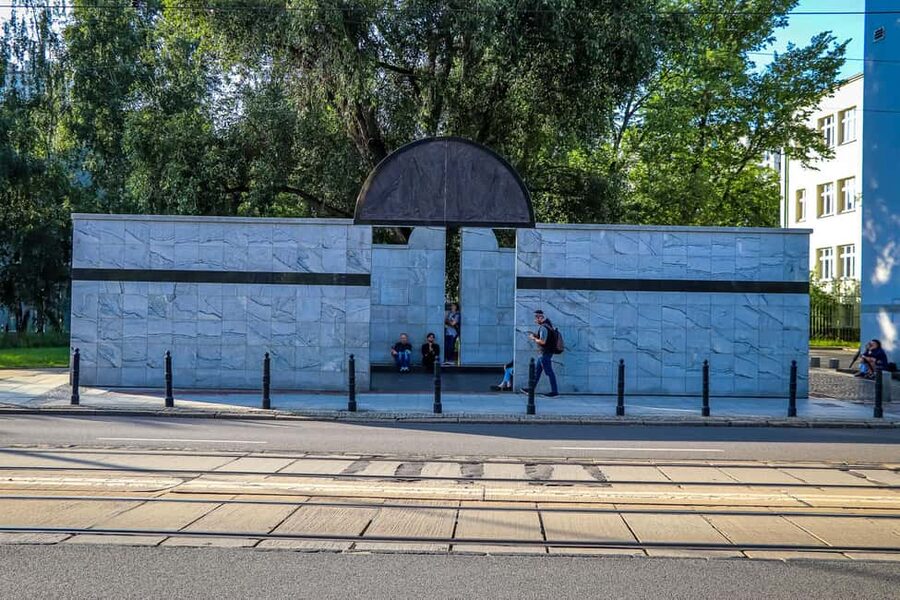
Meet beside All Saints Church at Grzybowski Square and look for the yellow umbrella. This is a useful meeting point in central Warsaw, and you should have little trouble spotting the group if you arrive a few minutes early.
The square is a fitting place to begin. It places you near the former Jewish district while also showing how present-day Warsaw has grown around sites marked by absence. The tour is not a museum visit with objects behind glass. Your guide uses streets, surviving buildings, photographs, maps, and spoken explanation to rebuild a city that was almost entirely destroyed.
The experience joins a general walking tour, so your group may be larger than a private party. The price covers the reservation fee and the guide’s payment. If you want a smaller private tour, you can contact Walkative after booking to ask about arranging one.
More History Tours in Warsaw
- Warsaw: POLIN Museum of the History of Polish Jews Ticket
★ 4.7 · 1,142 reviews - Warsaw: Chopin Concert at Historical Venue in Old Town
★ 4.7 · 445 reviews - Small-Group Historical Guided Tour of Warsaw with pick up/drop off. Public Tour.
★ 4.5 · 343 reviews
Understanding Jewish Warsaw before the war
A major strength of this walk is its starting point in ordinary Jewish life. You hear about Jewish residents as workers, neighbors, writers, performers, political activists, and participants in the wider life of Warsaw.
That wider frame matters. If a tour begins only with Nazi persecution, it can reduce a whole community to its final tragedy. Here, the guide explains how Jewish Warsaw developed over centuries and how Jews took part in struggles against occupying powers during the 19th century, including Polish uprisings.
The interwar period gets particular attention. Between the First and Second World Wars, Warsaw had a Jewish cultural life unlike any other period in the city’s history. Hundreds of artists, actors, writers, and journalists lived and worked here. That detail changes how you view the streets. You are not only looking at the site of a destroyed population. You are trying to picture a busy intellectual and cultural world that had its own voices, arguments, humor, ambitions, and daily routines.
I find this historical order one of the best reasons to book the tour. The guide does not rush straight to dates and atrocities. You first gain a sense of what was lost.
The Nożyk Synagogue and what survived
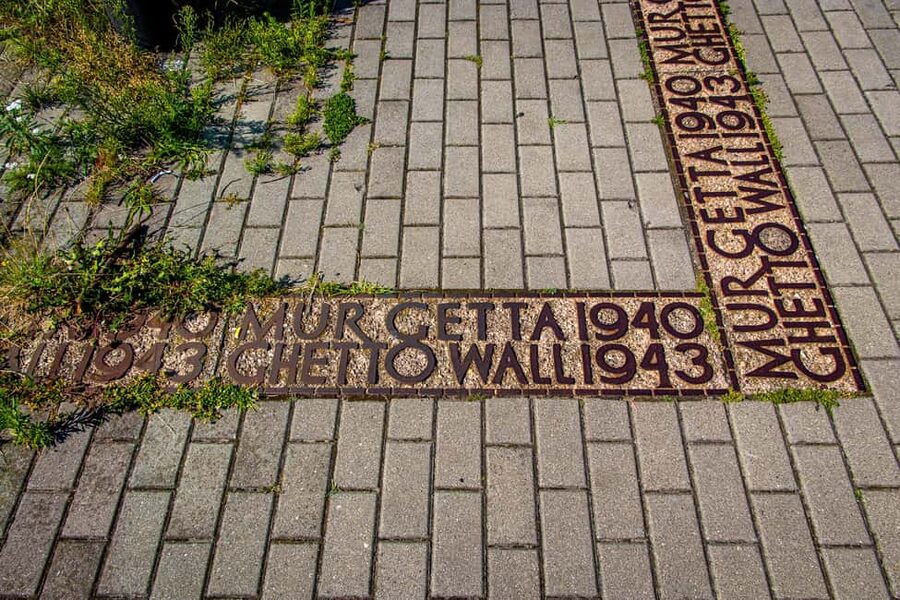
The Nożyk Synagogue is the only surviving pre-war synagogue in Warsaw. It gives the walk one of its clearest physical connections to Jewish Warsaw before the Second World War.
You should expect to see the synagogue as part of the route. Do not assume that your ticket includes entry inside. One visitor specifically noted that some people hoped to go in, while the tour itself focused on the exterior and surrounding history. If entering the synagogue is important to you, check separately rather than counting on it as part of this walk.
Even from outside, the building gives the guide a strong point of reference. It helps explain the scale of Jewish life in Warsaw and the destruction that followed. The contrast is stark: one surviving synagogue cannot represent an entire community, but it can help you connect a broad historical story to a real structure.
The tour also shows how difficult Warsaw’s Jewish history can be to see. Many important buildings and boundaries are gone. A good guide must explain what used to occupy an empty space, and several guides have brought old photographs and maps to make that task easier.
Chłodna Street and the vanished ghetto bridge
At Chłodna Street, you learn about the bridge that once joined two parts of the Warsaw ghetto. The bridge crossed above the normal street, connecting Jewish residents who had been cut off from one another at ground level.
This is one of the walk’s most striking stops because the bridge itself no longer exists. You see the street, listen to the explanation, and use the guide’s images to picture a structure that has disappeared. It is a good example of why a walking tour works well here. The location gives scale and distance in a way a written account cannot fully provide.
The stop also helps explain the machinery of separation. The ghetto was not simply a walled neighborhood in one compact block. Its divisions affected movement, family connections, work, food, and access to other parts of the city. Chłodna Street turns that idea into something physical.
A guide who moves too quickly can make this kind of stop difficult, especially in a big group. One participant found it hard to hear when the guide walked ahead before finishing a sentence. Stay close, and do not be shy about asking the guide to repeat an important point.
More Walking Tours in Warsaw
- Warsaw: Old Town Highlights Walking Tour in English
★ 4.7 · 1,516 reviews - Warsaw: Old Town Guided Walking Tour
★ 4.9 · 599 reviews - Half-Day Polish Food Walking Tour with Guide and Dinner
★ 4.5 · 381 reviews - Warsaw: Warsaw Ghetto Private Walking Tour with Hotel Pickup
★ 4.9 · 369 reviews
Waliców Street and the Warsaw Uprising
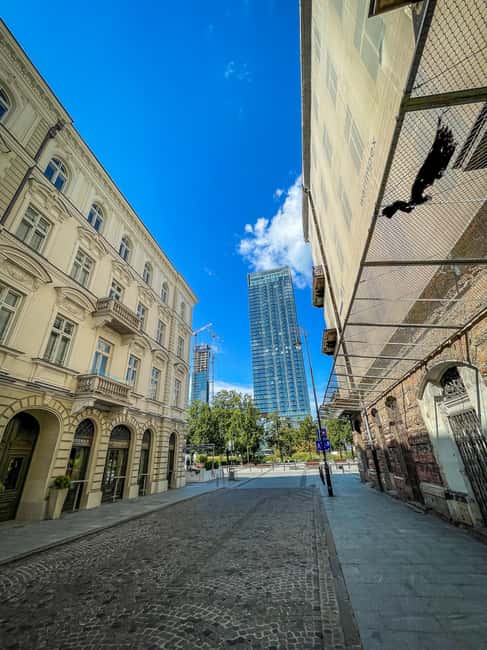
Waliców Street was once part of the ghetto border. Here, the route shifts from a story of boundaries and confinement to the later wartime resistance and the Warsaw Uprising.
The connection is important, since Warsaw’s wartime history cannot be separated into neat chapters. Jewish resistance, German occupation, the destruction of the ghetto, and the 1944 uprising belong to a wider story of a city under violent occupation. Your guide explains these events in relation to the streets around you.
Waliców Street also makes the theme of change especially clear. The former border is not always obvious to someone seeing Warsaw for the first time. The guide’s role is to show you how the city’s current streets overlap with its wartime geography.
Several guides have been praised for using photographs and maps during this part of the walk. That extra visual help is worth having, because so much of the original built environment has vanished. You might also hear suggestions for films or television programs connected to the history, a useful bonus if you want to continue learning after the tour.
A difficult subject handled with care
This is an emotional tour. You will hear about persecution, deportation, death, and the Holocaust. The subject cannot be made light, but the best guides keep the presentation human rather than turning it into a cold list of facts.
The strongest feedback points to guides who combine clear historical explanation with compassion and, at times, restrained humor. Luke, Andrzej, Jacek, Anna, Christopher, Aga, and others have been singled out for their ability to keep people engaged during a difficult subject. One guide was praised for asking first before sharing especially harsh details. That kind of awareness can matter in a group with different ages, backgrounds, and levels of preparation.
You should also expect room for questions. Guides have stayed after the scheduled finish to continue conversations, and visitors have praised the chance to ask about family connections, Christianity, Polish history, and specific places such as Mila 18.
The tour does not present Jewish Warsaw only as a story of victims. It also covers bravery, resistance, cultural achievement, and the survival of Jewish identity. The final emphasis reaches toward the present: Warsaw has a young, diverse, energetic Jewish community that looks to the future.
That closing note gives the experience needed balance. You are asked to remember the destruction without treating Jewish life as something that ended in 1945.
The guide makes or breaks the walk
The subject requires more than dates. You need a guide who can explain a complicated sequence of events in plain English, answer questions accurately, and judge when the group needs a pause.
The overall rating of 4.7 from 324 reviews suggests a strong and steady experience, and the praise is remarkably consistent. The most valued qualities are clear English, strong command of Warsaw’s history, a thoughtful manner, and the ability to keep the pace moving.
Names vary because this is a general tour with different guides. Andrzej has been praised for offering the walk even when only one person had booked. Jacek has been described as engaging, fluent, and happy to answer questions. Luke is often praised for making the subject accessible, while Christopher has been noted for explaining details across many parts of Warsaw and for connecting the route to personal family interest.
No tour is identical from one day to the next. The guide may shape the discussion around the group’s questions, and the amount of detail can vary. That is a benefit if you enjoy conversation, but less ideal if you want a fixed script or a small private group.
Two and a half hours on foot
The advertised duration is 150 minutes, and you should plan to be outside for the full time. There is no hotel pickup or drop-off, and the experience is a walking tour from the central meeting point.
Wear comfortable shoes and dress for the forecast. Cold weather has not stopped the tour from going ahead, but it has made the experience tougher for some people. A warm coat, gloves, and suitable footwear can make a real difference in winter. In warmer weather, water and sun protection are sensible, although the supplied details do not specify the amount of shade along the route.
There is no planned café stop. One person specifically wished for a break indoors during very cold weather. If you need regular rest stops, have limited tolerance for standing, or prefer to spend part of a history tour inside, take this into account before booking.
The pace is generally described as good, with enough movement to cover the main sites while allowing discussion. A larger group may affect how easily you hear. Stand near the guide, especially when photographs or maps are being shown.
Is $26 good value?
At $26 per person, this is a fair price for a 150-minute guided walk in English. You are paying for a local guide and the structure of the experience, not for museum admission, transport, food, or hotel service.
The value comes from interpretation. You could walk past Chłodna Street or Waliców Street alone and see little more than modern Warsaw. A good guide gives those places meaning, explains the missing buildings, and connects Jewish life before the war with the Holocaust, resistance, the Warsaw Uprising, and the community that exists today.
The price is especially reasonable if you have limited time in Warsaw and want a clear introduction to Jewish history without committing to a longer private tour. It is less suited to someone who wants extensive indoor access or a highly specialized genealogy tour.
You can reserve now and pay later, which keeps your plans flexible. Cancellation is free up to 24 hours before the start time for a full refund. Those terms are useful if your Warsaw schedule is still changing.
Who should book this Warsaw walk?
I would recommend it to anyone who wants context before visiting other sites connected with Warsaw’s wartime history. It is also a strong choice if you know little about the Warsaw ghetto and want the subject explained in accessible English.
It suits people who value stories about daily life and culture as much as military dates. The discussion of artists, actors, writers, journalists, political activity, and community life gives you a fuller picture of Jewish Warsaw.
Families and mixed-age groups should consider the emotional weight. The material is serious, and the guide may discuss terrible events in direct language. At the same time, the reported approach is thoughtful and often allows people to decide how much detail they want to hear.
You may want something else if you have already studied Warsaw’s Jewish history in depth and want only a specialized focus on one topic. In that case, ask Walkative about a private tour after booking. You may also prefer a different activity if entering the Nożyk Synagogue is your main goal, since entry is not guaranteed here.
Should you book it?
Book this tour if you want Warsaw’s Jewish history explained on the streets where it happened, with a guide who can connect pre-war culture, the ghetto, resistance, destruction, and Jewish life today. The strongest reason to go is the balance between human stories and physical places, even when those places have disappeared.
Skip it only if two and a half hours outdoors sounds uncomfortable, or if you need guaranteed synagogue admission. Arrive ready to walk, listen, ask questions, and accept that the most powerful stop may be an ordinary street with only a photograph showing what once stood there.
FAQ
Where does the Jewish history walking tour meet?
The meeting point is next to All Saints Church at Grzybowski Square. Look for a yellow umbrella.
How long does the tour last?
The tour lasts 150 minutes, or two and a half hours.
What language is the tour in?
The live tour guide speaks English, and English is the listed tour language.
What is included in the price?
The price includes a local guide and the walking tour.
Is hotel pickup included?
No. Hotel pickup and drop-off are not included.
Does the tour enter the Nożyk Synagogue?
The tour includes seeing the Nożyk Synagogue, but entry inside is not guaranteed by the supplied tour information.
What places does the walking route cover?
The route includes Grzybowski Square, the Nożyk Synagogue, Chłodna Street, the former bridge site that connected parts of the ghetto, and Waliców Street.
Is this a private tour?
No. The tour joins a general walking tour. If you want a smaller private tour, contact the supplier after booking to ask about arranging one.
Can I cancel for a full refund?
Yes. You can cancel up to 24 hours in advance for a full refund.
Do I have to pay when I book?
No. The reserve-now-and-pay-later option lets you hold a place without paying immediately.
Recently added in Warsaw
- Warsaw Wolf’s Lair with St. Lipka and Mamerki Private Guided★ 4.2 · 3 reviews
- Taste of Poland, food tour and guided walk with 12 tasting★ 5.0 · 3 reviews
- Discover Warsaw’s most Photogenic Spots with a Local★ 5.0 · 3 reviews
- Lodz Small Group Tour from Warsaw with Lunch★ 4.0 · 3 reviews
- Jewish heritage in Warsaw★ 4.5 · 3 reviews
- Warsaw Outdoor Paintball with Transfers (all year round)★ 5.0 · 3 reviews
- Electric Scooter Tour: Full Tour – 3-Hours of Magic!★ 5.0 · 3 reviews
- Skip-the-Line Polin Museum Warsaw Jewish History Tour★ 5.0 · 3 reviews
Historical Tours, compared.
POLIN Museum of the History of Polish Jews Ticket
Read our review →
Gdańsk City Sights & History Guided Walking Tour in English
Read our review →
Small-Group Historical Guided Tour of Warsaw with pick up/drop off. Public Tour.
Read our review →Where else this one turns up