
Reviewed · OLD TOWN TOURS
Old Town Warsaw Walking Tour
Warsaw’s Old Town is not simply old. It is a carefully rebuilt portrait of a city nearly erased during World War II. This walking tour gives you the useful backstory as you move from the royal boulevard of Krakowskie Przedmieście through the colorful Old Town to the Barbican.
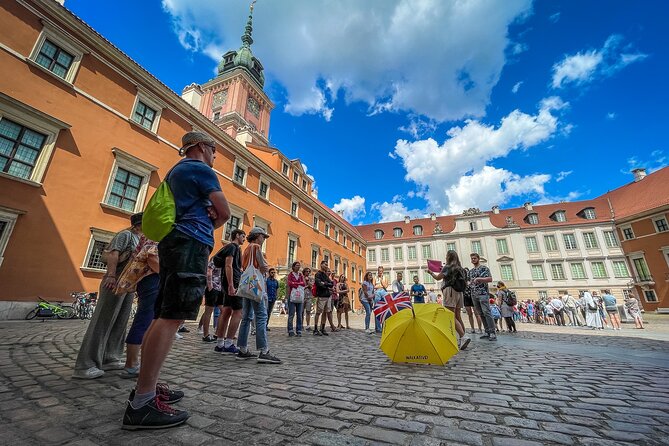
I like the route’s clear historical shape, from royal Warsaw to wartime destruction and modern reconstruction. I also like the guides’ lively delivery. Aga, Andrzej, Jack, Ania, Oliwia, and Josek are among the guides praised for humor, strong English, personal stories, and a willingness to answer questions.
The main consideration is group size, which can reach 40 people. A strong guide can make that work, but you may need to gather close and listen carefully, especially in traffic or bad weather. One report also noted that a guide’s accent and microphone made some explanations hard to follow.
Key points
- A powerful reconstruction story: See a UNESCO-listed Old Town rebuilt after near-total wartime destruction.
- A royal approach to the city: Walk Krakowskie Przedmieście past palaces, monuments, the Presidential Palace, and St. Cross Church.
- Chopin and Curie connections: Learn where Chopin’s heart is interred and where Maria Skłodowska-Curie was born.
- A manageable two-and-a-half-hour route: The pace is active but not an exhausting march, with plenty of time spent listening.
- A guide-led history lesson: The best guides combine politics, music, art, war, humor, and present-day Poland.
- Simple point-to-point logistics: Meet at the Nicolaus Copernicus Monument and finish at the Warsaw Barbican.
Starting beneath Copernicus on Krakowskie Przedmieście
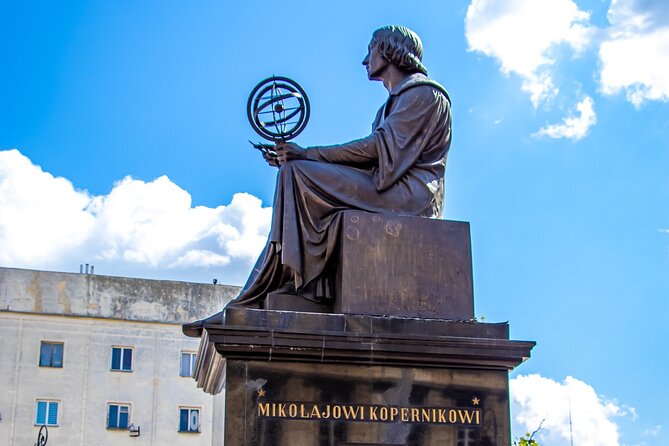
The walk begins at the Nicolaus Copernicus Monument on Krakowskie Przedmieście, one of Warsaw’s most important ceremonial streets. This is a sensible starting point because the boulevard leads naturally toward the Old Town, while giving your guide room to explain how Warsaw grew around its royal center.
Krakowskie Przedmieście recalls the city’s royal past through palaces, monuments, churches, and grand public buildings. The route includes the Presidential Palace and the Bristol Hotel, two places that help show how Warsaw moved between royal power, national politics, diplomacy, and modern city life.
The first hour is not just a parade of façades. Your guide uses the street to connect Warsaw’s cultural and political story. Expect attention to the city’s changing identity, Poland’s complicated past, and the way history still shapes daily life.
The strongest guides bring their own style to this section. Aga has been praised for mixing music, art, war history, politics, and the rebuilding of Warsaw. Andrzej and Andrew are noted for clear explanations of Polish history, while Jack, also identified as Jacek, is described as witty and well read. The guide on your departure may be different, but the experience clearly depends a great deal on who leads the group.
More Old Town Tours in Warsaw
- Warsaw: Chopin Concert in the Old Town
★ 4.8 · 2,287 reviews - Warsaw: Old Town Highlights Walking Tour in English
★ 4.7 · 1,516 reviews - Warsaw: Old Town Guided Walking Tour
★ 4.9 · 599 reviews
St. Cross Church and Warsaw’s musical connection
St. Cross Church is one of the most memorable stops on the boulevard. The church is associated with Frédéric Chopin because his heart is interred there. That detail gives you a more personal connection to the composer than a simple statue or commemorative plaque would.
This is also where the tour’s storytelling style matters. A dry list of dates would make the stop brief and forgettable. A good guide can use Chopin to connect Warsaw with Polish culture, exile, national feeling, and the city’s long habit of preserving identity through art and music.
The tour does not include an admission ticket to the church or other interiors. It is an outdoor walking experience, so you should think of it as a guided introduction rather than a museum visit. If you want to spend serious time inside the Royal Castle, churches, or other buildings, plan those visits separately after the walk.
Entering the reconstructed Old Town
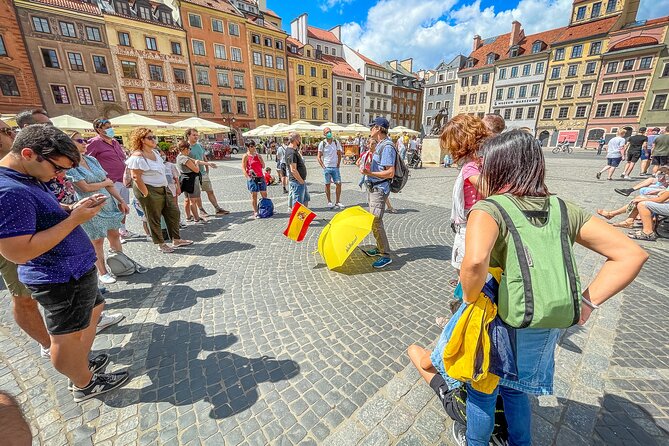
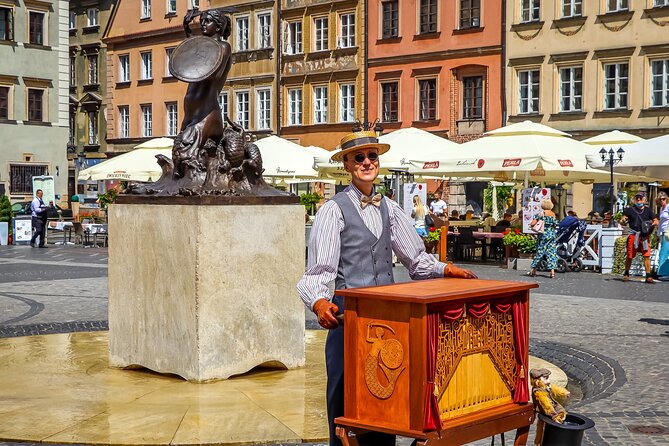
After Krakowskie Przedmieście, the route reaches Warsaw’s Old Town, known in Polish as Stare Miasto. Here you encounter the red roofs, bright façades, narrow streets, and the Royal Castle that make this part of Warsaw feel medieval.
The surprising fact is that the Old Town was almost completely destroyed during World War II. Its later reconstruction was so careful that the area earned UNESCO World Heritage recognition. For you, this changes the way you see every colorful house and decorative detail. The question is not simply, How old is this building? It is also, How did Warsaw decide what to rebuild, and why?
That story is the heart of the tour. The rebuilt Old Town is not a fake version meant to fool you. It is a visible record of national determination, historical research, and postwar choices. The guides explain how the city was restored and help you distinguish the surviving past from the reconstructed city you see today.
Several guides are praised for making this subject easy to follow without turning it into a solemn lecture. Humor appears often, even when the subject is painful. That approach can be useful in Warsaw, where World War II and its aftermath are central to understanding the city but can also make for an emotionally heavy afternoon.
The Old Town section lasts about an hour. That gives the guide enough time to discuss the streets, the Royal Castle area, the destruction of the war, and the rebuilding that followed. Still, this is a general walking tour, not a focused wartime history program. One person wanted more discussion of World War II and its effect on Poland, so you should book a dedicated museum or war-history visit if that is your main interest.
Seeing the Royal Castle without an interior visit
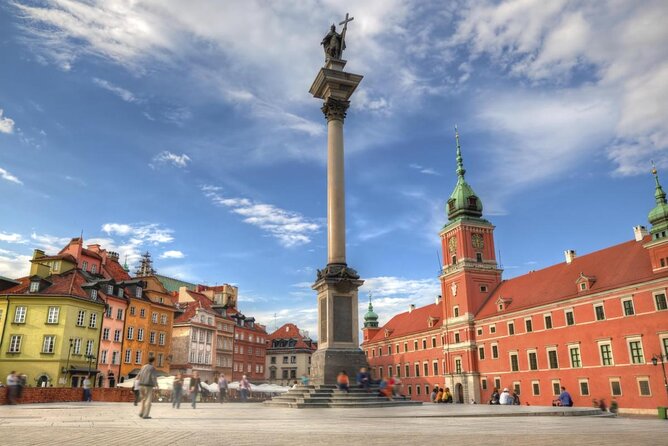
The Royal Castle is one of the visual anchors of the Old Town. From the outside, it helps explain Warsaw’s royal importance and the way the city’s central district was arranged.
The tour does not include transportation or admission into attractions. That keeps the price low and the route moving, but it also means the castle is treated as part of the street story rather than as a full visit. I see this as a strength for a first look, especially if you have only one day in Warsaw. You get context before deciding which interiors deserve your own time.
The guide’s role here is to make the buildings mean something. You are not just collecting photographs. You are learning how royal power, wartime destruction, national memory, and modern reconstruction meet in one compact area.
More Walking Tours in Warsaw
- Half-Day Polish Food Walking Tour with Guide and Dinner
★ 4.5 · 381 reviews - Warsaw: Warsaw Ghetto Private Walking Tour with Hotel Pickup
★ 4.9 · 369 reviews - Warsaw: Jewish History Guided Walking Tour in English
★ 4.7 · 324 reviews - World War 2 in Warsaw walking tour in English
★ 4.7 · 237 reviews
From Old Town to New Town Square
The final section leads toward New Town Square, or Nowe Miasto. The name can mislead you: this district was also founded in the Middle Ages. It became a useful way for the guide to show that Warsaw’s historic center is larger than the postcard views around the Royal Castle.
New Town Square is linked with Maria Skłodowska-Curie, the Polish-born scientist better known internationally as Marie Curie. That connection adds another layer to the walk. The tour moves beyond kings and wartime ruins to science, education, and the Polish figures whose work reached far beyond Warsaw.
The route ends at the Warsaw Barbican on Nowomiejska Street. The Barbican once formed part of the city’s defensive system and now creates a strong visual finish between the Old Town and New Town. It is a practical endpoint too. You are not returned to the starting monument, so you can continue exploring from the northern side of the historic center.
One drawback is that the supplied information gives only the Barbican as the ending point, not a return transfer. You should be ready to make your own way afterward. The tour includes meeting-point arrangements and a guide, but not hotel pickup, hotel drop-off, or transportation between attractions.
What two and a half hours feels like on foot
The advertised duration is about two hours and thirty minutes, divided roughly into one hour on Krakowskie Przedmieście, one hour in the Old Town, and thirty minutes around New Town Square and the Barbican.
The walking itself appears moderate rather than punishing. The route is designed for a general audience with a moderate level of physical fitness, and the pace has been described as suitable even when the guide delivers a lot of information. One useful point for older visitors or anyone conserving energy: the experience is not built around covering huge distances quickly.
The challenge is less the mileage than the listening. Some guides speak quickly because there is much to explain. You may be asked to gather close, and a group of up to 40 people can make it harder to hear at the back. Stay near the guide when possible and raise your hand quickly when you have a question.
Comfort also depends on the season. The walk operates in all weather, so bring suitable clothing. Winter means warm layers, a hat, gloves, and thermal clothing. Rain can make a long outdoor explanation tiring, even though the route itself is not unusually strenuous.
Guide style: humor, stories, and a fast history lesson
The most praised feature of this experience is the guide’s delivery. The best guides do not merely recite dates. They use jokes, personal observations, and clear connections between past events and Warsaw today.
Aga is noted for making difficult subjects feel approachable while still discussing the city’s rebuilding in detail. Oliwia is praised for communicating clearly and keeping the tour light. Jack or Jacek is remembered for blending facts with humor, and Andrzej or Andrew for explaining centuries of Polish history with energy.
The tone can be quick and opinionated. One description advises you to gather close and listen closely because the information and jokes come rapidly. That will suit you if you enjoy a lively guide who keeps moving between subjects. It may be less comfortable if you prefer long quiet pauses, slow architectural study, or a highly formal lecture.
The pay-as-you-wish format also shapes the experience. The $26.60 price covers the reservation fee and the guide’s payment, so this is not a free walk in the usual sense. You are paying for a reserved place and for the guide’s work. You can still choose to give an additional tip for exceptional service, but the advertised amount already covers the stated payment arrangement.
Is $26.60 good value?
For two and a half hours with a professional local guide, $26.60 is a fair price, particularly because the route covers three connected historic areas without requiring transport. You receive a structured introduction to Warsaw’s royal center, reconstructed Old Town, and medieval New Town.
The value is strongest at the start of your visit. If Warsaw is new to you, the tour gives you a working map and a historical framework. Afterward, you can return to the Royal Castle, St. Cross Church, or other sights with a better sense of what you are seeing.
The value is less clear if you already know the Old Town well or want entry to museums and interiors. No attraction admissions, hotel transfers, or transport are included. You are paying for the route, the explanation, and the chance to ask questions.
The average booking point is 22 days ahead, so I would not leave this until the last minute if the timing matters to you. The maximum group size is 40, and a smaller private walk can be arranged by contacting the provider, though the private option is not described with a separate price here.
Who should book this Warsaw walk?
I would choose this tour for a first visit, a short stay, or a morning when you want to understand the city before exploring alone. It suits you if you like history delivered through stories rather than through a museum label.
It is also a good fit for families with older children, provided an adult accompanies each child. The humor can help younger visitors stay with the subject, though the amount of historical detail may be more suitable for children who can listen for several hours.
You should think twice if you dislike group tours, need a very slow speaking pace, or want extensive time inside monuments. A group of 40 can feel crowded, and one report raised concerns about accent and microphone clarity. The tour is in English, but audio conditions can vary outdoors.
For visitors with limited stamina, the moderate pace is encouraging, but this remains a 150-minute outdoor walk. Dress for the forecast and be ready to stand while listening.
Booking, meeting points, and cancellation
Your starting point is the Nicolaus Copernicus Monument on Krakowskie Przedmieście, Warsaw, postal code 00-333. The walk ends at the Warsaw Barbican, Nowomiejska 15/17, postal code 00-257.
The activity is offered in English and uses a mobile ticket. It operates in all weather and requires a minimum number of participants. If that minimum is not met and the tour is canceled, you are offered another date or experience, or a full refund.
You can cancel for a full refund up to 24 hours before the local start time. Cancellations or changes made within 24 hours are not refunded or accepted. That rule makes it wise to check your Warsaw schedule before booking.
Should you book the Old Town Warsaw Walking Tour?
Book it if you want a strong first introduction to Warsaw at a reasonable price, especially if the reconstruction of the Old Town interests you. The route is compact, the endpoint is useful, and the guides often bring enough humor and personality to make difficult history stick.
Do not book it expecting a private walk, museum admissions, or a detailed World War II program. For the best experience, arrive ready to listen, stay near the guide, dress for the weather, and treat the tour as your city orientation. Then use the rest of your day to explore the interiors and museums that the walk introduces from the street.
FAQ
How long is the Old Town Warsaw Walking Tour?
The tour lasts approximately 2 hours and 30 minutes. The route allocates about one hour to Krakowskie Przedmieście, one hour to the Old Town, and 30 minutes to New Town Square and the Barbican.
How much does the tour cost?
The listed price is $26.60 per person. The amount covers the reservation fee and the guide’s payment for the general pay-as-you-wish tour format.
Is the tour offered in English?
Yes. The tour is offered in English.
Where does the tour start?
The meeting point is the Nicolaus Copernicus Monument on Krakowskie Przedmieście, 00-333 Warsaw, Poland.
Where does the tour end?
The tour ends at the Warsaw Barbican, Nowomiejska 15/17, 00-257 Warsaw, Poland.
What does the price include?
The experience includes a local professional guide, a mobile ticket, and pickup and drop-off from designated meeting points. It does not include hotel pickup or drop-off, transportation to or from attractions, or attraction admission tickets.
Does the tour operate in bad weather?
Yes. The walk operates in all weather conditions, so you should dress appropriately.
Can I cancel for a full refund?
Yes. You can cancel at least 24 hours before the experience start time for a full refund. Cancellations or changes made less than 24 hours before the start time are not refunded or accepted.
Recently added in Warsaw
- Warsaw Wolf’s Lair with St. Lipka and Mamerki Private Guided★ 4.2 · 3 reviews
- Taste of Poland, food tour and guided walk with 12 tasting★ 5.0 · 3 reviews
- Discover Warsaw’s most Photogenic Spots with a Local★ 5.0 · 3 reviews
- Lodz Small Group Tour from Warsaw with Lunch★ 4.0 · 3 reviews
- Jewish heritage in Warsaw★ 4.5 · 3 reviews
- Warsaw Outdoor Paintball with Transfers (all year round)★ 5.0 · 3 reviews
- Electric Scooter Tour: Full Tour – 3-Hours of Magic!★ 5.0 · 3 reviews
- Skip-the-Line Polin Museum Warsaw Jewish History Tour★ 5.0 · 3 reviews
Old Town Tours, compared.
Bike Tour of Old Town, Jewish Quarter and the Ghetto
Read our review →

Sightseeing EcoCruise around the Old Town of Gdansk
Read our review →
Where else this one turns up