
Reviewed · HISTORICAL TOURS
Historical Walking Tour of Jewish Warsaw
Warsaw’s Jewish past is not laid out like a preserved old quarter. Much of the former ghetto was destroyed, so the power of this tour comes from learning to read the city’s remaining clues: a wall fragment, a synagogue, scattered memorials, street plans, and places that now look surprisingly ordinary. I like the way Aga, Agnieszka, and Oliwia use photographs and maps to show what has vanished. I also like the small group, limited to 10 people, which makes a difficult subject easier to discuss.
The main drawback is simple: you walk a long way over roughly three hours, and many stops are memorials or sites marked by absence rather than intact buildings. Wear sturdy shoes, bring water and an umbrella, and do not expect a museum-style display at every stop.
Key points to know before you book
- Trace the ghetto from Sienna Street to Umschlagplatz: The route crosses a large section of former Jewish Warsaw rather than staying around one memorial.
- See the only surviving prewar synagogue: Nozyk Synagogue is the tour’s principal surviving place of Jewish worship, with a 20 PLN entry fee not included.
- Use maps and photographs to rebuild the vanished city: Visual aids help you understand streets and buildings that no longer exist.
- Expect an intense but carefully paced morning or afternoon: The tour lasts about three hours, with breaks and time for photographs.
- Keep the group small: A maximum of 10 participants gives the guide room to answer questions and adjust the pace.
- Finish at Umschlagplatz: The final stop marks the point from which about 300,000 Jews were transported to Treblinka.
Why this walk matters in a city that was almost erased
The hardest part of seeing Jewish Warsaw is knowing how much is missing. The former ghetto was almost entirely destroyed during the Second World War, and modern streets and apartment blocks can make the area difficult to read without help.
That is exactly where a walking guide earns the fee. You are not simply taken from one monument to another. You are shown how the old district fitted together, where Jewish life took place, how the ghetto was organized, and how the Nazi occupation brought that life to a brutal end.
I find this more useful than wandering alone with a guidebook. A remaining wall fragment may take only a few minutes to see, but photographs and maps can show you the streets, courtyards, and buildings that once surrounded it. The result is less a collection of intact sights than a lesson in reconstructing a lost city.
The tour is offered in English. Its guides, including Aga, Agnieszka, and Oliwia, are praised for clear explanations, strong preparation, and a humane approach to painful material. The tone is serious and factual. Do not expect theatrical storytelling or forced cheerfulness. That restraint suits the subject.
More History Tours in Warsaw
- Warsaw: POLIN Museum of the History of Polish Jews Ticket
★ 4.7 · 1,142 reviews - Warsaw: Chopin Concert at Historical Venue in Old Town
★ 4.7 · 445 reviews - Small-Group Historical Guided Tour of Warsaw with pick up/drop off. Public Tour.
★ 4.5 · 343 reviews
Starting at Sienna 53 and setting the historical frame
Meet at Sienna 53, on the corner with Jana Pawla II Avenue, near the Baguette Mi banh mi bistro. The introduction is brief, about five minutes, but it gives the guide a chance to explain what you are about to see and how the modern streets relate to prewar Warsaw.
This is a good starting point because you need context before the first memorial has much meaning. Jewish Warsaw was not only a wartime tragedy. It was also a living part of the city before the occupation, with homes, religious institutions, businesses, schools, and neighborhood life.
The opening is not a formal attraction, and there is no admission charge. It is simply the point where the guide begins connecting today’s Warsaw with the city that stood here before the war.
Nozyk Synagogue, the rare surviving place of worship
Nozyk Synagogue is one of the tour’s most important physical sights. It is described as the only Warsaw synagogue that survived the war and remains in use today, making it a rare link with prewar Jewish life.
The stop lasts about 10 minutes. Admission is not included, and the entry fee is 20 PLN. That extra charge is modest, but you should carry local currency or be prepared to pay as required at the site.
The synagogue gives the walk a welcome change of scale. Many later stops are outdoor monuments, street corners, or traces. Here, you encounter an actual surviving religious building. The visit helps put a human face on the community described during the rest of the tour.
Keep your expectations practical. This is a short stop within a much larger walk, not a long interior visit. Its value comes from its survival and its place in the story of Jewish Warsaw.
The ghetto wall fragment and the problem of vanished evidence
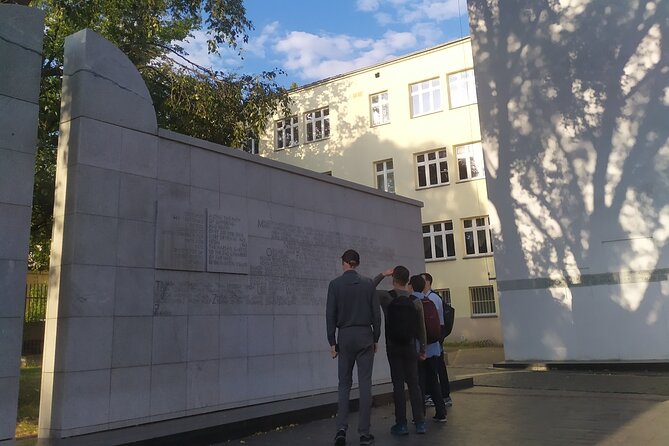
The remaining fragment of the ghetto wall is a quick but striking stop. You spend about 15 minutes here, with no separate admission fee.
A wall fragment can seem small compared with the scale of the former ghetto. That is part of the lesson. The original district was large, crowded, and central to the lives of hundreds of thousands of people, yet very little physical fabric remains.
The guide’s photographs and maps are especially useful here. They help you see the fragment as part of a larger system rather than as an isolated piece of masonry. Without that explanation, you could easily walk past it, take a photograph, and miss its meaning.
This is one of the places where the tour is stronger than a self-guided walk. The city does not always announce its most important traces. You need someone to point them out and explain what stood around them.
More Walking Tours in Warsaw
- Warsaw: Old Town Highlights Walking Tour in English
★ 4.7 · 1,516 reviews - Warsaw: Old Town Guided Walking Tour
★ 4.9 · 599 reviews - Half-Day Polish Food Walking Tour with Guide and Dinner
★ 4.5 · 381 reviews - Warsaw: Warsaw Ghetto Private Walking Tour with Hotel Pickup
★ 4.9 · 369 reviews
Two hours through Muranów and the former Warsaw Ghetto
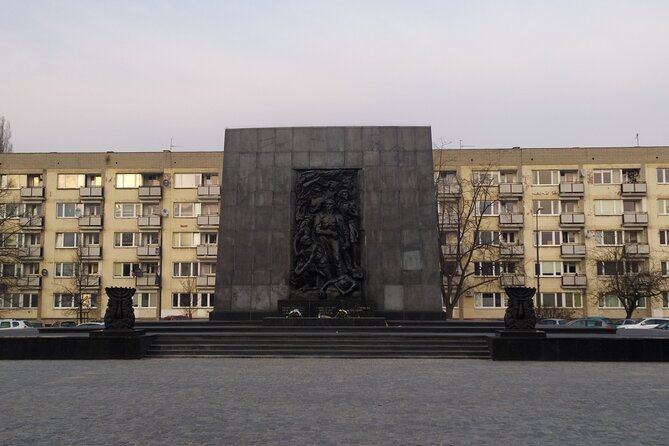
The longest section takes about two hours and five minutes. It covers the former Warsaw Ghetto, the Muranów residential district, the Jewish Ghetto memorial, the courthouse on Solidarności Street, the location connected with the Ringelblum Archive, the Church of St. Augustine, the Heroes of the Jewish Ghetto Memorial, and Miła 18, the site associated with Anielewicz’s bunker.
This is the heart of the experience. You move through a functioning modern district while learning how the wartime ghetto occupied the same ground. That contrast can be jarring. Apartment buildings, roads, and daily city life continue around places tied to confinement, resistance, starvation, deportation, and death.
The Ringelblum Archive is especially important because it preserves Jewish accounts of life under occupation. The archive was created secretly in the ghetto and recorded documents, testimonies, and ordinary details that might otherwise have disappeared. The tour’s reference to its discovery helps show that history is not made only of military events. Diaries, lists, letters, and personal accounts also tell the story.
The courthouse on Solidarności Street and the Church of St. Augustine add further layers. They help you understand that the former ghetto was not a single isolated monument zone. It intersected with wider Warsaw, its streets, institutions, and changing population.
At the Heroes of the Jewish Ghetto Memorial, the focus turns to resistance and remembrance. Miła 18 marks the bunker connected with the Warsaw Ghetto Uprising and Mordechai Anielewicz. These places are not presented as simple victory monuments. They sit within a story of impossible choices, organized resistance, and a community fighting under conditions designed to destroy it.
The route is long, but the pace appears measured. Guides have used breaks, shady seating areas, maps, and photographs to keep the group together. You may have time to take photographs without feeling pushed along, though the total distance still requires reasonable stamina.
Karski’s bench and the monuments of resistance
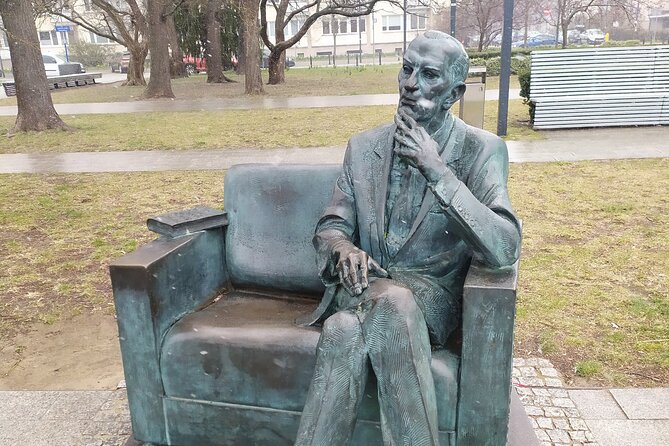
Laweczka Jana Karskiego, or Jan Karski’s bench, comes later in the walk and takes about 15 minutes. Karski was a Polish resistance courier who reported on the destruction of European Jewry to the outside world. The bench is one of several memorials that broaden the tour beyond the central uprising monuments.
This stop works well because memorials around Warsaw often reward attention to detail. You are not only looking at a plaque and moving on. The guide explains how different monuments remember Jewish resistance, individual courage, and the effort to bear witness.
The sequence also gives you a short pause after the longer Muranów section. Still, do not mistake the break for a reduction in walking. You continue on foot toward the final stop.
Umschlagplatz, the tour’s quiet ending
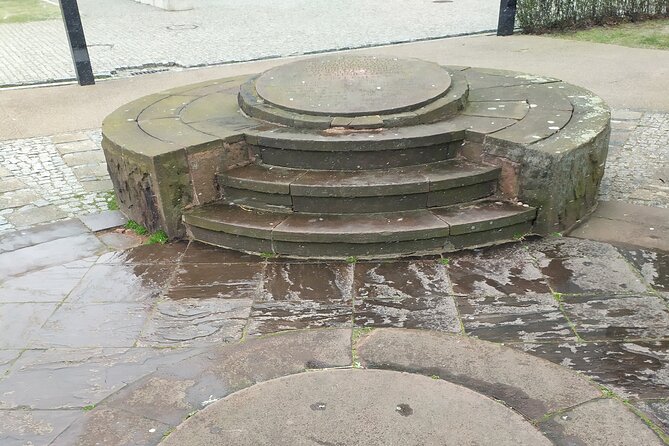
The tour ends at the Umschlagplatz Monument on Stawki 10. The stop lasts about 10 minutes, and the route ends in front of the monument.
Umschlagplatz was the departure point from which about 300,000 Jews were transported to Treblinka. That number is difficult to grasp, which is why the setting and the guide’s explanation matter. The monument marks a place where people were gathered and sent away, not a conventional sightseeing attraction.
Ending here gives the walk a clear emotional and historical direction. You begin with the existence of Jewish Warsaw and move through the ghetto’s walls, streets, archives, resistance sites, and memorials before arriving at the place of deportation.
There is no need to force a cheerful finish. The ending is quiet and reflective. Afterward, you are in a position to continue exploring Warsaw on your own, visit a museum, or simply take a break.
What the $28.87 price really buys you
At $28.87 per person, this is a reasonable price for a three-hour small-group tour in English. You are paying less for entrance tickets than for the guide’s preparation, route design, visual materials, and ability to explain sites that are easy to miss.
Most of the stops are free. The only listed extra cost is the 20 PLN entry fee for Nozyk Synagogue. That keeps the total modest, but the true value depends on how much context you want.
If you already know Warsaw’s Jewish history well and prefer to read plaques at your own pace, you might find the walk less necessary. If the former ghetto is new to you, the price is easier to justify because the guide makes sense of a district where so much physical evidence has gone.
The included information pack is also useful. It contains frequently asked questions, links, and additional suggestions for places to visit, eat, and drink. The visual aids are more important than they may sound. Photographs and maps help you compare the current streets with wartime Warsaw in a way that a spoken explanation alone cannot.
The walking demands and how to prepare
You should plan on a genuine three-hour walk, not a short stroll between nearby sights. The route covers a broad section of former Jewish Warsaw, and several people found the distance tiring.
Wear sturdy, comfortable shoes. Parts of Warsaw can have uneven paving or cobblestones, and the walk includes outdoor stops. Bring an umbrella and dress for changing weather. A light rain shower would not cancel the meaning of the tour, but it could make the long route less comfortable.
The tour is not recommended if you have trouble walking long distances. Most people can participate, and service animals are allowed, but the amount of time on your feet matters more here than on a compact city-center walk.
If you plan to visit POLIN Museum on the same day, think carefully about your energy. The museum and this walk cover related subjects in very different ways, but doing both can make for a long day.
How the guides handle a difficult subject
The strongest part of this experience is the guide’s command of detail and the care taken with presentation. Aga, Agnieszka, and Oliwia are specifically praised for clear English, strong preparation, and the ability to make complicated events understandable.
Oliwia is described as combining factual explanation with humanity, while Aga is noted for being easy to talk with and well prepared. Agnieszka is praised for her steady pace and use of photographs. Names and styles may vary depending on the date of your booking, but the tour is built around a guide who does more than recite dates.
The subject also requires historical precision. The guide distinguishes German occupation, German concentration camps, the experience of Polish Jews, the actions of the Polish resistance, and the varied responses of Polish people during the war. These are sensitive subjects, and a serious guide may correct simplified assumptions rather than offer a neat version of the past.
Do not judge the tour by whether the guide appears cheerful. The material concerns mass murder and the destruction of a community. A calm, direct presentation can be more fitting than dramatic performance.
Who should book this Warsaw walk?
I would choose this tour if you want to understand the former ghetto as a place where people lived, struggled, resisted, and were deported, rather than simply ticking off a few memorials.
It suits you especially well if:
- You want an English-speaking guide to explain places that are easy to overlook.
- You learn best from maps, photographs, and stories tied to specific streets.
- You are interested in the Second World War, Jewish life in Warsaw, or the Warsaw Ghetto Uprising.
- You can comfortably walk for about three hours.
- You prefer a small group, with no more than 10 participants.
- You want suggestions for other places to visit and eat in Warsaw.
It may not suit you if you want a preserved historic quarter full of original buildings. Much of the former ghetto no longer exists, and some stops are defined by what was destroyed. If you want exhibitions and artifacts, add POLIN Museum, but understand that the museum and this walk offer different experiences.
Should you book Historical Walking Tour of Jewish Warsaw?
Book it if you want the city itself to be your classroom. The tour’s best feature is not one spectacular monument. It is the way a guide connects Nozyk Synagogue, the wall fragment, Muranów, the Ringelblum Archive site, Miła 18, Karski’s bench, and Umschlagplatz into one clear account.
Skip it only if a long walk or a mostly memorial-based route would frustrate you. For everyone else, $28.87 buys a thoughtful introduction to a part of Warsaw that is easy to misunderstand when seen alone. Bring good shoes, allow time to think, and consider visiting POLIN on another part of your stay.
FAQ
How long does the Historical Walking Tour of Jewish Warsaw last?
The tour lasts approximately three hours.
Where does the tour begin?
It begins at Sienna 53, 00-820 Warszawa, on the corner with Jana Pawla II Avenue, near the Baguette Mi banh mi bistro.
Where does the tour end?
It ends in front of the Umschlagplatz Monument at Stawki 10, 00-178 Warszawa, Poland.
Is the tour offered in English?
Yes. English is the listed tour language.
Is admission to Nozyk Synagogue included?
No. Entry to Nozyk Synagogue costs 20 PLN and is not included in the tour price.
How many people can join the tour?
The group has a maximum of 10 participants.
Can I cancel for a full refund?
Yes. You can cancel up to 24 hours before the experience begins for a full refund. Changes or cancellations made less than 24 hours before the start time are not accepted for a refund.
Recently added in Warsaw
- Warsaw Wolf’s Lair with St. Lipka and Mamerki Private Guided★ 4.2 · 3 reviews
- Taste of Poland, food tour and guided walk with 12 tasting★ 5.0 · 3 reviews
- Discover Warsaw’s most Photogenic Spots with a Local★ 5.0 · 3 reviews
- Lodz Small Group Tour from Warsaw with Lunch★ 4.0 · 3 reviews
- Jewish heritage in Warsaw★ 4.5 · 3 reviews
- Warsaw Outdoor Paintball with Transfers (all year round)★ 5.0 · 3 reviews
- Electric Scooter Tour: Full Tour – 3-Hours of Magic!★ 5.0 · 3 reviews
- Skip-the-Line Polin Museum Warsaw Jewish History Tour★ 5.0 · 3 reviews
Historical Tours, compared.

POLIN Museum of the History of Polish Jews Ticket
Read our review →

Gdańsk City Sights & History Guided Walking Tour in English
Read our review →
Small-Group Historical Guided Tour of Warsaw with pick up/drop off. Public Tour.
Read our review →Where else this one turns up