
Reviewed · JEWISH QUARTER & KAZIMIERZ TOURS
Jewish heritage in Warsaw
Warsaw’s Jewish story is told through memorials, ruins, cemetery stones, surviving buildings, and places tied to the Warsaw Ghetto Uprising. This private tour brings those pieces together, from the Rappaport monument and Mila 18 to the Nozyk Synagogue and the archive of the Jewish Historical Institute. Renata Kopczewska leads the experience, which lasts about five hours and includes hotel pickup and return transport.
I like two things right away: you avoid transport planning, and you see more than one part of Warsaw in a single morning. I also like the mix of famous memorials and less obvious sites in Praga Polnoc, including buildings connected with Jewish life before World War II. The main caution is comfort: one review describes a very small replacement car with little legroom, so it is sensible to ask about the vehicle if you are tall or have mobility concerns.
Key points to know before booking
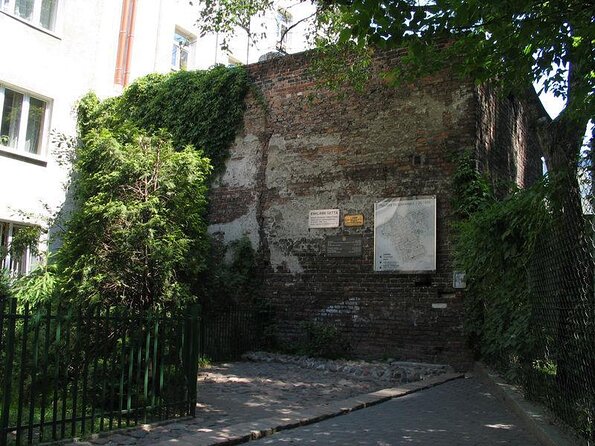
- The tour covers six important stops, including the former ghetto, Jewish Cemetery, Umschlagplatz, Nozyk Synagogue, Praga Polnoc, and the Jewish Historical Institute.
- Hotel pickup and drop-off are included, a real help when several sites are spread across Warsaw.
- The Jewish Cemetery is closed on Saturdays, so plan your day carefully.
- Nozyk Synagogue is Warsaw’s only synagogue to survive World War II and still functions as a place of worship.
- Museum and cemetery admission fees are extra, and lunch is not included.
- The private format suits families and small groups, with a listed price of $270 for up to four people.
Why this five-hour route works
Warsaw’s Jewish heritage cannot be understood from one museum alone. The former Jewish district was largely destroyed, so the story now appears in scattered places: a memorial in an open square, a street marker, a cemetery wall, a synagogue, a surviving building in Praga, and documents preserved indoors.
This tour gives you a guide to connect those locations. That matters because some stops are visually modest. Umschlagplatz is a memorial at a former railway loading area, not a preserved station. Mila 18 is a place of memory rather than a grand monument. The Jewish Cemetery can look like a field of old stones until someone explains the people, symbols, and events represented there.
You receive private transport, so you do not need to work out several tram or taxi connections between sites. The route also includes places that are easy to miss if you plan only around the best-known memorials. The pace is purposeful rather than leisurely, with about five hours spread across six stops.
The cost is $270 per group of up to four. For a full group, that works out to $67.50 per person before admission fees, which is a fairer deal than the headline number first suggests. For one or two people, it is a larger expense, but the private vehicle, hotel transport, and guide’s time make the price easier to justify if this is a major interest.
More History Tours in Warsaw
- Warsaw: POLIN Museum of the History of Polish Jews Ticket
★ 4.7 · 1,142 reviews - Warsaw: Chopin Concert at Historical Venue in Old Town
★ 4.7 · 445 reviews - Small-Group Historical Guided Tour of Warsaw with pick up/drop off. Public Tour.
★ 4.5 · 343 reviews
The former Warsaw Ghetto and the Warsaw Ghetto Uprising
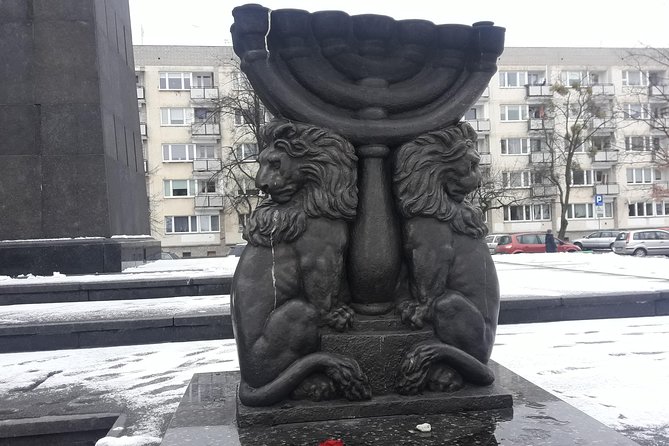
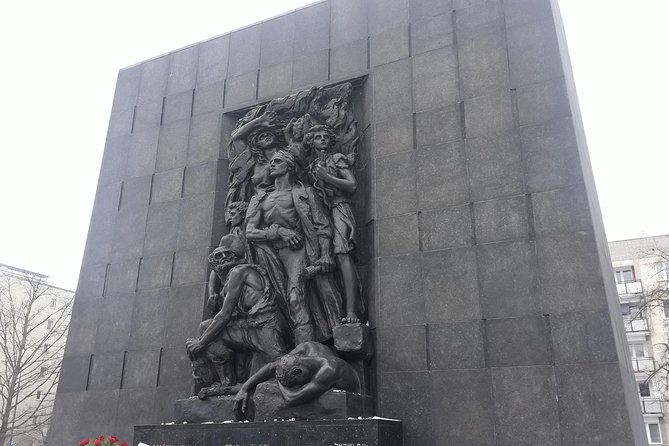
The first stop lasts about an hour and sets the tone for the day. The former Warsaw Ghetto was destroyed after the collapse of the uprising, but its memory is marked by several important sites.
The Rappaport monument, dedicated to the Heroes of the Ghetto, is the main landmark. You will also see Mila 18, associated with the Jewish resistance, along with the memorial to Szmul Zygelbojm. These places carry different parts of the story: armed resistance, the destruction of the ghetto, and the desperate effort to alert the outside world to the murder of European Jews.
This is where a guide adds real value. The area can look like ordinary modern Warsaw, with wide streets and postwar buildings. Without context, you may pass through quickly. With explanation, the open spaces become a map of a vanished neighborhood.
The tour also includes filming locations connected with The Pianist. That will interest anyone who knows the film, but the sites are not presented only as movie scenery. The film offers one personal route through wartime Warsaw, while the memorials and surrounding streets point to the much larger community that lived here.
Admission to this stop is free. Wear comfortable shoes, since the experience involves walking between outdoor memorials and standing while the guide explains what happened at each location.
Jewish Cemetery: names, symbols, and mass graves
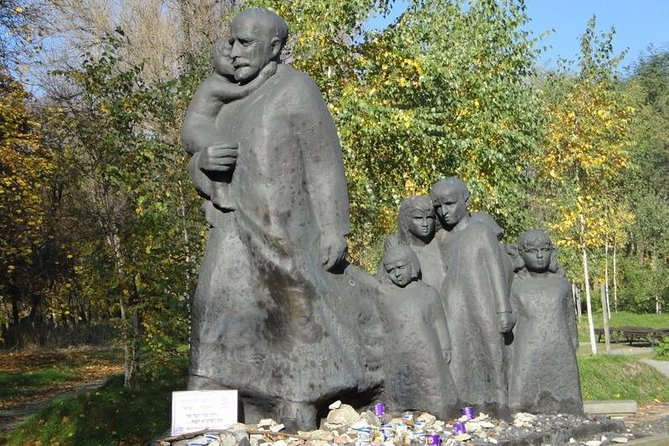
The Jewish Cemetery, or Cmentarz Zydowski, receives about 45 minutes. Its preserved matzevot, or Jewish gravestones, help show the scale and character of Warsaw’s Jewish community before the war.
Look closely at the stones and you can learn about more than burial customs. The cemetery reflects Jewish contributions to Polish literature, science, and art, as well as the social structure of the community. A guide can help you read the names and symbols rather than treating the cemetery as a collection of old monuments.
The grounds also include mass graves from World War II and symbolic stones dedicated to people murdered at Treblinka. Those areas shift the focus from individual lives to the mass destruction of the ghetto’s population. Give yourself a quiet moment here. This is not a stop to rush through with a camera.
The cemetery admission fee is not included. Most important, it is closed on Saturdays. If your only possible tour day is Saturday, ask before booking, since this stop is a central part of the route and cannot simply be treated as an ordinary open-air sight.
The tour calls for a moderate level of physical fitness. That does not mean a strenuous hike, but you should be comfortable walking and standing at outdoor sites. The condition of cemetery paths can vary, and the pace is not designed around long rest periods.
Umschlagplatz and the final journeys to Treblinka
Umschlagplatz is a shorter stop, about 15 minutes, but its meaning is enormous. This was the site of the former railway station from which roughly 300,000 Jews from the Warsaw Ghetto were deported to the Treblinka death camp in the summer of 1942.
The memorial wall carries 300 first names in alphabetical order. The names create a symbolic inscription for the people who began their last journey from this place. It is a simple idea, but it gives a human scale to a number that is otherwise impossible to picture.
You will not spend as long here as at the former ghetto or cemetery. That is appropriate for the compact memorial, though some people may want more time for reflection. If you prefer to read every panel slowly, let your guide know. The overall route has a fixed shape, but a private tour may offer more flexibility than a large group outing.
Umschlagplatz also shows why transport is useful on this tour. It is not part of a single obvious walking loop with every other stop. Having a driver means you can focus on the history instead of figuring out the next connection.
Other Jewish Quarter and Kazimierz walks:
- Private Tour: Warsaw’s Jewish Heritage by Retro Fiat
★ 5.0 · 208 reviews - Warsaw: Jewish Heritage & Holocaust Walking Tour
★ 4.7 · 119 reviews - Warsaw: Jewish Heritage 4-Hour Private Tour
★ 4.9 · 26 reviews - Warsaw Jewish Heritage Private Tour in Retro Fiat
★ 4.9 · 22 reviews
Nozyk Synagogue, the city’s surviving place of worship
Nozyk Synagogue is one of the most important buildings on the route. Built at the beginning of the 20th century, it is the only synagogue in Warsaw that survived World War II. It remains in use.
That combination gives the building a special role. You are not looking only at a historic shell or a museum display. It is still a functioning synagogue, linking prewar Jewish Warsaw with the city’s Jewish life today.
The visit lasts about 15 minutes, so expect a brief stop rather than an extended architectural tour. Admission is not included. On Saturdays, the synagogue is open for prayers only, and no admission fee is charged. Because religious services affect access, Saturday visitors should not expect the same type of sightseeing visit available on other days.
The short duration may feel limiting if you have a strong interest in synagogue architecture or Jewish religious practice. Still, the chance to see a surviving, functioning synagogue gives this stop a weight that its 15-minute schedule does not fully suggest.
Praga Polnoc and the buildings that escaped destruction
Praga Polnoc adds a different note to the day. Much of central Warsaw was destroyed during the war and rebuilt afterward, while Praga was not damaged to the same extent. As a result, several Jewish-related buildings survived here.
The route points out a former student dormitory where Menachem Begin lived as a student. It also includes a former shelter for poor people and orphans, now used as a puppet theater, and a former mikveh, or ritual bath, that survives as part of a high school.
These are not polished museum exhibits. That is exactly why the stop is useful. The buildings show how Jewish institutions were woven into ordinary city life: education, charity, housing, religious practice, and care for children. Their present-day uses also remind you that Warsaw is a living city, not a preserved historical set.
The stop lasts about 30 minutes and is free. The information provided does not promise interior access to each building, so expect to see and discuss the sites rather than tour every room. This is one of the places where a good guide matters most, since the significance may not be obvious from the street.
Jewish Historical Institute and the surviving ghetto archive
The Jewish Historical Institute receives about 45 minutes. The building was once a Judaistic Library and survived World War II. Its location near the former Great Synagogue adds another layer to the visit.
The Great Synagogue was blown up during the destruction of the ghetto, and traces of the fire can still be seen on the floor. That physical mark is a stark reminder that wartime destruction did not end when the fighting stopped. The building around you carries evidence of what happened.
Inside, you can see a map of prewar Poland marked with former shtetles. This helps place Warsaw within a wider network of Jewish towns and communities. The exhibit of ghetto archives is especially important. These records survived against terrible odds and preserve documents from Jewish life and from the ghetto itself.
Museum admission is extra, so allow for that added cost when comparing the tour price. The 45-minute visit gives you enough time for an introduction, but it is not a full museum day. If you want to read every document and display at length, you would need a separate visit.
For most people, though, this is a strong final stop. The morning begins with places of destruction and remembrance, then ends with documents created by people who tried to record life as it happened.
Guide quality and the private format
The guide is Renata Kopczewska. The strongest praise for this experience centers on her ability to explain the sites, answer questions, and connect the different parts of Warsaw’s Jewish story. One five-star account describes seeing every significant World War II-related Jewish site expected on the route, plus more locations than anticipated.
Another five-star account highlights a professional, friendly guide who brought the community and its history to life. Those comments point to the feature that matters most here: interpretation. The memorials are essential, but a list of locations alone would not make a worthwhile tour.
The private format means only your group participates. That gives you room to ask questions and keeps the day from feeling like a fixed lecture. The maximum group size is four, which is small enough for direct conversation.
There is one practical concern. A three-star account describes a car that was extremely small and uncomfortable, with little legroom. The provider’s response indicates that a last-minute replacement vehicle was used during a busy period. That does not prove every booking will have the same problem, but it does tell you to raise the issue in advance if comfort is important. Ask about the vehicle, especially if your group includes tall adults or anyone who cannot sit comfortably in a compact car.
Timing, meals, fees, and what to bring
The experience lasts approximately five hours and includes pickup and drop-off in Warsaw. Fuel and a driver-guide are included. Lunch is not, so eat beforehand or plan to bring something if you need food during the morning.
The listed operating hours are 9:00 a.m. to 1:00 p.m., while the advertised duration is about five hours. Since those details do not line up neatly, confirm the exact pickup time when booking. The tour starts and ends in Warsaw, with transport back to the meeting point or your pickup location.
Extra admission costs apply to the Jewish Cemetery, Nozyk Synagogue, and Jewish Historical Institute. The former ghetto, Umschlagplatz, and Praga Polnoc stops are listed as free. Budget for those fees in addition to the $270 group price.
Wear comfortable shoes and clothing suitable for outdoor walking. You will move between open-air memorials, a cemetery, and indoor sites. Bring questions, too. This is the sort of route that becomes more useful when you ask about a name, building, or event that catches your attention.
Free cancellation is available if you cancel at least 24 hours before the start time. Changes or cancellations made less than 24 hours ahead are not accepted for a refund.
Who will get the most from this tour?
I would choose this for a first visit to Warsaw when Jewish heritage is a main reason for the trip. It covers enough ground to give you a clear framework, while the private guide helps explain what remains and what has disappeared.
It also suits families, couples, and small groups who value door-to-door transport. The full group price is easier to justify when four people share it. A solo visitor may find the cost high, but the convenience and private attention may still be worthwhile if public transport feels complicated.
This is less suitable if you want a slow museum day, a long cemetery visit, or a tour focused mainly on architecture. The schedule moves through six stops, and some visits are brief. It is also not ideal for anyone who needs guaranteed spacious transport unless the vehicle is confirmed before booking.
Should you book the Jewish heritage tour in Warsaw?
Book it if you want a guided overview of Warsaw’s Jewish past in one concentrated morning, especially if you value hotel transport and a private setting. The best parts are the thoughtful range of stops, Renata’s reported ability to explain the subject clearly, and the balance between major memorials and less familiar sites in Praga Polnoc.
Before paying, check two points: the vehicle size and your intended date. The cemetery is closed on Saturdays, while Nozyk Synagogue has prayer-only access that day. Also remember that museum and cemetery fees are extra.
For four people with a serious interest in Jewish Warsaw, this is a practical and well-focused choice. For one or two people on a tight budget, compare the $270 group price with independent visits, but expect to spend more time arranging transport and building the route yourself.
FAQ
How long does the Jewish heritage tour in Warsaw last?
The tour lasts approximately five hours.
How much does the private tour cost?
The price is $270 per group of up to four people.
Is hotel transportation included?
Yes. Hotel pickup and drop-off are included, along with the driver-guide and fuel surcharge.
Which Jewish heritage sites are visited?
The route includes the former Warsaw Ghetto, the Jewish Cemetery, Umschlagplatz, Nozyk Synagogue, Praga Polnoc, and the Jewish Historical Institute.
Is the Jewish Cemetery open on Saturdays?
No. The Jewish Cemetery is closed on Saturdays.
Are entrance fees included?
No. Admission fees for the Jewish Cemetery, Nozyk Synagogue, and Jewish Historical Institute are not included. The former ghetto, Umschlagplatz, and Praga Polnoc stops are listed as free.
Is the tour private?
Yes. Only your group participates, with a maximum group size of four people.
Recently added in Warsaw
- Warsaw Wolf’s Lair with St. Lipka and Mamerki Private Guided★ 4.2 · 3 reviews
- Taste of Poland, food tour and guided walk with 12 tasting★ 5.0 · 3 reviews
- Discover Warsaw’s most Photogenic Spots with a Local★ 5.0 · 3 reviews
- Lodz Small Group Tour from Warsaw with Lunch★ 4.0 · 3 reviews
- Warsaw Outdoor Paintball with Transfers (all year round)★ 5.0 · 3 reviews
- Electric Scooter Tour: Full Tour – 3-Hours of Magic!★ 5.0 · 3 reviews
- Skip-the-Line Polin Museum Warsaw Jewish History Tour★ 5.0 · 3 reviews
- Warsaw: Wolf’s Lair & Swieta Lipka Small-Group Tour + Lunch★ 5.0 · 3 reviews
Jewish Quarter & Kazimierz Tours, compared.

Bike Tour of Old Town, Jewish Quarter and the Ghetto
Read our review →
Kazimierz, Schindler’s Factory & Ghetto Guided Tour
Read our review →
Bike Tour of the Old Town, Kazimierz, and the Ghetto
Read our review →

Jewish Quarter and Ghetto Electric Golf Cart Tour
Read our review →
Where else this one turns up