
Reviewed · JEWISH QUARTER & KAZIMIERZ TOURS
Private Tour: Warsaw’s Jewish Heritage by Retro Fiat
Warsaw’s Jewish Heritage by Retro Fiat takes you through places where the city’s Jewish story is still visible, even after war and rebuilding erased much of the old neighborhood. You’ll see a surviving fragment of the Ghetto Wall, the former ghetto streets, the Ghetto Heroes Monument, Nożyk Synagogue, and the Jewish Cemetery, all with a private English-speaking guide beside you.
I like the small private format, which gives you room to ask personal or family-history questions. I also like the old Fiat 125p, a cheerful Communist-era car that makes moving between scattered sites part of the experience. The main drawback is timing: a late afternoon departure can prevent entry to the synagogue and cemetery.
Key points to know before booking
- A four-hour private route covers the main Jewish heritage sites without making you navigate between widely separated locations.
- The surviving Ghetto Wall fragment gives you a physical starting point for understanding the scale of the former ghetto.
- Nożyk Synagogue and the Jewish Cemetery require careful timing, since both close from Friday evening through Saturday.
- The route can be adjusted, including stops connected with the film The Pianist or specific family-history interests.
- Groups of four or more use a vintage minivan, not the smaller Fiat 125p.
- The tour earns a 4.9 rating from 208 reviews, with 98 percent of customers recommending it, though one important timing complaint deserves attention.
Why the Fiat works for this particular tour
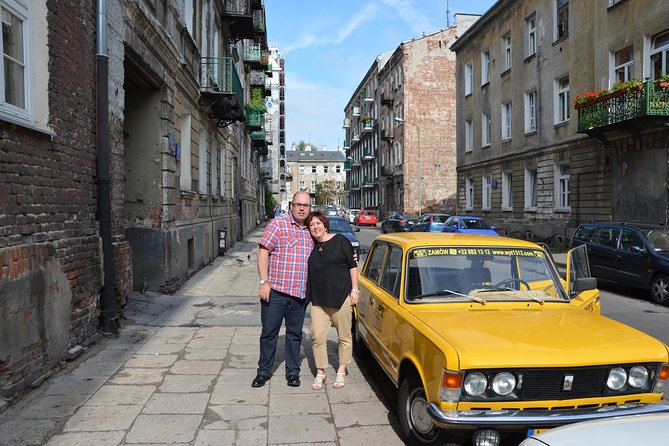
The retro Fiat is more than a photo prop, though it certainly attracts attention on Warsaw’s streets. The Fiat 125p was a familiar Polish car during the Communist period, so it adds a small piece of modern Polish life to a tour focused mainly on wartime destruction and Jewish history.
I like the way the car turns the spaces between stops into useful travel time. The Jewish sites are not all gathered around one compact square. You need transport to connect the Ghetto Wall, Chłodna Street, Muranów, the synagogue, and the cemetery. In this setting, a private car is far more practical than trying to piece the route together with public transport.
You should know that the Fiat is a vintage vehicle, not a modern luxury car. One customer found the car untidy, and groups of four or more are placed in a vintage minivan instead. That may be more comfortable for a larger party, but it means you lose some of the small-car charm.
The private setup is the bigger advantage. You are not listening to a fixed speech while trying to keep up with a group. You can ask about a particular street, a relative, a wartime event, or film locations from The Pianist. Guides named Alex, Alec, Karol, Marcin, Martin, Conrad, and Max have received especially warm praise for clear English, patience, historical insight, and a friendly manner.
More History Tours in Warsaw
- Warsaw: POLIN Museum of the History of Polish Jews Ticket
★ 4.7 · 1,142 reviews - Warsaw: Chopin Concert at Historical Venue in Old Town
★ 4.7 · 445 reviews - Small-Group Historical Guided Tour of Warsaw with pick up/drop off. Public Tour.
★ 4.5 · 343 reviews
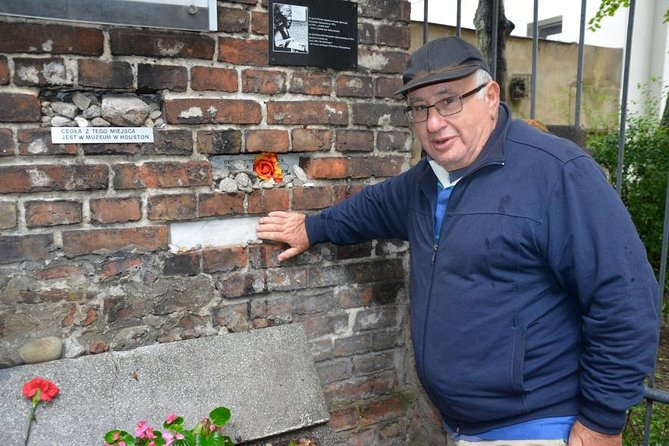
Starting at the Ghetto Wall
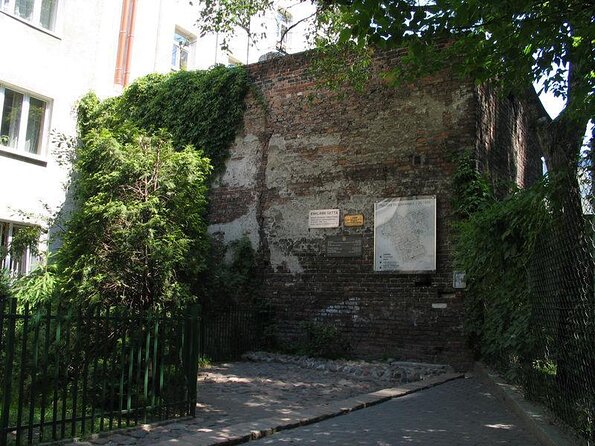
The first stop is a surviving section of the Ghetto Wall, with commemorative plaques nearby. You receive about 15 minutes here, and there is no admission charge.
This is an important opening because Warsaw’s present-day streets can make the former ghetto hard to picture. The wall was built in 1940, and more than 400,000 Jews were imprisoned inside the ghetto during the Nazi occupation. A fragment of brick and a plaque cannot explain that scale on their own, so the guide’s spoken context matters greatly.
I would listen closely for the contrast between the small physical remnant and the enormous human story it represents. The city around it has changed, but the wall fragment helps fix the history to a real location rather than leaving it as an abstract wartime lesson.
Chłodna Street and the Footbridge of Memory
At Chłodna Street, the tour pauses for about 10 minutes to see the Footbridge of Memory and the building where Adam Czerniakow, president of the Jewish Community during the occupation, lived.
The footbridge recalls the connection between two sections of the ghetto. Its importance is easy to miss if you pass through the area alone, especially because modern Warsaw has grown around and over the old wartime boundaries. Your guide’s explanation should help you understand how the ghetto was divided and how movement was controlled.
This is one of the places where the car and guide combination makes sense. You are not simply stopping at a famous monument. You are linking streets, buildings, and decisions that shaped daily life inside the ghetto. The stop is brief, so ask questions while the details are fresh.
Muranów, the former Large Ghetto
The tour then reaches Muranów, the area of the former Large Ghetto, for roughly 30 minutes. Today, you’ll see modern buildings, new streets, and public art rather than an intact prewar Jewish quarter.
That contrast is central to the experience. Muranów is not a preserved old town waiting to be photographed. It is a place rebuilt after catastrophic destruction. Modern architecture and street art sit over a district marked by the absence of much of its former community.
I appreciate that this part of the route does not pretend the old neighborhood still survives in full. The guide can help you read what is missing, what has been rebuilt, and how the district functions today. Several tours have also included wartime photographs, which are especially helpful here because they show the same area before and during the war.
Other Jewish Quarter and Kazimierz walks:
- Warsaw: Jewish Heritage & Holocaust Walking Tour
★ 4.7 · 119 reviews - Warsaw: Jewish Heritage 4-Hour Private Tour
★ 4.9 · 26 reviews - Warsaw Jewish Heritage Private Tour in Retro Fiat
★ 4.9 · 22 reviews - Warsaw : Jewish Quarter Private Walking Tour
★ 4.8 · 11 reviews
The Ghetto Heroes Monument and POLIN
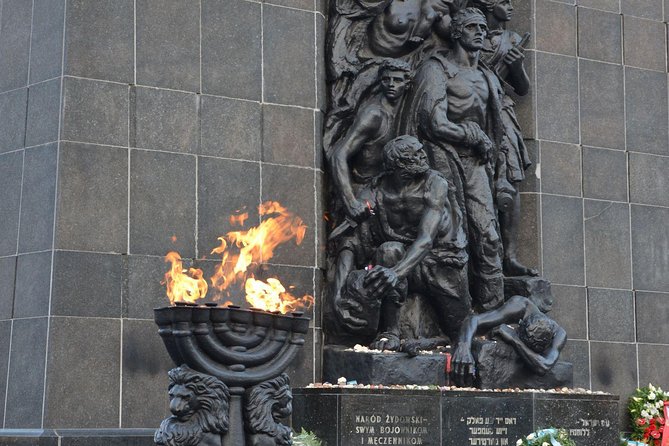
The Monument to the Ghetto Heroes commemorates the Warsaw Ghetto Uprising of 1943. The stop lasts about 15 minutes and is free.
Give this monument your full attention. It is not just another wartime memorial on a sightseeing route. It marks the uprising and gives the tour a strong emotional center. The surrounding area also connects directly with the POLIN Museum of the History of Polish Jews.
The tour includes a look at POLIN from the outside, usually for about 15 minutes. Museum admission is not included, but your guide can leave you there after the tour if you choose to visit independently. That arrangement is useful if you want a longer look at the museum, but it changes the end of your day because you will not be returned to the original meeting point afterward.
POLIN covers more than the Nazi period. It presents about 1,000 years of Polish Jewish history, so it can add the wider context that a four-hour driving tour cannot provide. If you have enough time in Warsaw, I would consider booking the car tour first and visiting the museum afterward, while the streets and memorials are still clear in your mind.
The route also includes several additional points connected with the ghetto, including the departure point toward Treblinka, a memorial connected with a group suicide during the uprising, and a street that survived from both sides of the ghetto area. The supplied timing does not assign a separate duration to these points, so expect them to be shorter stops or explanations along the route rather than full visits.
Entering Nożyk Synagogue
Nożyk Synagogue receives about 30 minutes. It is the only surviving prewar Jewish house of prayer in Warsaw, and it remains an active place of worship.
That makes this stop different from the wall fragments and uprising memorials. You are seeing a functioning religious site, not only a memorial to a destroyed community. Admission is not included, and you may be asked to cover your head at Jewish sites.
Timing matters here more than the daylight. The synagogue is closed from Friday evening through all of Saturday for the Sabbath. A late start may also prevent entry. One otherwise very positive experience began at 5 p.m. in summer, when it was still light until after 9 p.m., but the synagogue and cemetery were already unavailable. If those interiors matter to you, choose a morning or earlier afternoon departure and confirm the schedule before booking.
Walking through the Jewish Cemetery
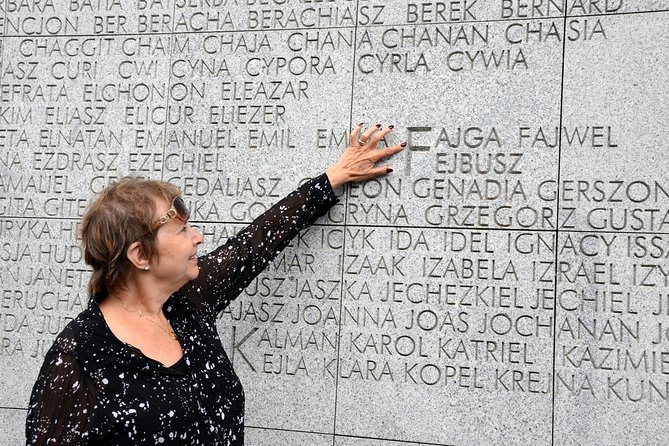
The Jewish Cemetery is allotted about 30 minutes, with admission not included. Its graves include spiritual and political leaders, figures from Jewish cultural life, and many unnamed victims of the ghetto. The grounds also contain remains from many generations of Jewish Varsovians.
I would treat this as one of the most important stops, not a quick photo break. The cemetery offers a direct connection to the community that existed before the war, while also showing the scale of loss. Its meaning comes from both the named people and the many graves without a famous name attached.
The cemetery is also closed from Friday evening through Saturday, so the same scheduling warning applies. Wear practical shoes if you plan to walk inside, though the tour information does not specify ground conditions or accessibility details. Entry costs extra, so carry that in your budget if you want the full visit.
Because the cemetery stop can be emotionally heavy, the private format helps. You can set the pace, ask about a particular grave or tradition, or simply take a quiet moment without holding up a large group.
A history tour that can follow your questions
The advertised route is clear, but the private format gives it flexibility. You can mention specific interests when you meet your guide, including family research and Warsaw locations used in The Pianist.
That flexibility has real value. One person used the tour to make personal discoveries about family and found the guide’s navigation and historical explanations especially helpful. Another stopped at Mi Polin, a small shop near a synagogue selling mezuzot made from molds of original doorposts from Jewish homes in Polish towns. That kind of detour is not guaranteed, but it shows what can happen when you tell the guide what matters to you.
Guides have also brought historic photographs to help compare wartime Warsaw with the streets you see today. If you have questions about prewar Jewish life, the ghetto divisions, the uprising, Communist-era Poland, or present-day Jewish life, raise them early rather than waiting for the final stop.
The quality of the guide matters a great deal. Karol was described as a doctoral student in history, while Marcin and Martin were praised for explaining a complicated 800-year story in a clear timeline. Conrad was noted for answering questions carefully, and Alex and Alec received strong marks for their driving, English, and good humor. These names reflect individual guide experiences, not a guarantee of who will lead your tour, but they show the level of personal attention this format can provide.
Price, pickup, and practical value
The listed price is $108.28 per person, with group discounts available. For a four-hour private tour, that is not the cheapest way to see Warsaw, but the price covers hotel pickup and drop-off in the city center, private transport, and a professional driver-guide.
I see the value in the transport and time saved. You are not paying only for a ride in an old car. You are paying to connect sites spread across the city and to have someone explain places that can be difficult to interpret on your own. The price becomes more attractive when shared by a small group, especially if you would otherwise pay separately for taxis or arrange several public transport journeys.
Hotel pickup is offered from the city center. If your hotel is outside the pickup area, contact the operator to find another meeting point. The listed start point is the Palace of Culture and Science at pl. Defilad 1, and the tour normally returns there unless you choose to finish at POLIN.
Confirmation is provided when you book, and the activity is offered in English. Most people can participate, but Jewish sites may require head covering. The tour is private, so only your own group takes part.
Free cancellation is available up to 24 hours before the start time for a full refund. Changes or cancellations inside that 24-hour window are not accepted or refunded.
Who will get the most from this tour
I would choose this tour if you want Warsaw’s Jewish history explained through actual streets, buildings, memorials, and religious sites rather than through a general city tour. It is particularly useful for people with Jewish family connections, an interest in World War II, or a desire to understand the Warsaw Ghetto Uprising in place.
It also suits first-time visitors who want a focused introduction without spending a full day in a museum. The car covers ground efficiently, while the guide fills in the links between stops.
I would be more cautious if your main goal is a long museum visit. POLIN entry is extra and is not part of the four-hour route. I would also avoid a late departure if you care about entering Nożyk Synagogue and the cemetery.
Families and older visitors may appreciate the door-to-door transport, though the information supplied does not promise specific accessibility arrangements. Groups of four or more should expect the vintage minivan, and anyone choosing this tour mainly for the Fiat should confirm the vehicle arrangement first.
Should you book Warsaw’s Jewish Heritage by Retro Fiat?
I would book it if you want a personal, serious introduction to Warsaw’s Jewish past and prefer a guide who can answer questions as the day unfolds. The strongest parts are the private attention, the efficient route between scattered sites, the cemetery and synagogue visits, and the chance to connect the history with your own interests.
Book an earlier time, not a 5 p.m. start, if you want to enter both Nożyk Synagogue and the Jewish Cemetery. Add POLIN separately if you want the full thousand-year story, and tell the operator about family research or The Pianist before the tour begins.
This is not a light sightseeing ride with a few old buildings added on. The subject is painful, and some stops demand quiet attention. But with the right timing and a strong guide, the retro Fiat provides a memorable way to see the places where Warsaw’s Jewish life, destruction, resistance, and renewal meet.
FAQ
How long is Warsaw’s Jewish Heritage by Retro Fiat?
The tour lasts approximately four hours.
What sites are included?
The route includes a fragment of the Ghetto Wall, Chłodna Street, the former Large Ghetto area in Muranów, the Ghetto Heroes Monument, an exterior view of POLIN, Nożyk Synagogue, and the Jewish Cemetery. It also includes several additional ghetto-related points along the way.
Is hotel pickup included?
Yes. Hotel pickup and drop-off are included for hotels in the city center. If your hotel is outside the pickup area, you should contact the operator to arrange another solution.
Can I enter POLIN during the tour?
Museum admission is not included. You can see the museum from outside, and the guide can leave you there after the tour if you decide to visit it.
Is Nożyk Synagogue open every day?
No. The synagogue is closed from Friday evening through all of Saturday because of the Sabbath. Entry is also not guaranteed on a late afternoon tour, so check the timing before booking.
Is the Jewish Cemetery open every day?
No. The cemetery is closed from Friday evening through all of Saturday. Admission is not included, and Jewish sites may require you to cover your head.
Recently added in Warsaw
- Warsaw Wolf’s Lair with St. Lipka and Mamerki Private Guided★ 4.2 · 3 reviews
- Taste of Poland, food tour and guided walk with 12 tasting★ 5.0 · 3 reviews
- Discover Warsaw’s most Photogenic Spots with a Local★ 5.0 · 3 reviews
- Lodz Small Group Tour from Warsaw with Lunch★ 4.0 · 3 reviews
- Jewish heritage in Warsaw★ 4.5 · 3 reviews
- Warsaw Outdoor Paintball with Transfers (all year round)★ 5.0 · 3 reviews
- Electric Scooter Tour: Full Tour – 3-Hours of Magic!★ 5.0 · 3 reviews
- Skip-the-Line Polin Museum Warsaw Jewish History Tour★ 5.0 · 3 reviews
Jewish Quarter & Kazimierz Tours, compared.
Bike Tour of Old Town, Jewish Quarter and the Ghetto
Read our review →
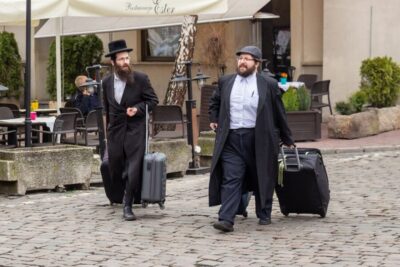
Kazimierz, Schindler’s Factory & Ghetto Guided Tour
Read our review →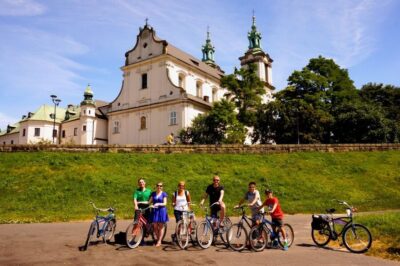
Bike Tour of the Old Town, Kazimierz, and the Ghetto
Read our review →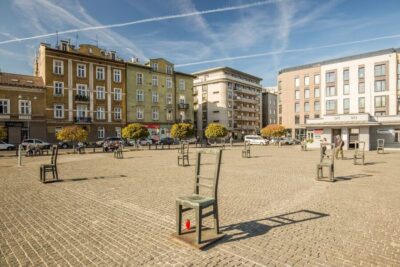
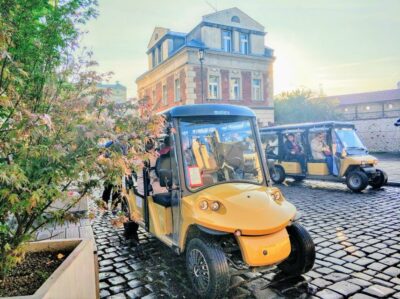
Jewish Quarter and Ghetto Electric Golf Cart Tour
Read our review →
Where else this one turns up