
Reviewed · HISTORICAL TOURS
Private Tour: Warsaw’s Communist History by Retro Fiat
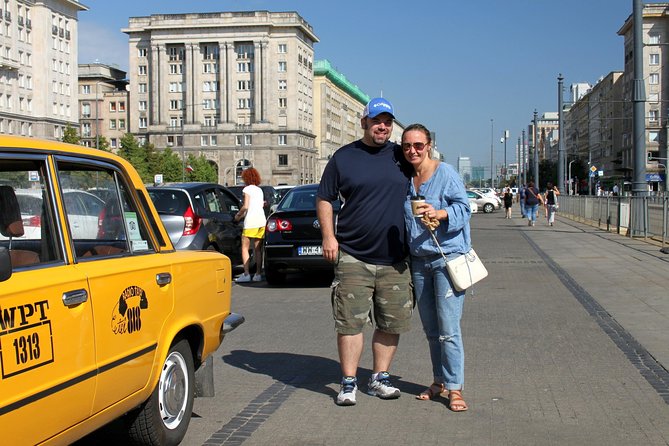
Warsaw’s Communist past is easiest to grasp from the back seat of a Polish-built Fiat 125p. This small, boxy car turns a history lesson into a moving street scene, taking you from Stalin-era monuments and government buildings to old housing districts and a former black market. The car itself draws smiles from people on the street, which gives the tour a pleasant local touch.
I like two things in particular: the tour reaches places a standard city sightseeing route may skip, and the private format lets you ask direct questions. Guides including Jacob, Olga, Martin, Karol, Konrad, and Pawel have brought personal memories and family stories to the subject. The main consideration is that the quality depends heavily on your guide, and one past experience felt too improvised, with too little explanation of the Communist period.
Key points to know before booking
- A vintage Fiat is part of the experience: The Fiat 125p is not just transport. It makes the tour playful and connects you with Poland’s recent past.
- The route covers major Socialist-era symbols: Expect the Palace of Culture and Science, Constitution Square, the former Communist Party House, Praga, and Mariensztat.
- Private touring means real conversation: Your guide can adjust the pace and respond to your interests rather than deliver a fixed group lecture.
- Personal stories add meaning: Several guides have described growing up before or during Poland’s move away from Communism.
- The tour lasts about four hours: That gives you a useful half-day introduction, though the itinerary can feel short if you want museum time or long walks.
- Check the extras before setting off: Food and drinks are not normally included, and one past booking had a missed vodka tasting and souvenir photo.
Why a Fiat 125p makes the history easier to understand
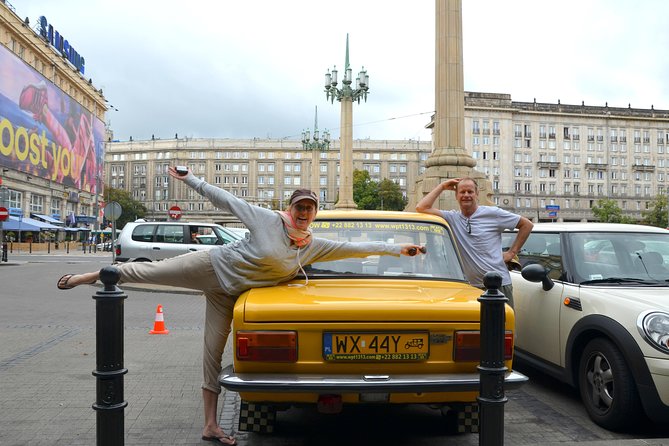
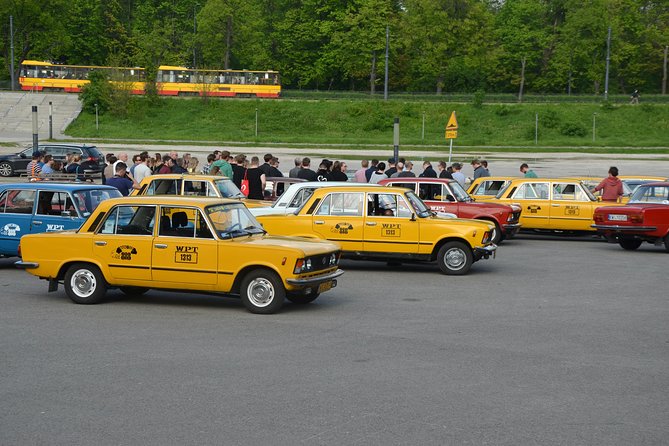
The car gives this tour its character. The Fiat 125p was a Polish-made symbol of ordinary life during the Communist period, so riding through Warsaw in one adds a physical link to the subject. You are not simply looking at old buildings from a modern minibus. You are moving through the city in an object tied to the era.
It also helps with Warsaw’s scale. The route crosses central Warsaw and reaches Praga on the east bank of the Vistula, a district that escaped much of the destruction suffered elsewhere in the city during the Second World War. You see more ground than you would on foot, while still getting short stops to look around.
This is a private tour, so only your party joins the vehicle. That matters here. Communist history can raise complicated questions about censorship, state planning, housing, political power, and daily life. With a private guide, you can stop and ask what a building meant, how people lived there, or how its role has changed.
The guides have different personalities and backgrounds. Jacob has been praised for flexibility and for discussing the present-day impact of past decisions. Olga has shared family experiences from the period. Konrad has focused on Cold War history, while Martin and Pawel have been described as especially engaging. Your guide may not be one of these people, but the experience clearly benefits from a guide who treats the subject as lived history rather than a list of dates.
More History Tours in Warsaw
- Warsaw: POLIN Museum of the History of Polish Jews Ticket
★ 4.7 · 1,142 reviews - Warsaw: Chopin Concert at Historical Venue in Old Town
★ 4.7 · 445 reviews - Small-Group Historical Guided Tour of Warsaw with pick up/drop off. Public Tour.
★ 4.5 · 343 reviews
Palace of Culture and Science: Warsaw’s most loaded landmark
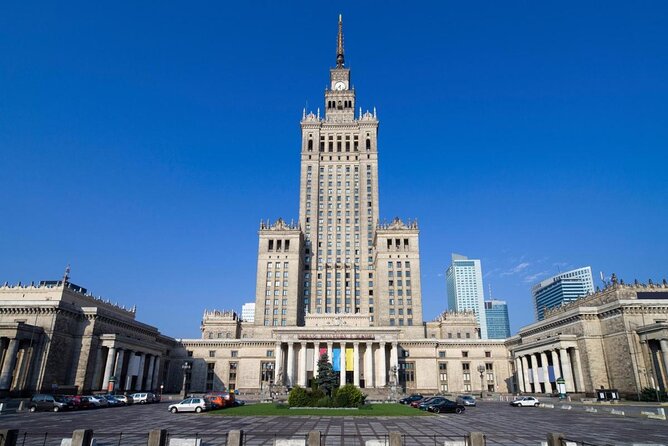
The first major stop is the Palace of Culture and Science, the city’s best-known Communist-era building. It is also Poland’s highest building, a fact that makes its scale hard to miss as you approach it.
The palace is a strong example of Socialist Realist architecture. Its broad mass, formal decoration, and imposing position were meant to project state power. It was presented as a gift from Stalin, but that description hides the politics behind it. The building became a visible reminder of Soviet influence, and many Polish citizens have long viewed it with mixed feelings.
Your guide explains that complicated story during a roughly 30-minute stop. The building now contains theatres, museums, a cinema, pubs, and other uses, so you see how Warsaw has given a former political symbol a more ordinary modern life.
Admission is not included. The tour stops at the building and explains its history, but you should not assume that an interior visit or ticket to an observation area is part of the four-hour route. If you want to spend serious time inside, ask your guide at the start about the available time.
Constitution Square and the Communist Ministerial District
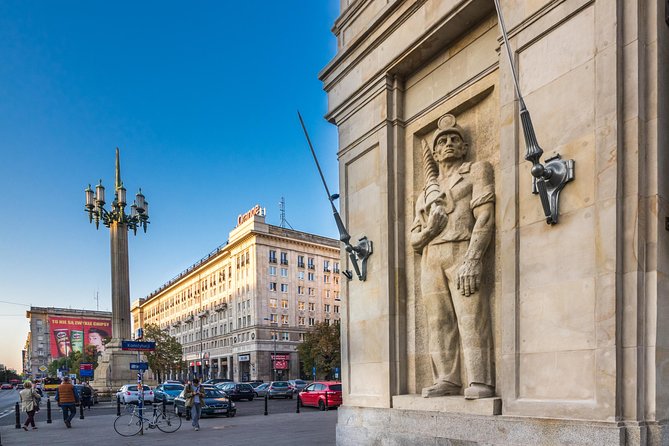
Plac Konstytucji, or Constitution Square, shows how architecture was used to create a model Socialist city. The square is framed by Stalin-era housing and monumental details, giving it a carefully planned, representative appearance.
This is not simply a grand open space. It was designed to show the success and order of the new system. The buildings were meant to provide housing and public purpose, but they also created a powerful visual message. Look closely at the scale, repeated forms, and decorative elements. They reveal how much the state wanted architecture to speak for it.
The tour also passes through the former Communist ministerial district, built in the Socialist Realist style. This section helps connect the housing projects with political power. Constitution Square shows the public face of the system, while the ministerial area points to the officials and institutions directing it.
The stop lasts about 30 minutes, and there is no admission charge. It is mainly an outdoor look at the buildings, so comfortable shoes are useful even though the tour is vehicle-based.
Censorship at the Monument of the Free Word
The Monument of the Free Word is a very short stop, listed at about five minutes, but it introduces one of the most important parts of Communist life: censorship.
The point is not just that newspapers and books were controlled. Censorship shaped what people could discuss in public, what writers could publish, and how news reached ordinary households. A guide who explains the daily effect of censorship can turn this brief stop into a useful link between official buildings and private life.
Do not expect a long walk or a museum visit here. The value is in the explanation. If this subject interests you, ask your guide how censorship affected newspapers, writers, or political discussion in Poland.
A different kind of day in Warsaw:
- Warsaw: Chopin Concert in the Old Town
★ 4.8 · 2,287 reviews - Warsaw: Traditional Galar Cruise on The Vistula River
★ 4.6 · 1,640 reviews - Warsaw: Old Town Highlights Walking Tour in English
★ 4.7 · 1,516 reviews - Warsaw Concert: Chopin – Painted by Candlelights with Wine
★ 4.8 · 1,442 reviews
The former Party House and the statue of Charles de Gaulle
Near the statue of Charles de Gaulle, you see the former Communist Party House, sometimes described as Poland’s White House. This is another place where architecture and political authority meet.
The building represented the ruling party and the people who directed the country. The statue provides a useful orientation point, but the real focus is the story of the leaders and institutions that shaped Communist Poland.
The scheduled stop takes about 15 minutes. That is enough for an exterior explanation and some photographs, but not for an extended architectural visit. I would treat it as one piece of a larger political story rather than a stand-alone attraction.
Praga Północ: surviving streets and changing neighborhoods
Praga Północ offers one of the tour’s most useful changes of mood. Central Warsaw was rebuilt and redesigned after wartime destruction, while Praga retained more of its prewar fabric. During the Communist period, it was an active district with a different feel from the monumental center.
Here you see how ordinary urban life fit around the grand plans of the state. Your guide may point out housing, stripped decoration, older structures, and contrasts between areas now being renewed and streets that still show earlier conditions.
This is also where the tour can move beyond political symbols. A palace or ministry tells you what the state wanted to project. Praga helps you think about how people actually lived with those plans. Several routes have included examples of apartment blocks that were intended as models for future housing, but were considered too luxurious to repeat.
The scheduled visit lasts around 30 minutes. Because Praga is a district rather than one single monument, your experience will depend on how actively the guide explains what you are seeing. This is a good place to ask about housing, daily routines, and the contrast between official ideals and practical life.
Różycki Bazaar and the old black market
Bazar Różyckiego was the most famous black market in Communist Poland. The name points to a time when shortages and state-controlled shops made unofficial trade important.
A bazaar like this helps explain Communist life in practical terms. Political history can feel distant when you only look at monuments. A market shows how people found goods, traded, and worked around an economy that did not always provide what they needed through official channels.
The stop is short, about 15 minutes, and there is no admission fee. You may see the site and hear its story rather than enter a museum devoted to the market. The guide’s explanation is what gives the place meaning, so ask for examples of what was traded and how the bazaar functioned during the period if that information matters to you.
Mariensztat Square and planned housing
Mariensztat Square is the final listed stop, with about 20 minutes to see its Communist-era housing blocks. This district helps complete the architectural side of the tour.
The housing here was part of the postwar rebuilding and social planning of Warsaw. After the war, the city needed homes quickly, and the Communist government used reconstruction to reshape the capital. Mariensztat shows how a residential district could also serve as a public statement about the new order.
I like this stop because it shifts attention from famous symbols to the places where people lived. The Palace of Culture announces power. Mariensztat asks a more practical question: what did the new city provide for its residents, and what did those promises look like on the ground?
The route may also include other sites or brief stops, since the private format allows some flexibility. One guide has been praised for showing contrasts between old districts and areas undergoing renewal. Still, the exact balance can change, so tell your guide if you prefer architecture, political history, daily life, or Cold War events.
What the four-hour format does well
Four hours is a sensible length for a first look at Warsaw’s Socialist past. You cover a wide area without giving up an entire day, and the Fiat lets you see central Warsaw and Praga in one outing.
The format is a mix of driving, short walks, and explanations beside the vehicle. That makes it suitable if you want historical context but do not want a long walking tour. Most people can take part, and the route is near public transport.
The limit is depth. You cannot give every district, building, and political event the attention it deserves in half a day. The Communist museum is not included, and one past booking found it closed when the subject came up. If you want a more academic treatment, pair this tour with a museum visit on another day.
Because the tour is private, you can also use the time better than on a fixed group excursion. Ask for fewer photo stops and more explanation, or request more time in a district that catches your interest. A strong guide will adjust the route while keeping its main theme intact.
Price, pickup, and practical value
The price is about $108.24 per person. For a private four-hour tour with a dedicated vehicle, hotel pickup and drop-off, and an English-speaking driver-guide, that can be fair value, especially for a small group. The larger your party, the easier it is to justify the cost compared with paying individual fares for several separate activities.
You are paying for more than transport. The Fiat, the guide’s time, and the ability to ask personal questions are central to the experience. A standard sightseeing bus may cover more headline attractions, but it will not offer the same focus on Communist Warsaw or the same private conversation.
Pickup is offered from your hotel lobby or in front of the building when the address falls within the service area. If it does not, contact the operator to arrange another meeting plan. The published meeting point is at Warsaw Central Railway Station, and the tour returns to the meeting point if hotel return is not used.
Food and drinks are not included. One past booking expected a snack, a Polish vodka shot, and a souvenir photograph but did not receive them. The provider apologized and offered a free return tour, but I would still confirm any promised extras before departure rather than build them into the value calculation.
The tour is offered in English and confirmation arrives at booking. Free cancellation is available up to 24 hours before the start time. Changes or cancellations inside that window are not accepted for a refund.
Who should book this Warsaw history tour?
I would recommend it most strongly if you have already seen Warsaw’s famous Old Town and want to understand the city’s twentieth-century story. It also suits anyone interested in architecture, the Cold War, postwar rebuilding, political power, or everyday life under state Socialism.
Families and mixed-interest groups may like the car and shorter stops. The Fiat adds a light, memorable element, while the subject remains serious. You can also make the tour work for a group with different interests by asking the guide to adjust the discussion.
History specialists should set realistic expectations. This is not a full university course, and the route does not include an admission-based Communist museum. It is a street-level introduction, with the best results coming from an engaged guide and an active questioner.
I would be cautious if you want a fixed, tightly scripted route. Most accounts describe flexible and well-informed guides, but one disappointing experience involved too much driving, too little Communist history, and no clear itinerary. At the start, confirm the stops you most want to see and ask how the four hours will be divided.
Should you book the Fiat tour?
Book it if you want Warsaw’s Communist past explained through real streets, planned housing, political buildings, and personal memories rather than only through museum displays. The vintage Fiat, private format, hotel pickup, and access to places such as Praga and Różycki Bazaar give it a strong identity.
I would book early, since it is commonly reserved several weeks ahead, and I would send your interests in advance. Ask for a clear route, confirm any promised snack or photo, and tell the guide if you want more politics, architecture, or daily-life stories.
For most people, this is a lively and useful half-day introduction to a difficult period. It is best when you treat the car as the hook and the conversation as the main event.
FAQ
How long does the Warsaw Communist history tour last?
The tour lasts approximately four hours.
What vehicle is used for the tour?
Transport is provided in a private Fiat 125p, a Polish-made vintage car associated with the Communist period.
Is this a private tour?
Yes. Only your group participates in the activity.
Is the tour offered in English?
Yes. The tour is offered in English.
Does the tour include hotel pickup and drop-off?
Hotel pickup and drop-off are included when your hotel is within the pickup area. The guide collects you from the hotel lobby or meets you in front of the building.
What happens if my hotel is outside the pickup area?
You should contact the operator, WPT1313 Warsaw Private Tours, to arrange the best alternative.
Which Warsaw sites are included?
The route includes the Palace of Culture and Science, Constitution Square, the Communist ministerial district, the Monument of the Free Word, the former Communist Party House near the Charles de Gaulle statue, Praga Północ, Bazar Różyckiego, and Mariensztat Square.
Is admission to the Palace of Culture and Science included?
No. Admission to the Palace of Culture and Science is not included.
Are food and drinks included?
No. Food and drinks are not included unless specifically stated. Confirm any additional snack or Polish vodka tasting before the tour begins.
What is the cancellation policy?
You can cancel up to 24 hours before the experience starts for a full refund. Cancellations or changes made less than 24 hours before the start time are not accepted for a refund.
Recently added in Warsaw
- Warsaw Wolf’s Lair with St. Lipka and Mamerki Private Guided★ 4.2 · 3 reviews
- Taste of Poland, food tour and guided walk with 12 tasting★ 5.0 · 3 reviews
- Discover Warsaw’s most Photogenic Spots with a Local★ 5.0 · 3 reviews
- Lodz Small Group Tour from Warsaw with Lunch★ 4.0 · 3 reviews
- Jewish heritage in Warsaw★ 4.5 · 3 reviews
- Warsaw Outdoor Paintball with Transfers (all year round)★ 5.0 · 3 reviews
- Electric Scooter Tour: Full Tour – 3-Hours of Magic!★ 5.0 · 3 reviews
- Skip-the-Line Polin Museum Warsaw Jewish History Tour★ 5.0 · 3 reviews
Historical Tours, compared.
POLIN Museum of the History of Polish Jews Ticket
Read our review →
Gdańsk City Sights & History Guided Walking Tour in English
Read our review →
Small-Group Historical Guided Tour of Warsaw with pick up/drop off. Public Tour.
Read our review →Where else this one turns up