
Reviewed · CITY TOURS
Warsaw City Tour – PRIVATE (4h)
Warsaw’s most striking lesson is how much of the city had to be rebuilt. On this private four-hour tour, your guide connects the handsome Old Town, wartime ruins, royal residences, and modern Warsaw into one clear story, with hotel pickup and transport between the more distant sights.
I like the blend of Old Town walking and a vehicle ride to places such as Łazienki Park. I also like the private format: guides including Anya, Karolina, Grazyna, and Margarita have adjusted the route, suggested lunch stops, and even helped with airport transport. The main caution is important: much of the Old Town and Royal Route is on foot, so this is not four hours of sitting in a car.
Key points to know before booking
- Warsaw’s destruction and rebirth: See the Old Town, Royal Castle, and monuments tied to World War II and the Warsaw Uprising.
- Private English-speaking guide: Your group receives a dedicated local guide rather than joining a large coach party.
- Part walking tour, part driving tour: Expect pavement time in the historic center and vehicle transport for sights farther away.
- Łazienki Park provides a welcome pause: The Rose Garden and Chopin monument bring a softer side of Warsaw into the day.
- Most stops are free to view: Optional entry fees, including the Copernicus Science Centre, are not included.
- Heat and mobility matter: A four-hour route can be demanding in hot weather or for anyone who cannot walk comfortably.
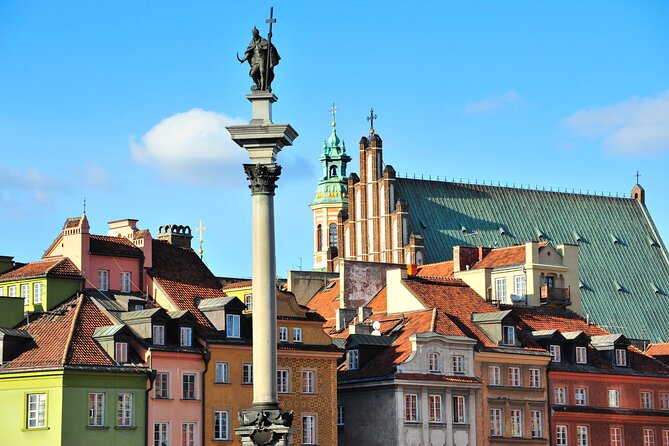
Warsaw’s story begins at Sigismund’s Column
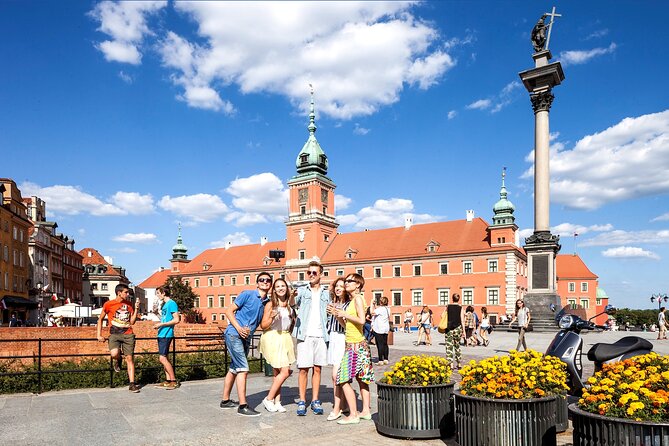
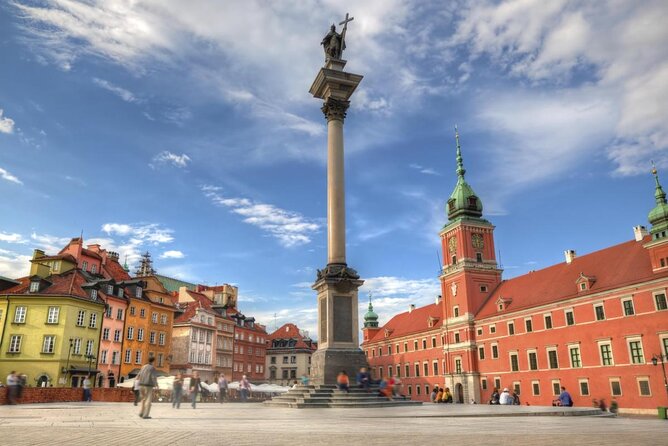
The tour usually starts around Castle Square, where King Sigismund III Vasa looks down from the top of Sigismund’s Column. This is Warsaw’s oldest public memorial and one of the city’s key symbols.
The column has had a rough life. It was moved more than once as streets changed, brought down by German troops in 1944, and rebuilt in 1949. Older versions of the column sit beside the Royal Castle walls, giving you a small but useful reminder that even familiar landmarks in Warsaw have a complicated past.
This is a short stop, listed at about 10 minutes, and admission is free. It works well as an introduction because your guide can explain the layout of Castle Square, the Royal Route, and the Old Town before you begin walking.
A few more Warsaw half days to consider
- Warsaw: Chopin Concert in the Old Town
★ 4.8 · 2,287 reviews - Warsaw: Traditional Galar Cruise on The Vistula River
★ 4.6 · 1,640 reviews - Warsaw: Old Town Highlights Walking Tour in English
★ 4.7 · 1,516 reviews
Old Town tells the clearest Warsaw story
Warsaw’s Old Town is the heart of the walking portion. The settlement grew beside the Vistula River on a trade route between the Baltic and Black seas. Merchants and craftsmen built up the town, first with wooden structures and earthen defenses, then with masonry houses and stone walls.
The central fact here is the destruction of 1944. About 90 percent of the Old Town area was razed during World War II. What you see now is a careful reconstruction, completed over many years and later recognized by UNESCO as an example of successful historic rebuilding.
I find this easier to understand with a guide than from plaques alone. A good explanation helps you look past the pretty facades and see the city’s act of recovery. The bright colors and tidy streets are not untouched medieval Warsaw. They are part of a deliberate postwar reconstruction.
Plan on about 45 minutes here, though the exact pace depends on your group. The Old Town is pedestrian-focused, and cars cannot simply carry you from door to door. That is why the description of an air-conditioned vehicle should not lead you to expect a fully driving-based tour.
The Royal Castle and St. John’s Cathedral
The Royal Castle sits at the edge of Castle Square. It became a royal residence in the 16th century after Masovia joined the Polish Crown, then suffered repeated destruction, including wartime bombing, fire, looting, and demolition after the Warsaw Uprising.
Reconstruction did not begin until 1971, and much of the money came from the Polish community. The castle opened to the public in 1984 and later joined the UNESCO-listed Old Town area. That rebuilding story is one of the best reasons to have a private guide here. You can ask how a city decides what to restore, what to leave as a ruin, and how much of the original interior survived.
Entry to the castle is not listed as part of the tour. Treat the exterior visit as included, but ask your guide about optional admission if you want to see the rooms and art inside. With only four hours, a full castle visit could also reduce time at other stops.
Nearby, the Archcathedral Basilica of St. John the Baptist is one of Warsaw’s oldest churches. It hosted major political and religious events, including the oath connected with the Constitution of May 3, one of Europe’s earliest modern constitutions. Its crypt contains the tombs of important Polish figures.
The cathedral stop is about 15 minutes and free. If you visit between July and September, organ concerts take place on Sundays at 4 PM as part of the International Organ Music Festival. That concert schedule is useful to know, but it will not necessarily fit within your tour time.
Market Square and the Barbican
Rynek Starego Miasta, or Old Town Marketplace, is the most picturesque pause in the historic center. Tenement buildings frame the square, now filled with restaurants, cafes, clubs, galleries, and museums. In the center, the Warsaw Mermaid recalls one of the city’s best-known symbols.
The square was divided into four sections named for Enlightenment-era activists: Kołłątaj, Dekert, Barss, and Zakrzewski. Your guide can turn what looks like a pleasant photo stop into a quick lesson in Warsaw’s civic life.
The Warsaw Barbican follows in about 15 minutes. Built in 1548, it formed part of roughly 4,000 feet of defensive walls. Today, artists and musicians often use the area, giving it a more everyday feel than a formal museum courtyard.
From May through October, an exhibition inside the Barbican uses historic photographs and models to show Warsaw’s former walls and towers. Admission to the stop itself is free, but exhibition access may be treated as optional. The photos are especially helpful because they let you compare old plans with the rebuilt streets around you.
A different kind of day in Warsaw:
- Warsaw Concert: Chopin – Painted by Candlelights with Wine
★ 4.8 · 1,442 reviews - Warsaw: City Sightseeing Hop-On Hop-Off Bus Tour
★ 3.6 · 1,415 reviews - Warsaw: POLIN Museum of the History of Polish Jews Ticket
★ 4.7 · 1,142 reviews - #1 Pub Crawl Warsaw with Optional Premium 1 Hour Open Bar
★ 5.0 · 790 reviews
Monuments that explain wartime Warsaw
The Warsaw Uprising Monument is a serious stop. Its sculpted figures show insurgents emerging from battle, recalling the 1944 uprising against German occupation. The revolt ended in defeat and the deaths of about 200,000 Poles, making this one of the most painful places in the city’s modern story.
Your guide may also point out Krasiński Palace, a graceful Baroque building now connected with special collections of the National Library. The palace reliefs draw on ancient models, and the park behind it offers a quiet place to pause.
The tour then moves toward Miodowa Street, lined with historic residences and institutions. The former Collegium Nobilium at number 24 became an early school for the children of Poland’s ruling elite and now houses the Academy of Theatre. The Archbishop’s Palace, an Eastern Catholic church, Pac Palace, and the Capuchin Church add layers of religious and political history to a short street.
At the Capuchin Church, you can see the heart of Jan III Sobieski, the church’s founder, near the right side of the altar. Farther along, the Monument of Warsaw’s Heroes, commonly called the Nike Monument, provides another reminder of the city’s wartime memory.
Theatre Square and the Tomb of the Unknown Soldier
Theatre Square gathers several notable buildings into a compact area. The Grand Theatre houses the National Opera and National Theatre, with one of Europe’s largest opera stages. The exterior is the main sight on this tour, while the interior is best seen by attending a performance.
Jabłonowski Palace, once the city hall, was destroyed in the war and rebuilt in the 1990s. Only the facade and clock tower reflect the original design, while foundations from the 19th century can be seen through the gate. Blank Palace and the Petrykus Tenement House complete the square’s architectural frame.
The Tomb of the Unknown Soldier is a quieter, more solemn stop. It commemorates Polish soldiers who died for the country, with urns representing battlefields from the last century. An eternal flame burns beside it, and a military honor guard changes at noon each day.
The timing can work in your favor if your tour passes through at midday. Even if you arrive at another hour, the tomb is worth a few still moments. After the bright market square and rebuilt facades, this simple memorial changes the mood.
The Royal Route from Krakowskie Przedmieście to Nowy Świat
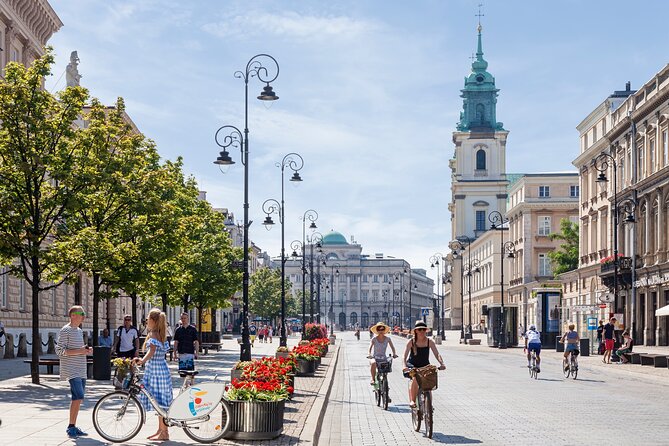
The Royal Route links Castle Square with Trzech Krzyży Square. It is one of Warsaw’s grandest urban walks, lined with churches, palaces, university buildings, restaurants, and shops.
You may pass St. Anne’s Church, with its church tower viewpoint, and the building once used as the Museum of Industry and Trade, where Maria Skłodowska-Curie worked. Radziwiłł Palace is now the residence of Poland’s president, while Warsaw University includes Kazimierzowski Palace and other historic buildings.
Czapski Palace houses the Academy of Fine Arts, and Nowy Świat continues the route with elegant stores and places to eat. The tour lists about 20 minutes here, so do not expect a slow architectural stroll from one end to the other. Think of this as a guided introduction with time to mark places you may want to revisit independently.
This is also where the walking issue matters most. The Royal Route includes pedestrian sections and restricted streets, and the car may need to drop you near, rather than directly beside, a sight. If you have a disability or limited walking ability, tell the operator before the day of the tour so the route can be adjusted.
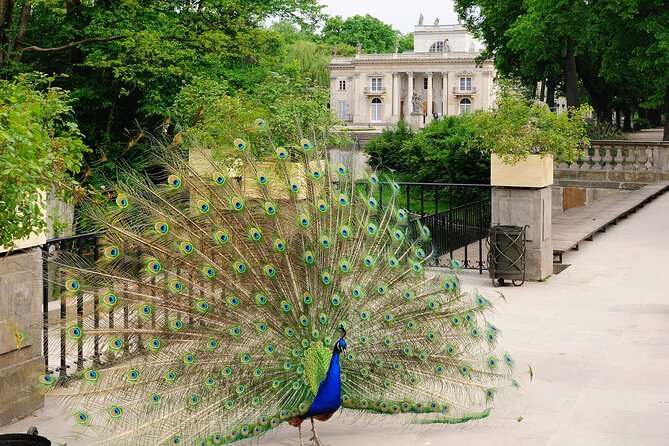
Łazienki Park is the tour’s breathing space
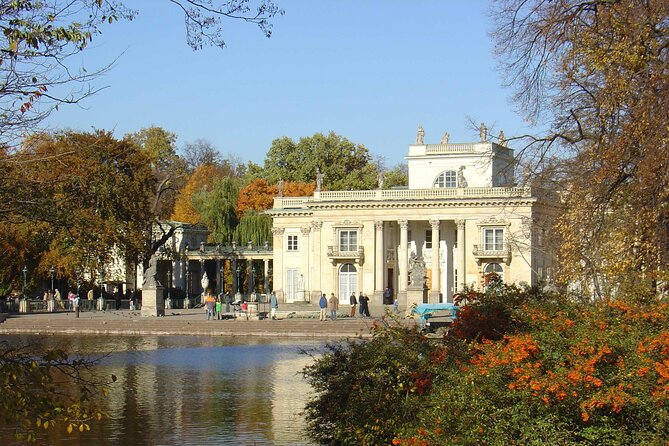
After the dense historic center, Royal Łazienki Park offers a change of pace. This palace and garden complex occupies what was once wild forest and now combines museums, monuments, lawns, gardens, and spaces for cultural events.
The Rose Garden is one of the highlights named for the tour. You can slow down here, enjoy the greenery, and give your feet a break. The famous Chopin monument is another key sight. Summer weekend piano concerts have been held near it for decades, drawing local classical music fans as well as people visiting the park.
The listed visit is about 30 minutes, enough for a good overview but not enough to see every corner. I like this stop because it keeps the tour from becoming a nonstop march through dates and monuments. The park also helps you understand Warsaw beyond its wartime story: this is a city with room for music, gardens, and relaxed public life.
Modern Warsaw in a few quick views
The route can also pass the Palace of Culture and Science, the 230.5-meter building presented as a gift from the Soviet people to Poland between 1952 and 1955. With 42 floors and about 3,000 rooms, it contains offices, institutions, theaters, museums, libraries, a cinema, a swimming pool, cafes, and clubs.
The observation deck on the 30th floor offers broad city views, but admission is not included in the tour details. Since the visit may be a drive-by or exterior explanation, confirm with your guide if you want to go up.
Another modern landmark is the National Stadium, built for the 2012 European Football Championship. It occupies the site of the former Tenth Anniversary Stadium, once used for major sports events and political rallies. After 1989, the surrounding area became home to the enormous Jarmark Europa market, a useful detail for understanding how Warsaw changed after the end of the Polish People’s Republic.
The Copernicus Science Centre is listed as the final stop, with about 10 minutes and admission not included. It opened in 2010 and contains hands-on exhibits such as an earthquake simulator and a magic carpet. Its roof garden has viewing areas, and nearby are an art gallery, climbing wall, and park with outdoor art.
Ten minutes is enough to identify the center, not to explore it. If science is a major interest for you, plan a separate visit rather than trying to squeeze it into this city overview.
What the private format is worth
The price is $195.18 per person, with group discounts offered. That is a serious cost for four hours, so the value depends on how much you want personal attention and door-to-door transport.
For a couple, the price may feel high if the vehicle is used only briefly and most of the day is spent walking. One poor experience involved a group being told to buy public transport tickets, despite the advertised air-conditioned vehicle. The provider later confirmed that a vehicle should be part of the service, so I would clarify the transport plan before booking.
The private format is more valuable for families, first-time visitors, and groups with a clear wish list. Anya adjusted the route around specific interests, while another guide suggested a good lunch and even drove the group to the airport. That kind of flexibility is difficult to get on a fixed group tour.
The guide matters greatly. Positive experiences describe Anya and Margarita as friendly, clear, and engaging. Karolina is noted for trying to adjust the route when walking became difficult. At the same time, one experience involved poor English, disorganization, and driving concerns, so the service can vary by guide.
Pickup and drop-off at your hotel are included, and the vehicle is described as air-conditioned. The guide waits in the hotel lobby with your name, so be ready at the agreed time. The tour is offered in English and is private, meaning only your group participates.
Free cancellation is available up to 24 hours before the start time. Changes or cancellations inside that window are not accepted for a refund.
Who should book this Warsaw introduction?
I would choose this tour if you have only half a day and want the city’s main chapters explained in one run: royal Warsaw, reconstructed Old Town, wartime memory, Łazienki Park, and the postwar skyline.
It suits you best if you enjoy a personal guide, want hotel pickup, and can handle a fair amount of walking. Ask for a customized route if your priorities are clear. You might prefer more time in the castle, more park time, or fewer stops and a slower pace.
I would hesitate if you expect four hours inside a private car. The Old Town and parts of the Royal Route are pedestrian areas, and the most meaningful sections require walking. Anyone dealing with a disability, high heat, or limited stamina should discuss adjustments in advance, not after the guide arrives.
FAQ
How long does the Warsaw City Tour last?
The tour lasts approximately four hours.
Is hotel pickup and drop-off included?
Yes. Private transportation, an air-conditioned vehicle, and hotel pickup and drop-off are included. The guide waits in the hotel lobby with your name.
Is this a private tour?
Yes. Only your group participates in the activity.
Is the tour offered in English?
Yes. English is the listed language for the tour.
Are admission fees included?
Optional entry fees are not included. The listed sightseeing stops are generally free to view, while places such as the Copernicus Science Centre and possible castle or observation deck visits may require separate admission.
How much walking should I expect?
You should expect substantial walking in the Old Town and along parts of the Royal Route. The vehicle is used for sights outside the pedestrian areas, so this is a combination walking and driving tour.
Can I cancel for a full refund?
Yes, if you cancel at least 24 hours before the experience start time. Cancellations or changes made less than 24 hours in advance are not accepted for a refund.
My booking advice
Book this private tour for a fast, personal introduction to Warsaw, especially if you want a guide to explain why the rebuilt Old Town matters and how the city’s wartime past shaped its present. Before paying, confirm that an air-conditioned vehicle will be provided, explain any mobility limits, and agree on how much time will be spent walking.
If those details suit you, the combination of Castle Square, the Old Town, the Uprising Monument, the Royal Route, and Łazienki Park gives you a useful first look at Warsaw in one compact outing. If you want museum interiors, long park walks, or a relaxed pace, treat this as an orientation tour and plan return visits.
Recently added in Warsaw
- Warsaw Wolf’s Lair with St. Lipka and Mamerki Private Guided★ 4.2 · 3 reviews
- Taste of Poland, food tour and guided walk with 12 tasting★ 5.0 · 3 reviews
- Discover Warsaw’s most Photogenic Spots with a Local★ 5.0 · 3 reviews
- Lodz Small Group Tour from Warsaw with Lunch★ 4.0 · 3 reviews
- Jewish heritage in Warsaw★ 4.5 · 3 reviews
- Warsaw Outdoor Paintball with Transfers (all year round)★ 5.0 · 3 reviews
- Electric Scooter Tour: Full Tour – 3-Hours of Magic!★ 5.0 · 3 reviews
- Skip-the-Line Polin Museum Warsaw Jewish History Tour★ 5.0 · 3 reviews
City Tours, compared.


Gdańsk City Sights & History Guided Walking Tour in English
Read our review →
Extended City Sightseeing Tour – Eco Buggy Golf Cart
Read our review →
Private Tour: Warsaw City Sightseeing by Retro Fiat
Read our review →Where else this one turns up