
Reviewed · CITY TOURS
Warsaw: Behind the Scenes City Tour with Hotel Pickup
Warsaw’s past comes into sharper focus from the seat of a battered-looking Żuk minibus, a vehicle closely tied to Poland’s communist era. This three-hour ride skips the usual city circuit and reaches wartime traces, old Praga, reconstructed Muranów, and districts shaped by Soviet planning.
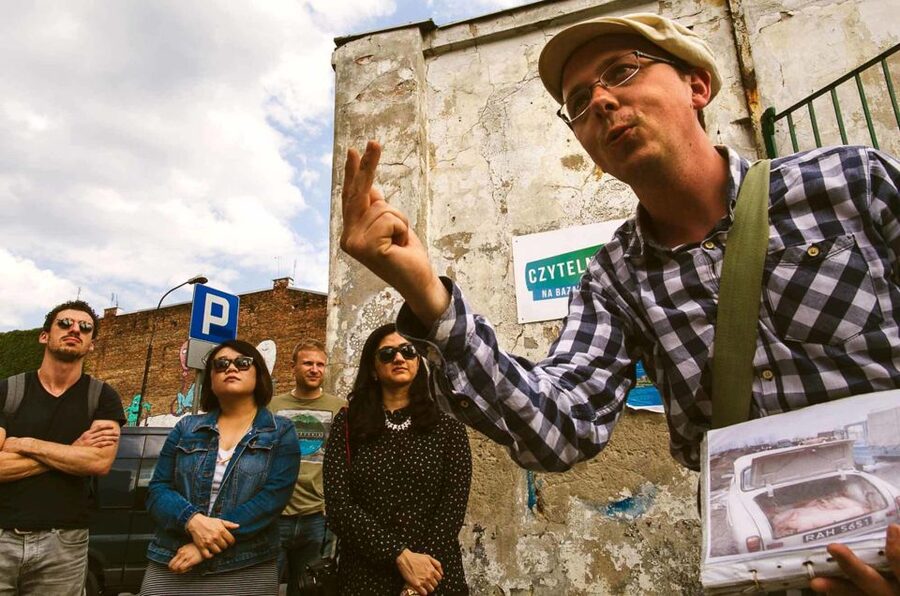
I like the way the tour connects Warsaw’s destruction and rebuilding instead of treating them as separate stories. I also like the small groups, with up to eight people per minibus, and guides such as Marcin, Konrad, Mark, and Marius who are known for making the tour conversational rather than stiff.
The main drawback is comfort. These historic vehicles do not have air conditioning, and some do not have seat belts. You will also get out and walk at several stops, so this is not a good fit for anyone needing a wheelchair or for children under 150 centimeters unless a booster seat has been arranged in advance.
Key points at a glance
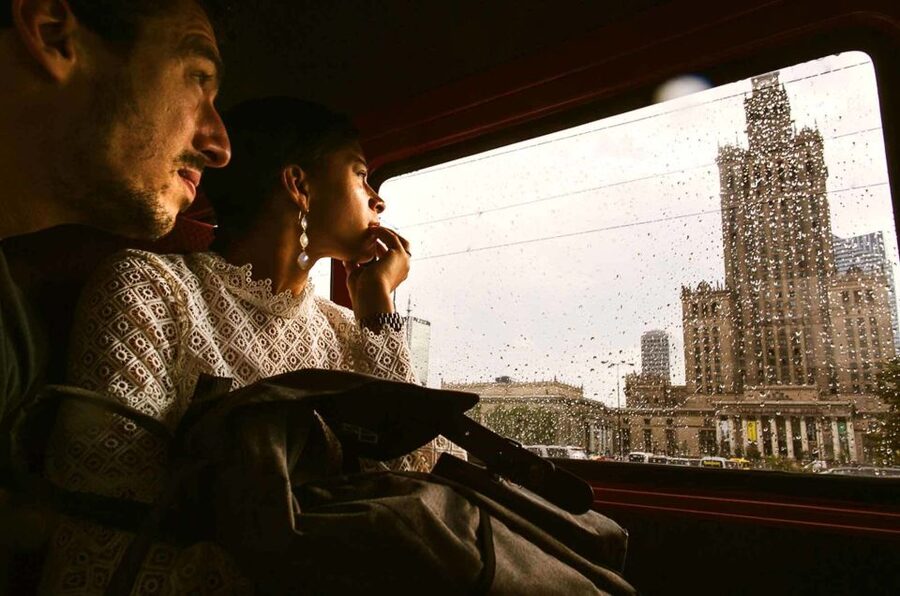
- A Żuk is part of the experience: The retro minibus is a former communist-era workhorse, not just ordinary tour transport.
- The route reaches overlooked districts: You visit sites connected with the Jewish Ghetto, both Warsaw uprisings, Muranów, and Praga.
- The story runs from prewar Warsaw to today: The guide explains the city’s Jewish past, wartime destruction, Soviet-era planning, and post-1989 growth.
- Small groups keep it personal: Each vehicle holds up to eight people, and the guide can respond to your questions and interests.
- Walking still matters: The minibus links the stops, but you will leave it at several points, so wear practical shoes.
- The price buys context, not major admissions: At $129 per person, the value is strongest if you want interpretation and access to lesser-seen areas rather than a basic orientation ride.
Why the Żuk makes Warsaw easier to understand
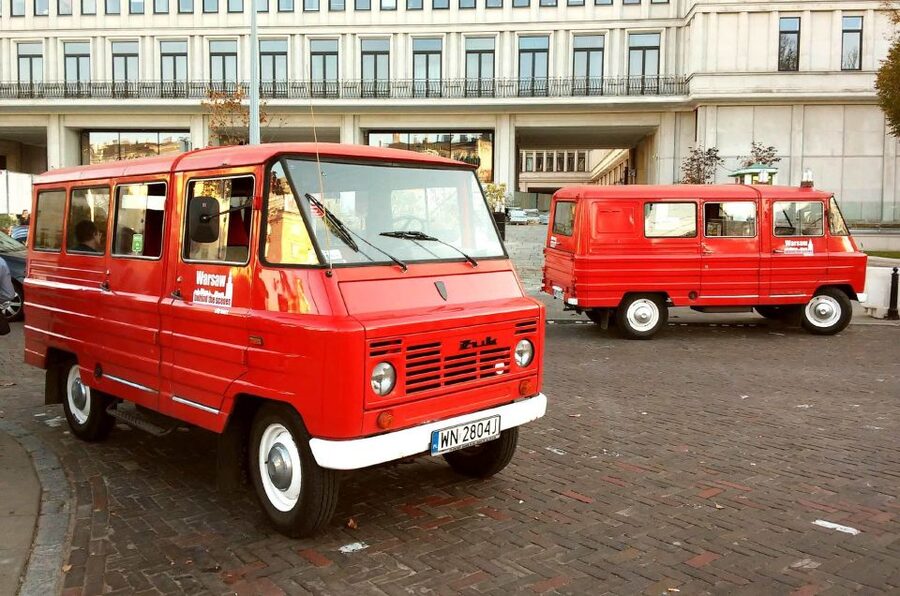
A standard sightseeing bus can show you Warsaw’s grand avenues and rebuilt center. This tour uses a much more characterful machine. The Żuk was a familiar vehicle during the communist period, and its age and design help set the mood before the guide even begins explaining the city.
That matters because Warsaw is not a city you can read at a glance. A handsome rebuilt street may sit on ground that was flattened during World War II. A broad avenue may reflect postwar political ideas rather than the older shape of the city. A weathered building in Praga may have survived while almost everything around it disappeared.
The Żuk also lets the guide connect places that are too far apart for a comfortable walking tour. You ride between districts, then get out for short walks and explanations. The experience is less about checking off monuments and more about learning why the city looks the way it does.
The vehicle is small, with room for no more than eight passengers. That is a real advantage over a large coach. You can hear the guide clearly, ask questions, and have a more relaxed conversation. If only a few people book, the tour may feel close to private. That happened on one outing with Marcin, who adapted the route and packed a great deal into the time.
A few more Warsaw half days to consider
- Warsaw: Chopin Concert in the Old Town
★ 4.8 · 2,287 reviews - Warsaw: Traditional Galar Cruise on The Vistula River
★ 4.6 · 1,640 reviews - Warsaw: Old Town Highlights Walking Tour in English
★ 4.7 · 1,516 reviews
Starting with Warsaw before the war
The tour begins with an overview of Warsaw’s past. This opening is important because the later stops carry heavy meaning. Without a basic picture of the prewar city, the Jewish Ghetto and postwar reconstruction can seem like isolated subjects.
Your guide sets out the city’s earlier character before moving into the events that changed it. The emphasis is not limited to famous dates. The goal is to help you see Warsaw as a city with several distinct layers, including its prewar atmosphere, wartime destruction, communist rule, and rapid changes after 1989.
The best guides on this experience use a conversational approach. Marcin has been praised for combining passion, humor, and a large amount of information without turning the ride into a classroom lecture. Konrad has also been singled out for adjusting the tour to individual interests. Names and assignments can change, but you should expect an English-speaking guide who interprets the city rather than simply pointing at buildings.
This is a useful first activity in Warsaw. It gives you a framework for later visits to museums, memorials, and the old town. It also helps you notice the difference between original fabric and careful reconstruction.
The Jewish Ghetto and the marks of occupation
The route continues to places connected with the Jewish Ghetto. Here, the value is in the contrast between what remains and what has vanished. Warsaw’s wartime story cannot be understood from polished landmarks alone, and the tour makes room for the quieter physical clues.
You will hear about the city under Nazi occupation and the conditions that shaped life in the Ghetto. The tour also links this period to the wider destruction of Warsaw, rather than presenting the Ghetto as a story isolated from the rest of the city.
Expect walking at the stops. The minibus takes you between locations, but you will need to get out to look around and listen. The short format means the guide cannot provide an exhaustive account of every site. Still, three hours is enough to give you a clearer sense of how the wartime city was organized and how much was lost.
This part can be emotionally difficult. It is not a light sightseeing ride from beginning to end, although the guides keep the tone human and approachable. The mix of serious history and ordinary city life is one of the tour’s strengths.
Warsaw’s uprisings and the cost of resistance
The itinerary includes sites tied to both major uprisings. The Jewish Ghetto Uprising and the Warsaw Uprising belong to different chapters of the war, and understanding that distinction is essential.
Your guide explains the separate circumstances, aims, and consequences rather than folding them into one general story of resistance. That added context helps you understand why different parts of Warsaw carry different memorial meanings.
The stops also show how history is not always marked by a grand monument. You might encounter ordinary streets, changed blocks, or rebuilt surroundings where the guide’s explanation supplies the missing layer. This is one reason the tour is useful for people who have already seen the Royal Castle, Old Town, or Palace of Culture and want something less familiar.
Past guides have been praised for making the subject personal and interactive. One guide adjusted the discussion after hearing what his group had already seen the day before. That sort of flexibility can prevent repetition and make the limited three-hour schedule work harder.
A different kind of day in Warsaw:
- Warsaw Concert: Chopin – Painted by Candlelights with Wine
★ 4.8 · 1,442 reviews - Warsaw: City Sightseeing Hop-On Hop-Off Bus Tour
★ 3.6 · 1,415 reviews - Warsaw: POLIN Museum of the History of Polish Jews Ticket
★ 4.7 · 1,142 reviews - #1 Pub Crawl Warsaw with Optional Premium 1 Hour Open Bar
★ 5.0 · 790 reviews
Rebuilt Muranów and the city made from ruins
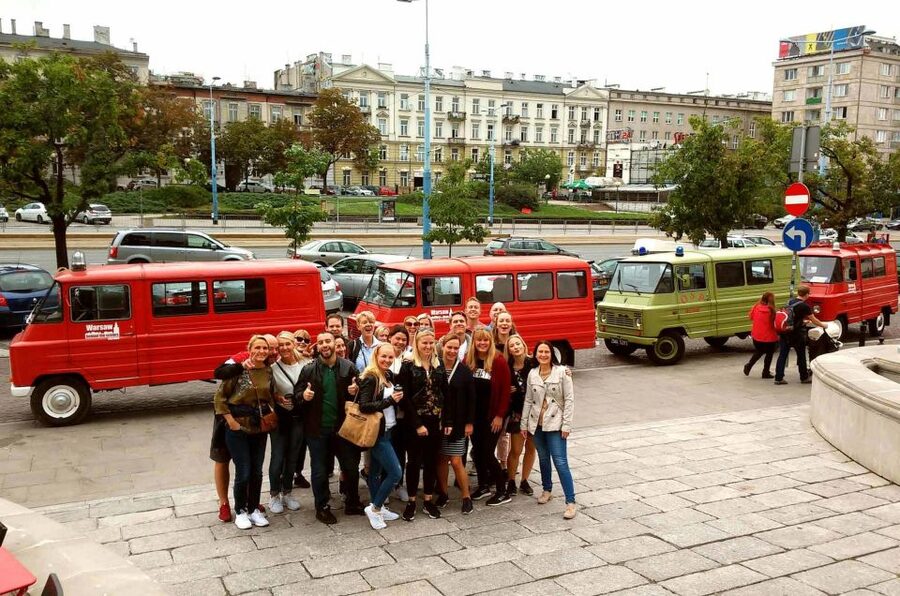
Muranów is one of the most revealing parts of the route. The district was rebuilt after the war, but it was not simply restored to its earlier form. Its postwar planning reflects the practical and political choices made when Warsaw had to be reconstructed on a massive scale.
Here the guide explains how planners shaped new streets, housing blocks, and open spaces after the old city had been devastated. You begin to see reconstruction as an active process, not a perfect return to the past.
The district can challenge the easy idea that a rebuilt city is either fake or original. Warsaw’s reconstruction created a functioning capital, but it also left visible signs of the period in which the work was carried out. The guide shows how those decisions still affect the city today.
I find this section especially useful for understanding Warsaw’s built environment. You learn to look beyond age and decoration. A building’s size, placement, and relationship to the street may tell you as much about political history as a plaque does.
Crossing the Vistula to old Praga
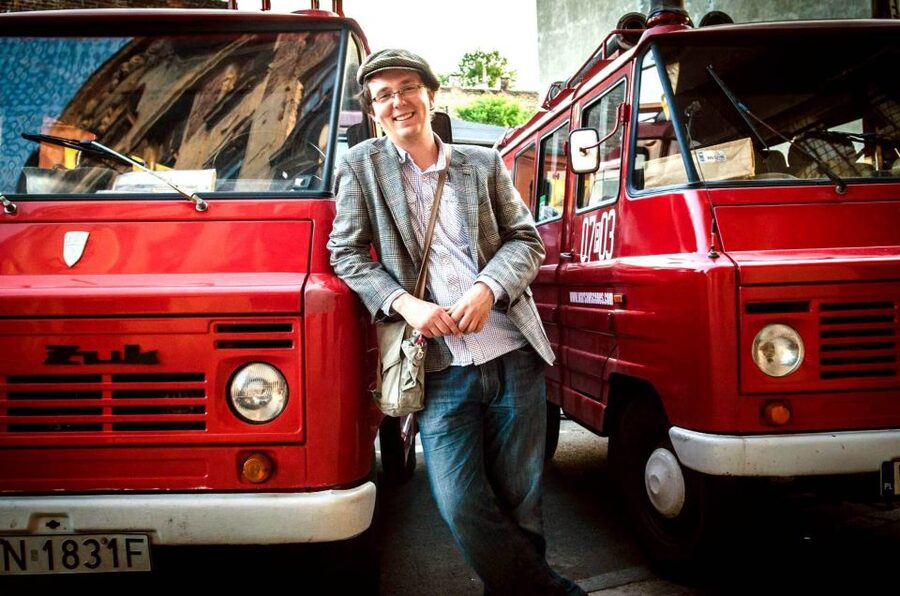
The Żuk then crosses the Vistula to Praga, one of Warsaw’s most distinctive districts. Praga survived the war with far more of its older structure intact than much of the city on the western bank. That gives it a different feel, with original architecture and traces of older neighborhood life.
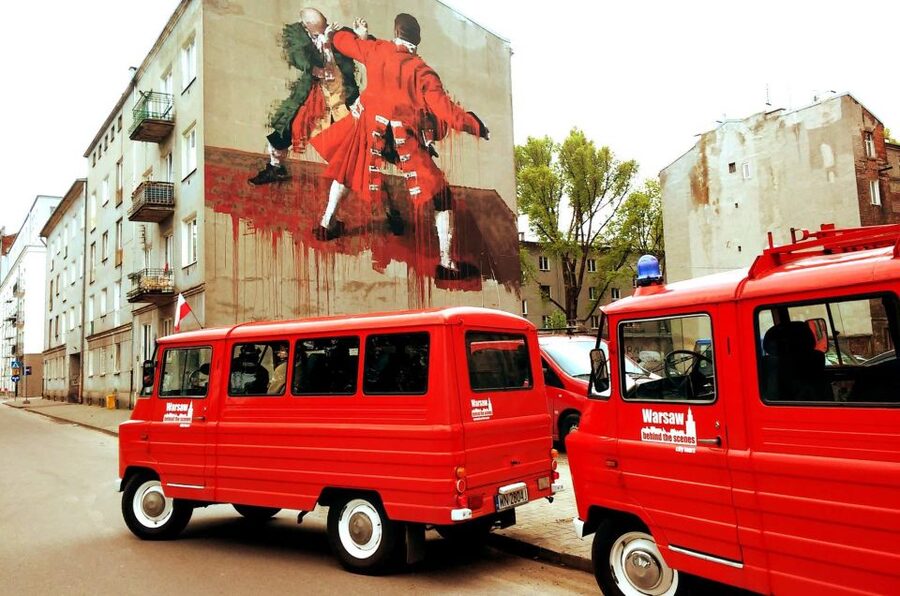
The district was once regarded as one of Warsaw’s rougher areas. Today, it has developed into a creative center with murals, workshops, and renovated corners alongside older, worn buildings. The point is not to present Praga as a polished theme park. Its appeal comes from the mixture of survival, change, and uneven redevelopment.
This is where the tour gets particularly good at showing present-day Warsaw. You see how a district with a difficult reputation can attract artists and new businesses while retaining signs of its earlier character. The guide’s local perspective helps you read those changes without reducing Praga to a fashionable photo stop.
The minibus is useful here because Praga is not always included in a short central walking route. You can cover more ground, then pause in selected areas. Comfortable shoes remain important, since the experience includes walking segments at each location.
Communist planning and the post-1989 city
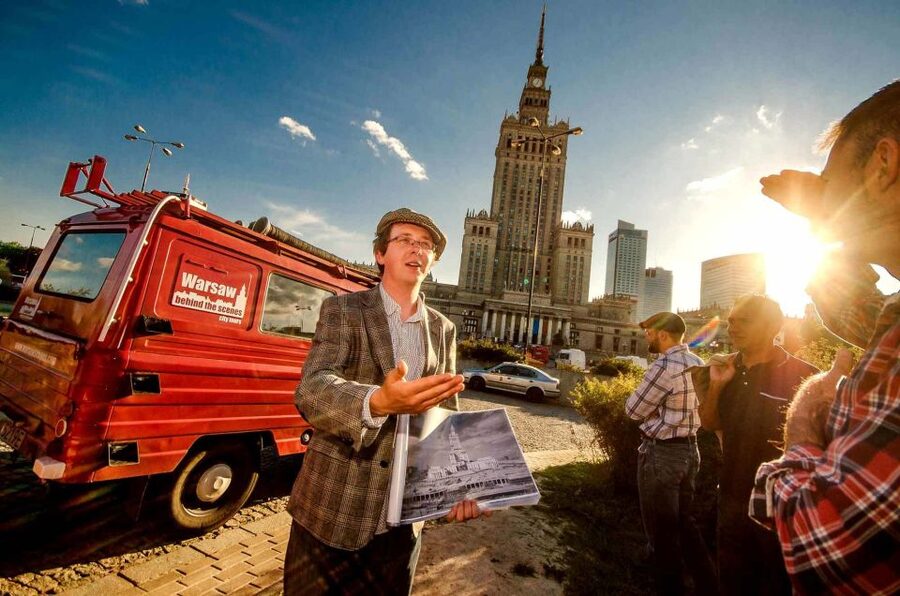
The tour also examines life under communism and the physical results of Soviet influence. Warsaw’s broad avenues, large housing districts, and monumental buildings make more sense once you understand the priorities behind them.
Your guide discusses how postwar planners worked with a ruined city and a new political system. Reconstruction was not only about replacing buildings. It also involved reshaping neighborhoods, transport routes, public space, and the visual identity of the capital.
The story then moves into the period after 1989. Warsaw changed quickly as Poland moved toward a new political and economic system. The final section presents a capital marked by growth, innovation, and renewed cultural activity.
This ending keeps the tour from becoming a memorial-only experience. You see the city as a place still changing, not a museum of wartime suffering. The modern view also gives you a better basis for judging the older parts of the route. Warsaw’s current mix of restored, rebuilt, communist-era, and contemporary architecture is the result of all these periods colliding.
What the three-hour format gives you
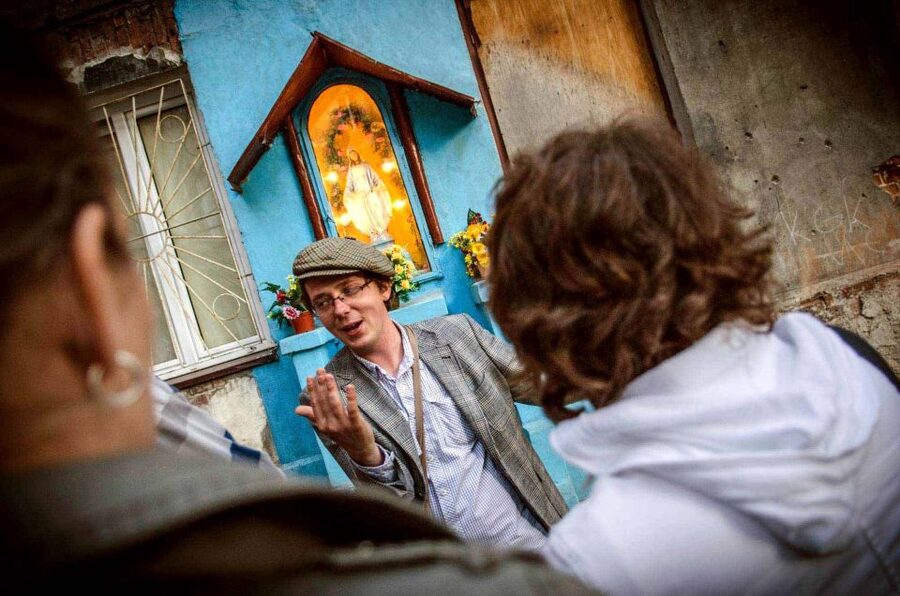
Three hours is long enough for a serious introduction, but not long enough for every museum, memorial, and neighborhood detail. That is the right expectation. You are buying a connected story and transport between important districts, not a complete study of Warsaw.
The small vehicle helps the schedule. You avoid the slower feel of a large coach, and the guide can keep the route responsive. You should still expect a fairly full outing, with riding, standing, and walking rather than three hours seated inside the Żuk.
Hotel pickup and drop-off are included for accommodation within 1 kilometer of the city center. Give the operator your full accommodation details when booking. If your hotel falls outside that area, the included pickup does not apply.
The tour is offered in English. It can be booked for adults and children over 150 centimeters. Polish law requires a booster seat for shorter children, so contact the operator before booking if you need one. Children under 150 centimeters cannot simply be added without checking availability.
Comfort, weather, and practical limits
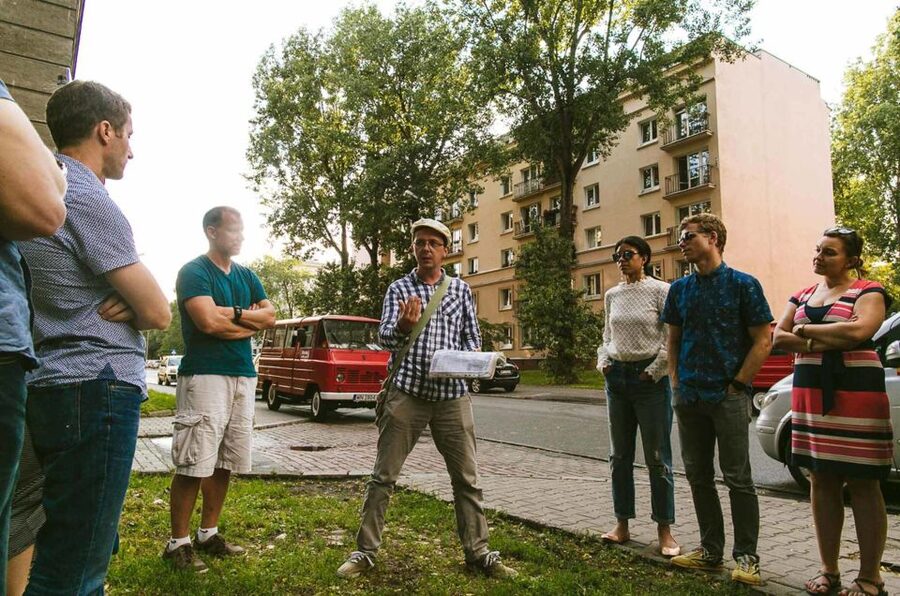
Classic vehicles have personality, but they also have limitations. The Żuk minibuses do not have air conditioning, and some do not have seat belts. Historic vehicles are permitted to operate this way, but you should consider your own comfort and safety expectations before paying $129.
Heating is available in winter. In warm weather, dress lightly and bring water if appropriate. The tour runs in changing conditions, so a practical outer layer and comfortable shoes are sensible choices.
Pets and large bags are not allowed. Pack lightly, since the vehicle is small and luggage has no place in the experience.
The tour is not suitable for wheelchair users. Because you leave the minibus at several points, it also requires enough mobility for walking and standing. This is not a hop-on, hop-off service with guaranteed step-free access.
Cancellation is flexible up to 24 hours before departure for a full refund, and you can reserve now and pay later. Starting times vary, so check the available schedule when you choose your date.
Is $129 a fair price?
At $129 per person, this is not the cheapest way to see Warsaw. You can walk through central districts at little cost, and public transport will take you across the city for much less.
The value comes from three things: the retro vehicle, the small group, and the guide’s interpretation. You are reaching areas that can be awkward to combine independently, while someone explains the relationship between them. For a first visit, that can save time and spare you from piecing together disconnected facts.
Past outings sometimes included a simple local lunch, a beer, cake, coffee, or vodka. Those extras are not part of the current stated inclusions, which list the minibus, English-speaking guide, and central hotel pickup and drop-off. Do not book on the assumption that food is included.
I think the price is easiest to justify if you have only a short stay, care about modern Polish history, or prefer a personal guide to a large organized coach. If you mainly want famous sights and exterior photographs, you may find the cost harder to defend.
Who should book this Warsaw tour?
I would choose this tour for a first or second visit, especially if you want to understand why Warsaw feels so different from other European capitals. It suits history-minded adults, couples, small groups of friends, and solo visitors who like asking questions.
It is also a good choice after you have seen the central sights. The route adds Praga, Muranów, wartime locations, and communist-era planning to the better-known picture of Warsaw.
You should think twice if you dislike old vehicles, need guaranteed air conditioning, want a fully seated outing, or have limited mobility. The Żuk is a memorable feature, but it is not luxury transport.
Should you book it?
Book this tour if you want Warsaw explained through its difficult changes, not just displayed through its rebuilt monuments. The combination of the Żuk, small group, Praga, Muranów, uprising sites, and a guide-led discussion gives you a useful first understanding of the city.
Skip it if your priority is a low-cost sightseeing loop or a fully accessible vehicle. For everyone else, $129 is a reasonable spend when the goal is context, local perspective, and a route you would be unlikely to assemble smoothly on your own.
FAQ
How long does the Warsaw Behind the Scenes tour last?
The tour lasts three hours. Check the available starting times when booking.
What language is the tour conducted in?
The tour includes a live English-speaking guide.
How many people fit in each Żuk minibus?
Each minibus accommodates up to eight passengers. The operator has a fleet of five minibuses.
Is hotel pickup included?
Pickup and drop-off are included from accommodation within 1 kilometer of Warsaw’s city center. Provide your full accommodation details when booking.
What areas does the tour visit?
The route includes sites connected with the Jewish Ghetto, both Warsaw uprisings, rebuilt Muranów, the Praga district, communist-era planning, and modern Warsaw.
Can children join the tour?
Adults and children over 150 centimeters can book online. Children under 150 centimeters need a booster seat under Polish law, so contact the operator in advance to check availability.
Does the Żuk minibus have air conditioning and seat belts?
The classic minibuses do not have air conditioning, and some do not have seat belts. They are equipped with heating for winter conditions.
Is the tour suitable for wheelchair users or large luggage?
The tour is not suitable for wheelchair users. Pets and large bags are not allowed.
Recently added in Warsaw
- Warsaw Wolf’s Lair with St. Lipka and Mamerki Private Guided★ 4.2 · 3 reviews
- Taste of Poland, food tour and guided walk with 12 tasting★ 5.0 · 3 reviews
- Discover Warsaw’s most Photogenic Spots with a Local★ 5.0 · 3 reviews
- Lodz Small Group Tour from Warsaw with Lunch★ 4.0 · 3 reviews
- Jewish heritage in Warsaw★ 4.5 · 3 reviews
- Warsaw Outdoor Paintball with Transfers (all year round)★ 5.0 · 3 reviews
- Electric Scooter Tour: Full Tour – 3-Hours of Magic!★ 5.0 · 3 reviews
- Skip-the-Line Polin Museum Warsaw Jewish History Tour★ 5.0 · 3 reviews
City Tours, compared.


Gdańsk City Sights & History Guided Walking Tour in English
Read our review →
Extended City Sightseeing Tour – Eco Buggy Golf Cart
Read our review →
Private Tour: Warsaw City Sightseeing by Retro Fiat
Read our review →Where else this one turns up