
Reviewed · WALKING TOURS
Walk through the Warsaw Old and New Town: like Phoenix from the ashes
Warsaw’s Old Town is not old in the usual sense. Much of what you see was rebuilt after the Second World War, making this a walking tour about destruction, courage, and careful reconstruction, not just pretty squares and church towers. Along the way, you connect Chopin, Marie Curie, Polish kings, the Warsaw Uprising, and the city’s postwar rebirth.
I like the compact route and the private format, which gives your own group the guide’s full attention. I also like the way the tour links famous people and grand monuments to specific places, such as Chopin’s heart in Holy Cross Church and Marie Curie’s birthplace. The main consideration is pace: two hours covers a lot, and several stops are brief. Also, the information says the tour is offered in English but describes a German-speaking guide, so confirm the language before paying.
Key points at a glance
- A private two-hour walk: Only your group participates, so you can ask questions and set the pace within the scheduled route.
- Warsaw rebuilt from ruins: Castle Square and the Old Town explain how the historic center was reconstructed after wartime destruction.
- Chopin and Marie Curie: The route visits the church holding Chopin’s heart and the birthplace museum of Marie Curie.
- A strong political history thread: You see the Presidential Palace, Tomb of the Unknown Soldier, Royal Castle, and Warsaw Uprising sites.
- A practical one-way route: Begin at the Copernicus Monument on Krakowskie Przedmieście and finish at the Warsaw Uprising Monument.
- Mostly outdoor sightseeing: Admission is free at most stops, but the Marie Curie museum ticket is not included.
Why Warsaw’s rebuilt Old Town makes this walk different
Many European old towns survived the war with scars and repairs. Warsaw’s center had a far more dramatic fate. This route presents an Old Town that was reconstructed after wartime destruction, which gives every restored facade and church wall a second layer of meaning.
At Castle Square, the guide explains the rebuilding process, how it was financed, and the role of a Venetian painter in preserving the appearance of the old city. You also hear about the first democratic constitution in Europe, as presented in the tour’s historical program. The point is not simply to admire the Royal Castle. It is to understand why restoring these streets mattered so much to Polish identity.
I find this theme especially useful if you are seeing Warsaw after visiting Krakow or another European capital. Warsaw can look polished at first glance, yet the city’s story is about survival. This walk gives you the background needed to read the streets properly.
The private format helps here. With only your own group, the guide can explain difficult subjects without rushing through a standard crowd-management routine. A five-minute pause at a major site will still be short, but you can ask for clarification when a detail catches your attention.
More Walking Tours in Warsaw
- Warsaw: Old Town Highlights Walking Tour in English
★ 4.7 · 1,516 reviews - Warsaw: Old Town Guided Walking Tour
★ 4.9 · 599 reviews - Half-Day Polish Food Walking Tour with Guide and Dinner
★ 4.5 · 381 reviews
Starting at the Copernicus Monument on Krakowskie Przedmieście
The walk begins at the Nicolaus Copernicus Monument on Krakowskie Przedmieście. Look for the guide holding a PolinTours sign. This is a useful meeting point on one of Warsaw’s main historic streets, and it gives the tour an immediate sense of place rather than starting at a transport hub or commercial plaza.
Krakowskie Przedmieście connects several important sights, so the opening section works as an introduction to Warsaw’s royal and intellectual center. The guide accompanies you for roughly two hours, finishing at the Warsaw Uprising Monument in Plac Krasińskich.
The route is one-way. That matters when planning the rest of your day. You do not return to the starting point, so arrange your next stop from the Uprising Monument rather than assuming you will end near the Copernicus Monument.
Chopin’s heart at Holy Cross Church
The stop at Holy Cross Church is brief, about five minutes, but it carries unusual personal weight. This is where the heart of Frédéric Chopin rests, and the guide uses the site to explain the composer’s connection to Warsaw.
You should not expect a long church visit from the stated timing. Instead, treat this as a focused historical stop within the larger walk. The value is in the story and the location. Chopin is one of the most famous figures linked to Poland, and seeing the place associated with his heart makes his connection to Warsaw more concrete.
The tour does not include admission charges at this stop. As with the other churches and public monuments, the experience is primarily an outdoor walking visit, with the guide pointing out the relevant details and setting them in context.
Warsaw University and the city’s intellectual life
The walk continues to the oldest part of the University of Warsaw. Again, the scheduled stop is only about five minutes, so this is a quick look rather than a full campus tour.
Still, it adds a useful change of subject. The route is not only about kings, battles, and ruins. University grounds bring in Warsaw’s academic and cultural life. When combined with the Chopin and Marie Curie stops, the tour shows how much the city’s identity is tied to education, science, and the arts.
If you want to explore the university in detail, you would need to return on your own. The tour provides orientation and historical context, not an extended visit inside the campus.
A different kind of day in Warsaw:
- Warsaw: Chopin Concert in the Old Town
★ 4.8 · 2,287 reviews - Warsaw: Traditional Galar Cruise on The Vistula River
★ 4.6 · 1,640 reviews - Warsaw Concert: Chopin – Painted by Candlelights with Wine
★ 4.8 · 1,442 reviews - Warsaw: City Sightseeing Hop-On Hop-Off Bus Tour
★ 3.6 · 1,415 reviews
Tomb of the Unknown Soldier and Saxon royal connections
At the Tomb of the Unknown Soldier, the guide explains more about the former estate of the Saxon kings in Poland. The stop lasts around ten minutes, giving you a little more time than at the university.
This is a good place to see how Warsaw’s public spaces carry several periods at once. Royal power, national memory, and military sacrifice meet in one location. The tomb is not treated as an isolated memorial. Instead, it becomes part of the wider story of Poland’s changing political fortunes.
The stop is free, and no transport is needed between locations. You walk from one site to the next, which keeps the connections between them clear.
The Presidential Palace and modern Polish power
The Presidential Palace receives another ten-minute stop. You admire the building and hear about its unusual history, according to the tour program.
This section shifts the focus from royal Poland to the modern state. The building is a reminder that Warsaw remains Poland’s political center, not simply a museum of past events. A short explanation can help you understand why this street contains such a concentration of government and national monuments.
The experience is best for people who want a broad overview. If you already know Warsaw’s political history well, you may find the timing too brief for detailed discussion. If you are new to the city, it provides a helpful framework before you reach the Old Town.
Castle Square and the Royal Castle
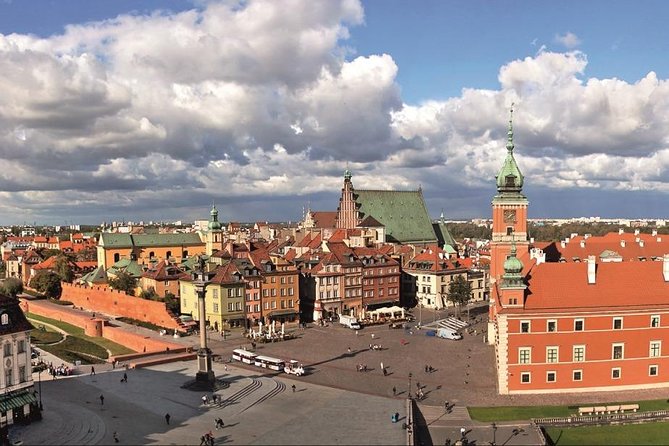
Castle Square is the tour’s central stop. Here you enter Warsaw’s UNESCO World Heritage-listed Old Town and see the Royal Castle. The scheduled visit lasts about 15 minutes, the longest pause on the main historic route.
The important point is that this is not a simple royal-palace photo stop. The guide explains the Old Town’s reconstruction, including how the work was financed and how a Venetian painter helped preserve the city’s earlier appearance. You also hear about Poland’s first democratic constitution in Europe, as presented in the tour.
I would pay close attention here. The rebuilt Old Town can look so complete that it is easy to miss the fact that it represents a huge postwar effort. The guide’s explanation gives the square emotional and political weight without requiring a museum admission.
The Royal Castle itself is admired from the route, but admission to interiors is not included. The tour is therefore a good first visit if you want orientation before deciding if you should return for a longer castle visit.
St. John the Baptist Basilica and the Warsaw Uprising
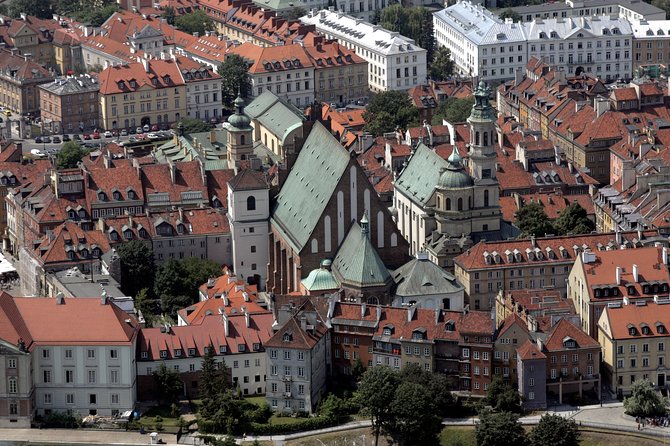
The Archcathedral Basilica of St. John the Baptist is one of the most sobering parts of the walk. The tour presents it as the only church in Europe through which the Second World War front ran. It also covers the heroic Polish struggle during the Warsaw Uprising and the role of the Russian army.
The stop lasts around ten minutes. That is enough for a concentrated explanation, but not enough for every detail of the church or the uprising. The subject is complex, and you may want to ask the guide for a reading suggestion or a museum recommendation if this becomes a major interest.
This stop also shows why the title’s Phoenix image works. Warsaw’s Old Town was not merely damaged and tidied up. It was caught in a war that reshaped the city and its people. The church provides a physical point where military history and religious life meet.
Gnojna Góra and a brief Vistula view
At Gnojna Góra, you look toward the Vistula. The stop lasts about five minutes, making it more of a viewpoint pause than a major sightseeing visit.
This is a useful change of rhythm after the dense history of Castle Square and St. John’s Basilica. It lets you look beyond the compact Old Town and remember Warsaw’s position along the river.
Do not plan on a long scenic break here. The published timing is short, and the route still has several important stops ahead. Think of it as a quick orientation point rather than a place to linger.
The Old Town Market Square and its legends
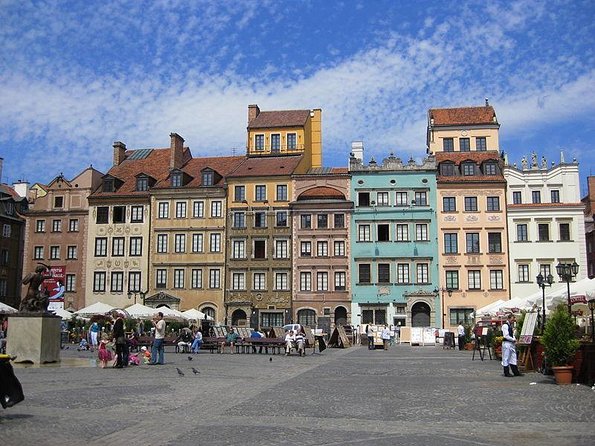
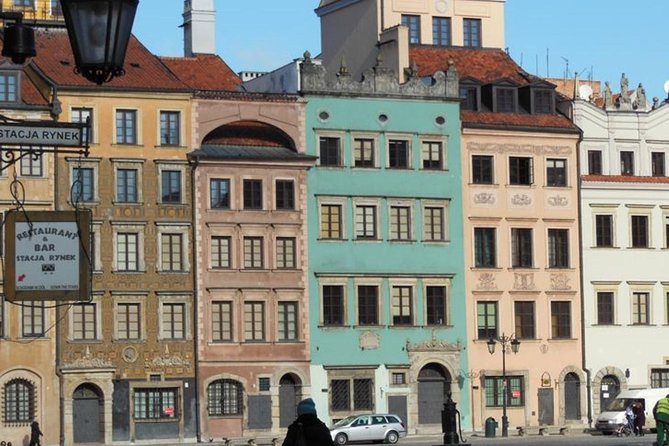
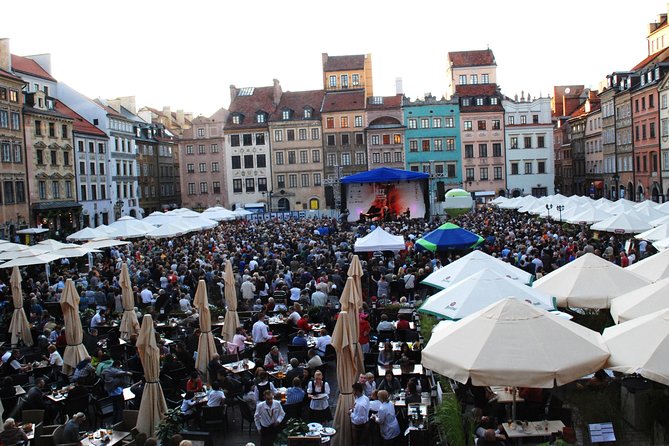
The Old Town Market Square brings the tour back to Warsaw’s most picturesque streets. Here you see famous corners and landmarks while hearing legends and authentic stories connected to the market place.
The square is a natural place to pause and absorb the visual side of the Old Town. Yet the historical explanation matters just as much. Once you know that the surrounding center was reconstructed, the painted facades and carefully arranged streets feel less like untouched scenery and more like a deliberate act of remembrance.
The scheduled stop is about ten minutes. That is enough to get your bearings and hear stories, but you will not have much free time for shopping, coffee, or photography. If you want photographs without the group moving on, plan to return later.
Passing through the city gate into New Town
The route then passes through a city gate and enters the New Town. This transition is easy to overlook, but it gives the walk a clear structure. You move from the celebrated Old Town into another historic district rather than stopping once you have seen the market square.
The New Town section helps you see that Warsaw’s historic center is larger than one postcard square. It also keeps the tour from becoming a loop of the same viewpoints. You continue north toward places tied to Marie Curie and the Warsaw Uprising.
Because the tour remains on foot, comfortable shoes are sensible. The supplied information does not list transport between stops, and the route is designed as a continuous walk.
Marie Curie’s birthplace and the optional museum visit
The Muzeum Marii Sklodowskiej-Curie marks the birthplace of Marie Curie, described in the tour as the birthplace of the most famous Pole. The stop lasts about ten minutes, and admission is not included.
This is one of the route’s most distinctive details. Marie Curie is often presented through her scientific achievements, but seeing the place associated with her beginnings makes the story more personal. It also gives the New Town section a strong purpose.
You should budget separately if you want to enter the museum. The tour price covers the licensed city tour and tax, but admissions are excluded. The short scheduled stop suggests that the guide introduces the site rather than leading a long museum visit. If science, Curie, or women’s history is a priority, you may want to return for more time inside.
Ending at the Field Cathedral and Warsaw Uprising Monument
The final part of the walk reaches the Field Cathedral of the Polish Army and ends at the Warsaw Uprising Monument. The stated stop lasts about ten minutes.
The monument gives the tour a fitting endpoint. Earlier sections explain wartime destruction and the struggle inside Warsaw. Here, the route closes at a memorial connected to the uprising, bringing the city’s resistance story back into view.
The ending is at Plac Krasińskich, not at the starting point. This makes the walk practical for continuing to nearby sights, but you should know the tour does not include return transport. The guide’s role ends at the monument.
What the $72.87 price means
At $72.87 per person, this is not the cheapest way to see Warsaw’s center. The value depends heavily on your group size and how much you want historical explanation.
Because this is a private activity, your group receives the guide’s attention rather than sharing the route with strangers. That can make the price reasonable for couples, families, or small groups who prefer questions and conversation. Group discounts are also available, which may improve the per-person cost for a larger party.
Most stops have no admission charge, and the tour includes the licensed city guide and tax. You still pay separately for snacks, transport, and admissions, including the Marie Curie museum. Since the itinerary is packed into two hours, you are paying mainly for the guided connection between sites, not for long interior visits.
The experience has a perfect five-star rating from 11 reviews, and one booking became a one-on-one walk because the guest was the only person scheduled. That detail shows how personal the format can be, though you should not assume every departure will have the same arrangement.
Who should book this Warsaw walk
I would choose this tour if you want a clear first look at central Warsaw and prefer a guide to explain the city’s wartime rebuilding. It suits first-time visitors, history-minded couples, families, and anyone who likes famous names tied to real places.
It is also a good fit if you value a private setting. You can ask about Chopin, Marie Curie, the Royal Castle, the constitution, or the Warsaw Uprising without waiting for a large group to move along.
I would hesitate if you want extensive time inside museums or churches. The walk is mostly a sequence of short outdoor stops, and the two-hour schedule leaves little room for lingering. It may also disappoint visitors seeking a food-focused experience, since snacks are not included and none are part of the route.
The tour is described as offered in English, but the itinerary also refers to a German-speaking guide. Confirm the language directly with PolinTours before booking. Most people can participate, service animals are allowed, and the route is near public transportation, according to the supplied details.
Should you book it?
Book this walk if you want Warsaw’s center explained as a story of survival, with Chopin, Marie Curie, Polish royalty, the Old Town reconstruction, and the Warsaw Uprising connected in one route. The private format and strong personal attention make the price easier to justify for a small group.
Skip it if you prefer to explore slowly, enter several museums, or spend a full morning photographing the Old Town. For everyone else, this is a focused way to get your bearings and understand why Warsaw’s restored center matters.
Free cancellation is available if you cancel at least 24 hours before the start time. Changes or cancellations made later are not accepted for a refund.
FAQ
How long does the Warsaw Old and New Town tour last?
The tour lasts approximately two hours.
Where does the tour begin?
It begins at the Nicolaus Copernicus Monument on Krakowskie Przedmieście in Warsaw.
Where does the tour end?
It ends at the Warsaw Uprising Monument at Plac Krasińskich.
Is this a private tour?
Yes. Only your group participates in the activity.
What language is the tour offered in?
The tour information says it is offered in English, while the itinerary describes a German-speaking guide. Confirm the language with PolinTours before booking.
Is admission included?
Most listed stops have free admission. Admission to the Muzeum Marii Sklodowskiej-Curie is not included, and admissions generally are not included in the tour price.
Is transportation included?
No. Transport is not included. The tour is a walking experience near public transportation.
Is the tour suitable for most people?
The additional information says most travelers can participate, and service animals are allowed.
Can I cancel for a full refund?
Yes. You can cancel at least 24 hours before the experience start time for a full refund. Cancellations or changes made less than 24 hours before the start time are not accepted for a refund.
Recently added in Warsaw
- Warsaw Wolf’s Lair with St. Lipka and Mamerki Private Guided★ 4.2 · 3 reviews
- Taste of Poland, food tour and guided walk with 12 tasting★ 5.0 · 3 reviews
- Discover Warsaw’s most Photogenic Spots with a Local★ 5.0 · 3 reviews
- Lodz Small Group Tour from Warsaw with Lunch★ 4.0 · 3 reviews
- Jewish heritage in Warsaw★ 4.5 · 3 reviews
- Warsaw Outdoor Paintball with Transfers (all year round)★ 5.0 · 3 reviews
- Electric Scooter Tour: Full Tour – 3-Hours of Magic!★ 5.0 · 3 reviews
- Skip-the-Line Polin Museum Warsaw Jewish History Tour★ 5.0 · 3 reviews
Walking Tours, compared.




Gdańsk City Sights & History Guided Walking Tour in English
Read our review →


Where else this one turns up