
Reviewed · WALKING TOURS
ROYAL & COMMUNIST WARSAW walking tour in English
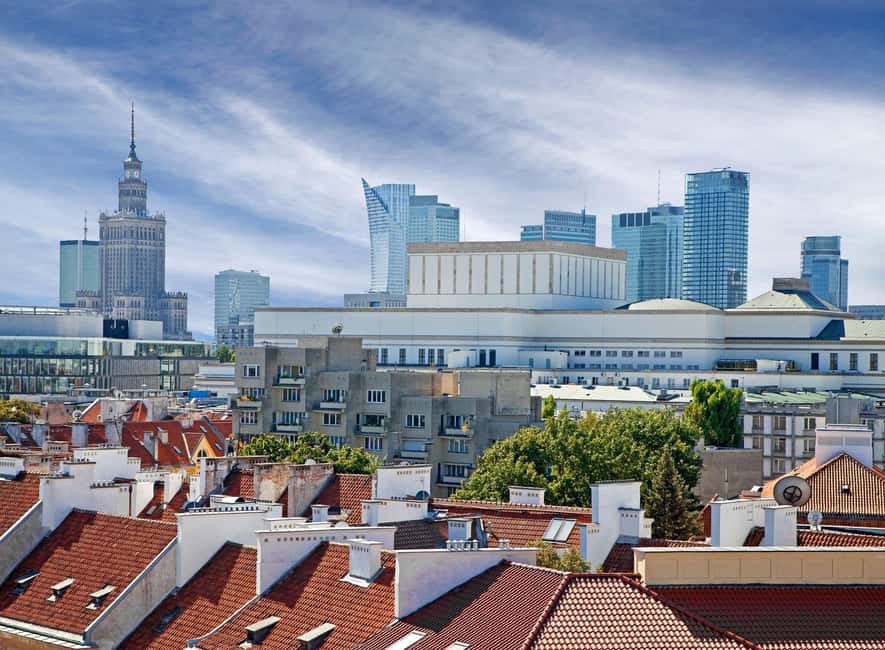
Warsaw’s most useful story is its sharp contrast: grand royal churches and palaces on one side, Soviet-era planning and Stalin’s giant Palace of Culture on the other. This $5 walking tour links both halves in one route, beginning in Castle Square and moving through the Royal Route before reaching the communist-era city center.
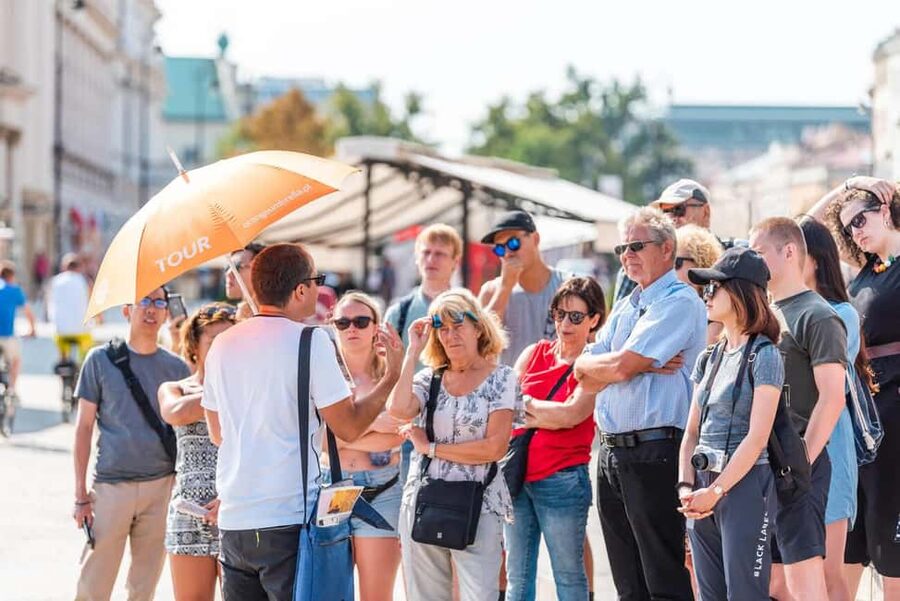
I like the local Warsaw guides, who were born and raised in the city, and I like the clear two-part design. Guides such as Arek, Margaret, and Gawel bring personal context, practical anecdotes, and a sense of how Warsaw changed during communist rule. The main drawback is pace: 2.5 hours on foot covers a lot, but most stops are viewed from outside rather than explored at length.
Key points about this Warsaw walk
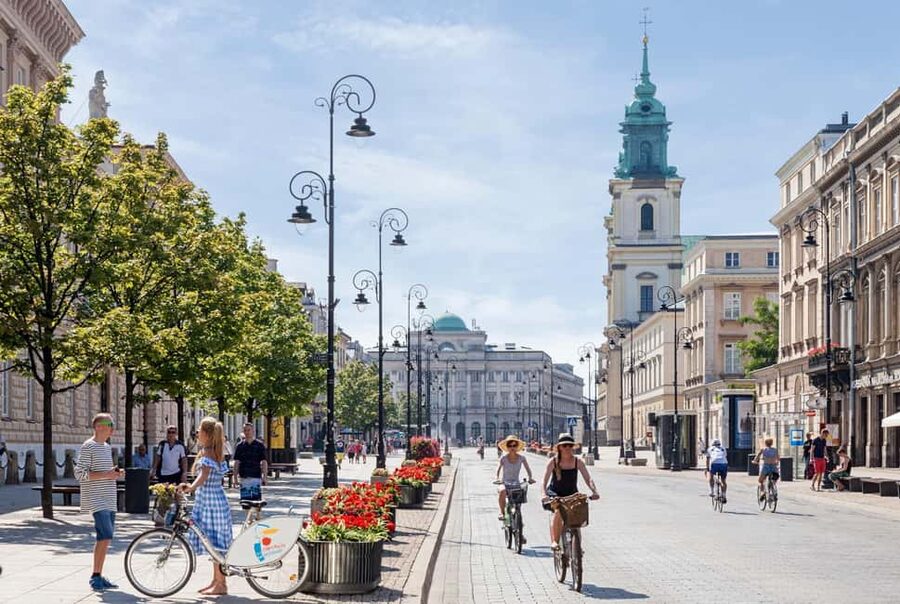
- Royal and communist Warsaw in one route: You move from Castle Square, baroque churches, and historic residences to postwar planning and the Palace of Culture.
- Local guides with personal context: Arek, Margaret, Gawel, and other Warsaw-born guides explain the city through both public history and everyday stories.
- A strong first introduction: If you have only a short time in Warsaw, the route gives you a useful map of the city’s main themes.
- A low-cost way to get oriented: At $5 per person, the tour offers unusually strong value for a 2.5-hour guided walk.
- Practical walking format: The tour is in English, includes a city map, and is listed as wheelchair accessible.
Why this 2.5-hour route works so well

Warsaw can be hard to read at first. The Old Town is beautifully reconstructed, the Royal Route stretches south through major landmarks, and the central district changes character again around the Palace of Culture. A short walk that explains all three areas can save you from treating the city as a collection of unrelated sights.
This tour has a simple idea: begin with the royal city, then show how the 20th century reshaped it. In the first half, you hear about noble residences, religious orders, Chopin, and Marie Curie. In the second, you look at the city center through communist architecture and urban planning.
That structure gives you a useful mental map. You are not only being shown attractive buildings. You are being told why Warsaw looks so different from many other European capitals and how power, politics, war, and rebuilding affected its streets.
The walk lasts 2.5 hours and the schedule gives many stops between roughly 10 and 20 minutes each. That means the guide needs to keep moving. Gawel is praised for interesting anecdotes and for keeping the tour to its promised length, while Margaret handled a drizzly day carefully. Arek is also noted for clear and helpful explanations.
More Walking Tours in Warsaw
- Warsaw: Old Town Highlights Walking Tour in English
★ 4.7 · 1,516 reviews - Warsaw: Old Town Guided Walking Tour
★ 4.9 · 599 reviews - Half-Day Polish Food Walking Tour with Guide and Dinner
★ 4.5 · 381 reviews
Starting at Sigismund’s Column in Castle Square
The meeting point is by Sigismund’s Column in Castle Square, at the edge of Warsaw’s Old Town. This is a practical place to begin because the column is easy to identify and the setting immediately introduces the old royal city.
The column honors Sigismund III Vasa, the king who moved Poland’s capital from Kraków to Warsaw in the late 16th century. The supplied route gives this stop about 20 minutes, so you should expect an explanation of the monument and its role in the square rather than a long visit inside a building.
Castle Square is also a good orientation point. From here, the route leads into the Royal Route, the city’s grand ceremonial spine. You can quickly see why Warsaw’s royal past is still central to its identity, even though much of the city was destroyed and rebuilt.
St. Anne’s Church and the old Royal Route
St. Anne’s Church receives another 20-minute guided stop. Its location near Castle Square makes it one of the most convenient places to see how Warsaw’s royal, religious, and academic worlds once overlapped.
The tour presents the Royal Route as the city’s most elegant historic street. In the 17th and 18th centuries, wealthy noble families built residences here while powerful religious orders raised baroque churches. That background helps you read the street as more than a pleasant walk. It was a corridor of status and influence.
You should expect the guide to focus on the building’s setting and history rather than a long interior visit. The route is designed as an overview, so the value comes from seeing how the church fits into the wider royal district.
University of Warsaw and the city’s cultural figures
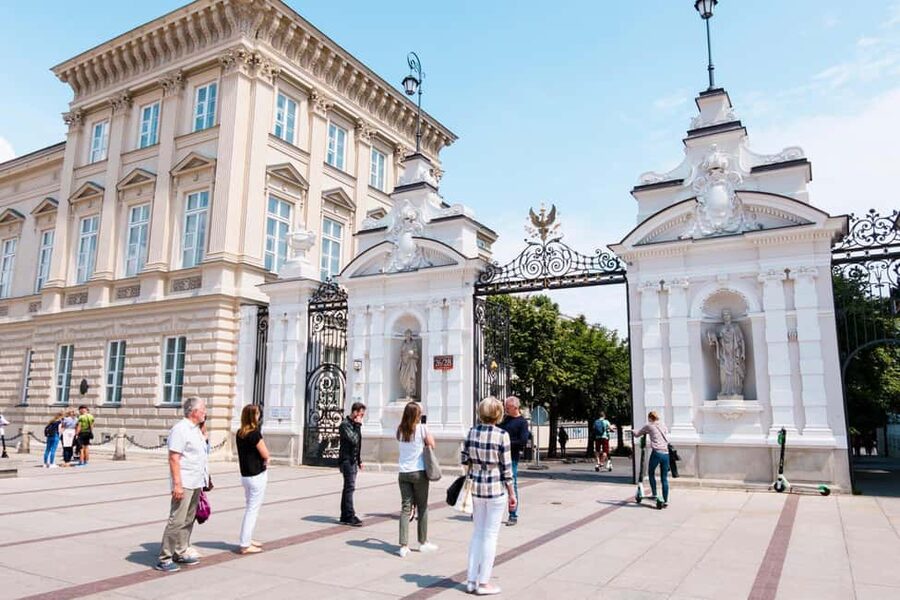
The University of Warsaw is allotted about 10 minutes. This is a short stop, but it adds an important academic layer to the Royal Route.
The walk connects this area with two famous figures tied to Warsaw: Frédéric Chopin and Marie Curie. Chopin lived in Warsaw, while Marie Curie studied there. These references help shift the tour beyond kings and political buildings, showing the city as a place of music, science, and education.
For you, this is one reason the tour works well as an introduction. It does not treat Warsaw as only a political capital. It gives you several ways to understand the city, through royal power, religious institutions, education, art, and science.
A different kind of day in Warsaw:
- Warsaw: Chopin Concert in the Old Town
★ 4.8 · 2,287 reviews - Warsaw: Traditional Galar Cruise on The Vistula River
★ 4.6 · 1,640 reviews - Warsaw Concert: Chopin – Painted by Candlelights with Wine
★ 4.8 · 1,442 reviews - Warsaw: City Sightseeing Hop-On Hop-Off Bus Tour
★ 3.6 · 1,415 reviews
The Presidential Palace and Warsaw’s public face

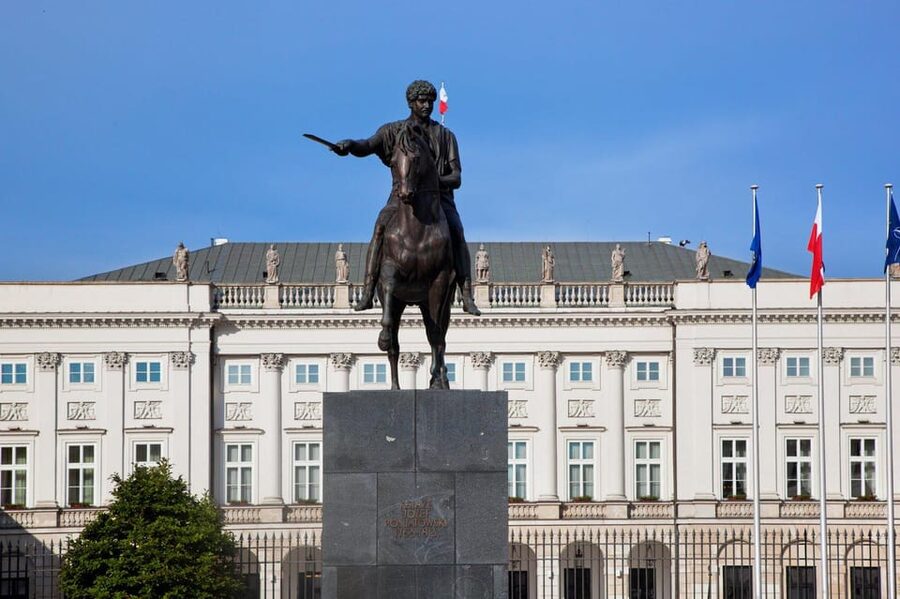
The Presidential Palace is another 10-minute stop along the Royal Route. Its presence reinforces the street’s continuing political importance.
Here, the guide can connect the old royal corridor with modern state power. The route does not promise entry, so plan to hear about the palace and its role while viewing it from the public street.
I find this kind of stop useful when a guide explains how a city’s buildings still shape daily life. A palace or government building can seem formal and distant on your own. With context, you can see why this stretch remains one of Warsaw’s main public stages.
Prudential Building and the move into the 20th century
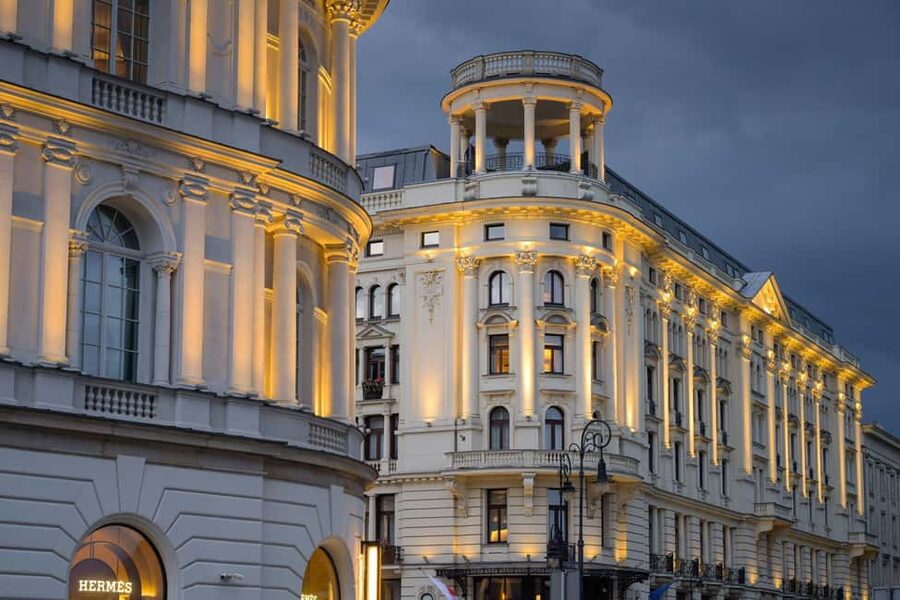
The tour then shifts toward the Prudential Building, now associated with Hotel Warszawa. This is where the route begins to change in character.
The building is important because it represents Warsaw’s modern city center and its changing skyline. The stop is listed twice in the route, with about 15 minutes assigned each time. That may reflect two separate points of discussion or a repeated route entry, so it is worth confirming the exact order with the guide at the start.
This part of the walk matters because Warsaw’s story does not end with its royal streets. The city center carries the marks of the 20th century, including new planning ideas, rebuilding, and communist-era architecture. The Prudential stop helps bridge those periods.
Holy Cross Church and the Chopin connection
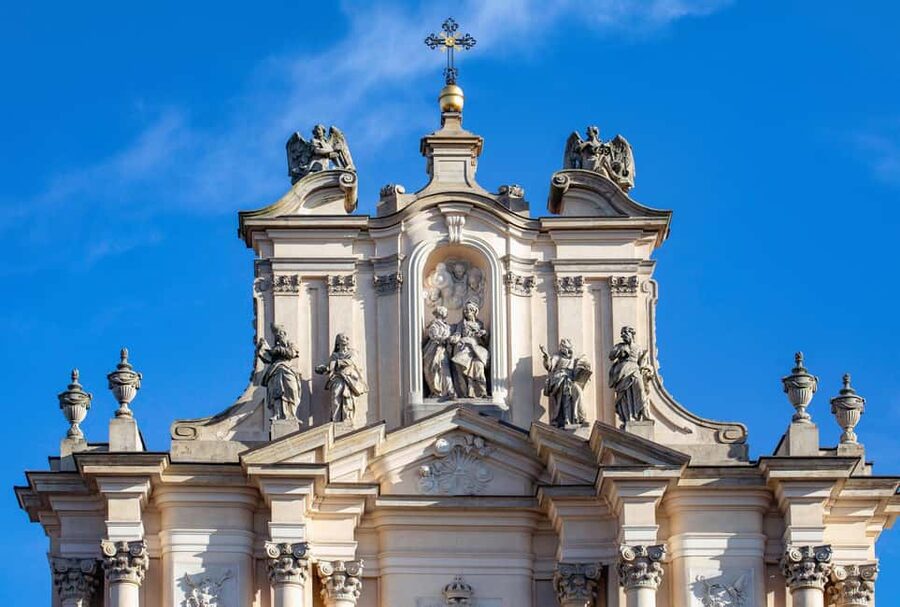
Holy Cross Church receives about 15 minutes. It is one of the route’s most personal stops because the church is linked with Chopin.
The tour uses Chopin’s life in Warsaw to make the Royal Route more immediate. You are not just hearing that a famous composer lived in the city. You are seeing the places connected with Warsaw’s cultural life and learning how the city shaped his early years.
This stop also slows the route slightly before the walk moves fully into the modern center. The church gives you another example of how religious buildings, public memory, and national culture overlap in Warsaw.
Adam Mickiewicz and Polish national memory
The Monument of Adam Mickiewicz is scheduled for about 15 minutes. Mickiewicz is one of Poland’s major literary figures, and the monument brings literature into a walk that already includes royalty, religion, music, and politics.
A stop here is valuable because public monuments reveal what a city chooses to remember. The guide can place Mickiewicz within Poland’s national story and explain why monuments matter in Warsaw’s public spaces.
You should expect an outdoor explanation rather than a museum-style presentation. That is typical of this route, which uses streets and monuments as its classroom.
Kubusia Puchatka and an everyday Warsaw detail
Kubusia Puchatka is one of the more unusual stops. The name refers to Winnie-the-Pooh, and the location offers a break from grand palaces, churches, and national monuments.
This kind of detail is exactly where a local guide can add value. A standard sightseeing route might rush past a small street or familiar name. A Warsaw-born guide can explain why it matters, how locals use the place, or what it says about ordinary city life.
The stop is listed for about 15 minutes. It helps keep the tour from becoming a procession of famous men and monumental buildings. You get a glimpse of a more everyday Warsaw before the route reaches the city’s most imposing symbol.
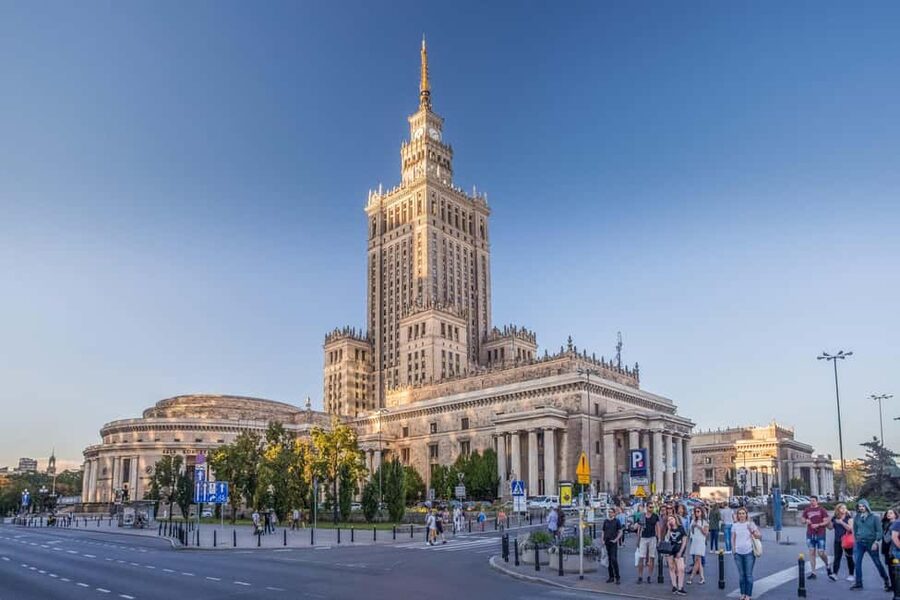
The Palace of Culture and Science, Stalin’s giant gift
The final major focus is the Palace of Culture and Science. You will see it as the defining landmark of communist Warsaw and as the famous gift from Stalin to the People’s Republic of Poland.
That description carries several layers. The building was intended to give Warsaw a new communist identity, and its huge scale still shapes the city center. For many people, it is the clearest visual reminder that postwar Warsaw was planned under a very different political system from the royal city.
The route gives the palace about 15 minutes. You should expect an explanation of its symbolism, its place in communist urban planning, and the mixed feelings it can inspire. The tour does not list an interior visit or a ticket to the observation terrace, so treat this as an exterior history stop.
The final stop is listed at Kazimierza Brokla, followed by the Palace of Culture and Science. The activity details also say the walk ends back at the original meeting point, while the route lists Pałac Kultury i Nauki as the finish. Because those details do not match perfectly, confirm the end location before setting your next appointment.
What the $5 price really gives you
At $5 per person, this is a remarkably inexpensive way to get a guided introduction to central Warsaw. The price includes a professional English-speaking guide and a city map, but not food or drinks.
The value is strongest if you are new to Warsaw and want context before exploring alone. You get royal history, cultural figures, communist planning, and practical orientation in one sitting. A private guide would cost much more, while a bus or boat tour would not give you the same street-level connection.
There are limits. The tour cannot offer long visits inside every church or building at this price and duration. You are paying for a focused outdoor overview, not a series of museum admissions.
I would also allow a little extra time afterward if you want to enter places along the route. The walk gives you reasons to return, but it is not designed to replace dedicated visits to Warsaw’s museums, churches, or palace interiors.
Walking comfort, weather, and accessibility
The tour is listed as wheelchair accessible, which is useful information for anyone planning around mobility needs. Still, a walking route through a historic center can involve changing surfaces and crowded public spaces, so you may want to confirm the exact route with the provider if you have specific accessibility requirements.
The experience lasts exactly 2.5 hours according to the supplied details. That precision matters if you have a train, meal reservation, or another tour afterward. Even so, leave a small buffer for the group, street crossings, weather, and the unclear finish-point wording.
Bring water because drinks are not included. In wet weather, the walk still goes ahead, and Margaret is noted for helping the group stay dry during a drizzly day. Comfortable shoes and weather protection make sense, since the tour is built around outdoor stops.
Who will get the most from this tour
I would choose this walk if you have only a couple of hours in Warsaw and want a sensible starting point. It is also a good fit if the city’s mix of royal buildings and communist blocks seems confusing and you want someone to explain the connection.
First-time visitors will get the most practical benefit. Families and mixed-interest groups may also like the variety, since the route includes churches, famous people, public monuments, architecture, and local anecdotes.
History fans who want long, detailed discussions at each site may find the pace too brisk. The same is true if you want extensive time inside buildings. In that case, use this tour as an introduction, then return to the places that catch your interest.
The English-language format is straightforward, and the guides are local Varsovians. That personal connection is one of the stronger reasons to book rather than simply follow a map.
Should you book Royal and Communist Warsaw?
Yes, if you want one affordable walk that explains two very different Warsaws. The price is low, the route is well chosen, and the guide’s local perspective adds useful details that a self-guided stroll can miss.
Book it early in your Warsaw stay so you can use the city map and historical framework for later sightseeing. Choose something else if you need interior visits, a slow photography walk, or a specialized tour focused only on the Old Town or communist architecture.
For a first look at Warsaw, the balance is hard to beat: royal streets first, Stalin’s palace later, and a clear explanation of how the city moved from one world to the other.
FAQ
How long does the Royal and Communist Warsaw tour last?
The walking tour lasts 2.5 hours. Starting times vary, so check availability when booking.
Where does the tour begin?
The guide waits by Sigismund’s Column in Castle Square, Warsaw Old Town.
Where does the tour finish?
The route lists the Palace of Culture and Science as the final stop, while the activity details say the walk ends back at the meeting point. Confirm the exact finish location with the guide.
Is the tour conducted in English?
Yes. It includes a live English-speaking guide, and English is the listed tour language.
What is included in the price?
The price includes a professional English-speaking Warsaw guide and a city map. Food and drinks are not included.
Is the tour wheelchair accessible?
Yes, the activity is listed as wheelchair accessible. If you have specific mobility needs, confirm the route details with the provider before booking.
Recently added in Warsaw
- Warsaw Wolf’s Lair with St. Lipka and Mamerki Private Guided★ 4.2 · 3 reviews
- Taste of Poland, food tour and guided walk with 12 tasting★ 5.0 · 3 reviews
- Discover Warsaw’s most Photogenic Spots with a Local★ 5.0 · 3 reviews
- Lodz Small Group Tour from Warsaw with Lunch★ 4.0 · 3 reviews
- Jewish heritage in Warsaw★ 4.5 · 3 reviews
- Warsaw Outdoor Paintball with Transfers (all year round)★ 5.0 · 3 reviews
- Electric Scooter Tour: Full Tour – 3-Hours of Magic!★ 5.0 · 3 reviews
- Skip-the-Line Polin Museum Warsaw Jewish History Tour★ 5.0 · 3 reviews
Walking Tours, compared.




Gdańsk City Sights & History Guided Walking Tour in English
Read our review →


Where else this one turns up