
Reviewed · WARSAW TOURS
Communist Warsaw: private tour by retro minibus with hotel pickup
Warsaw’s communist past is easiest to understand when you see its buildings, streets, and rebuilt districts together. This private tour links the Palace of Culture and Science, Muranów, Praga, and the government quarter in a retro communist minibus, giving you a moving lesson in how postwar Poland was planned and lived.
I like the private format, since your guide can focus on your questions rather than follow a large group. I also like the hotel pickup and the mix of major landmarks with less polished corners of the city. The tradeoff is that the three-hour schedule includes transfers, so a hotel far from central Warsaw can reduce your sightseeing time.
Key points to know before booking
- The Palace of Culture begins the story: Learn why Warsaw’s most famous tower was presented as a Soviet gift and remains politically awkward.
- Muranów shows postwar social planning: This residential district was built on wartime ruins as a model socialist neighborhood.
- Praga reveals a rougher side of communism: Courtyards and neglected streets point to informal trade and daily survival.
- The minibus saves time and effort: You ride between areas instead of making long walks across central Warsaw.
- Private means personal: Your group has the guide’s full attention, with minibuses carrying up to eight people.
- Plan for vintage-vehicle limits: Some minibuses lack air conditioning and seat belts, though all have winter heating.
Why communist Warsaw makes a good city tour
Warsaw can look newly built at first glance. Much of the city was destroyed during World War II, and the communist government used the rebuilding period to reshape not only streets but also society. The result is a city where prewar modernism, socialist planning, Soviet influence, and postwar improvisation sit close together.
That is what makes this tour useful. It does not treat communism as a single monument or a distant political chapter. Instead, you move through districts that show different choices: monumental power at the Palace of Culture, planned housing in Muranów, neglect and informal commerce in Praga, and official government architecture in Śródmieście.
I would choose this experience if you want context while looking at Warsaw rather than a simple ride past landmarks. You will still see well-known buildings, but the guide’s job is to explain what they meant to the people who lived around them.
The tour is offered in English and lasts about three hours. Since it is private, the pace may feel more relaxed than a large coach excursion. Still, do not expect three hours of sitting. The minibus mainly carries you between stops, and you walk around at each location.
A few more Warsaw half days to consider
- Warsaw: Chopin Concert in the Old Town
★ 4.8 · 2,287 reviews - Warsaw: Traditional Galar Cruise on The Vistula River
★ 4.6 · 1,640 reviews - Warsaw: Old Town Highlights Walking Tour in English
★ 4.7 · 1,516 reviews
Starting beneath the Palace of Culture and Science
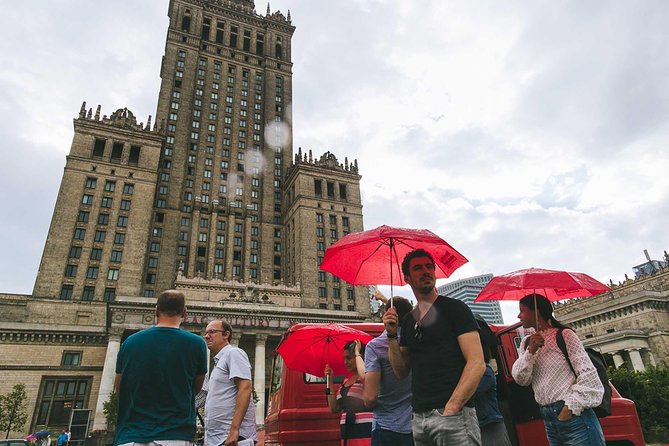
The Palace of Culture and Science is the obvious place to begin. Built between 1952 and 1955, it was presented by the Soviet Union as a gift to Poland. Its size and position make it impossible to ignore, and its political meaning has never been simple.
For some people, the building recalls Soviet control and the pressure placed on postwar Poland. For others, it is simply part of the city they grew up with. Your guide can connect the architecture to that tension, helping you see why one building can be both a familiar Warsaw landmark and a reminder of foreign power.
You spend about 20 minutes here, with admission included because the tour does not enter a paid attraction. One important point: the tour does not visit the building’s terrace on the 30th floor. If panoramic views are your main reason for coming to the Palace of Culture, you will need a separate visit.
That limitation is not necessarily a weakness. The purpose here is the building’s place in communist Warsaw, not a long indoor visit or a skyline stop. You get an efficient introduction before moving on to districts where the social effects of postwar planning become easier to see.
Muranów and the idea of a model socialist neighborhood
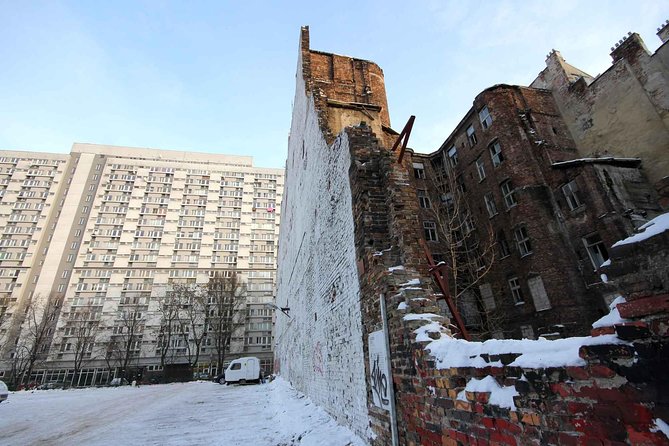
Muranów gives the tour a different tone. Before the war, Warsaw was a capitalist European city packed with tenement buildings. After 1945, the authorities and architects saw the ruined city as an opportunity to start again with a new plan.
The late 1940s reconstruction of Muranów created a green residential district on wartime ruins. It was designed as a model socialist neighborhood, with the arrangement of housing and open areas meant to support a new kind of urban life.
You spend roughly 20 minutes here. That is enough for an explanation and a look around, but not enough for a full architectural walk. Keep that in mind if you want a long, detailed study of the district. The value is in seeing how the planning idea fits into the larger story of communist rule.
Muranów also helps you avoid a common mistake: thinking communist Warsaw was only about huge government buildings. The system reached into ordinary housing, public space, and the way neighborhoods were arranged. This stop gives you a practical example of that process.
Passing the rebuilt Old Town and the underground route
The route between the stops includes a look at Warsaw’s reconstructed Old Town. The Old Town is famous for its colorful historic appearance, but its postwar rebuilding also belongs to the story of communist Warsaw.
A major traffic route was built beneath the area with assistance from Soviet engineers who had worked on the Moscow metro. You pass through this part of the city on the way to Praga rather than stopping for a long visit.
That short passage is useful because it connects two different images of Warsaw. Above ground, you see a carefully rebuilt historic center. Below and around it, you encounter the large infrastructure projects that helped modernize the postwar capital.
If you want a full Old Town tour, this experience will not replace one. The route treats it as part of the city’s reconstruction story, not as a main attraction. I see that as a sensible choice for a three-hour tour focused on communism.
A different kind of day in Warsaw:
- Warsaw Concert: Chopin – Painted by Candlelights with Wine
★ 4.8 · 1,442 reviews - Warsaw: City Sightseeing Hop-On Hop-Off Bus Tour
★ 3.6 · 1,415 reviews - Warsaw: POLIN Museum of the History of Polish Jews Ticket
★ 4.7 · 1,142 reviews - #1 Pub Crawl Warsaw with Optional Premium 1 Hour Open Bar
★ 5.0 · 790 reviews
Praga Północ and the practical side of survival
Praga Północ is where the tour becomes less ceremonial. While some parts of Warsaw received major state investment, Praga was largely neglected. The result was a district where people often relied on informal networks and unofficial trade.
Behind the courtyards, residents exchanged foreign currency, traded Western music, and searched for goods that were difficult to find through official channels. These details help explain what daily life could look like when shops and state systems did not provide everything people needed.
You spend about 30 minutes here. The walking portion matters, because Praga’s story is tied to its courtyards and local spaces rather than one single monument. Wear shoes that are comfortable for uneven urban walking, even though the minibus handles the longer distances.
Praga is also a good counterpoint to the Palace of Culture. The palace represents power, order, and official ambition. Praga shows what happened when investment and attention did not reach everyone equally. The contrast gives the tour more honesty than a route made only of grand buildings.
I would not book this stop expecting a polished sightseeing district. Its appeal comes from the rougher, more ordinary side of the city. Some people may prefer the rebuilt center, but if you want to understand how residents adapted to shortages and neglect, Praga is essential.
Śródmieście and the architecture of official power
The final major stop is Śródmieście, Warsaw’s central government district. Here, prewar modernist architecture meets monumental socialist realism, creating one of the clearest visual contrasts on the route.
Socialist realism favored buildings that projected order, strength, and public purpose. In practice, that often meant grand façades and formal spaces intended to represent the state. Placed beside the cleaner lines of prewar modernism, these buildings show how political ideas shaped the city’s appearance.
You spend about 45 minutes here, the longest stop of the tour. That gives your guide time to explain the government buildings, statues, and architecture without rushing through every point.
One detail adds a touch of irony. The leader of communist Poland reportedly refused to move into the new party headquarters because he thought it looked more like a capitalist bank than the office of a workers’ party. It is a small story, but it captures the contradictions of the period: a government rejecting capitalist symbolism while building in a grand, imposing style.
This is also where a strong guide matters most. Tom, one of the named guides associated with the experience, received specific praise for explaining the history of communism and pointing out buildings and statues across central Warsaw. The tour depends on that storytelling. Without it, the architecture can blur into a series of large façades.
What the retro minibus adds to the experience
The vintage minibus is more than a novelty. It gives the tour a physical connection to the period being discussed, and it saves your legs between districts that are too spread out for a short walking tour.
Each vehicle holds up to eight passengers, and the operator has a fleet of five minibuses. Since the activity is private, only your own group participates. That setup works well for couples, families, and small groups who want to ask questions or adjust the conversation.
There are practical limits. These classic vehicles are not equipped with air conditioning, and some do not have seat belts. That is permitted for historic vehicles, but you should know it before booking. In warm weather, the lack of air conditioning may affect your comfort. In winter, the vehicles have heating.
The minibus is mainly used to transfer you from one stop to the next. You still walk at the Palace of Culture, Muranów, Praga, and Śródmieście. Comfortable clothes and suitable footwear are a sensible choice.
The ride itself may appeal to anyone who enjoys old vehicles and a little atmosphere. If you prefer modern transport, a larger air-conditioned vehicle, or fully equipped safety features, this format may not suit you as well.
Hotel pickup is convenient, but the clock matters
Hotel pickup and drop-off are included, which makes this an easy choice when you do not want to arrange transport across Warsaw. If your address is not shown during booking, you can send it to the operator.
The key detail is that transfers count toward the total tour time. The experience lasts about three hours, not three hours plus however long it takes to reach your hotel. If you stay well outside the center, meeting the guide in central Warsaw may give you more time at the actual stops.
That is a useful choice to consider before booking. Pickup is most valuable when your hotel is conveniently located or when you want a simple start and finish. If your accommodation is far away, compare the comfort of door-to-door service with the sightseeing time lost on the road.
The tour is offered in English, and confirmation is provided at booking. It is also near public transportation, which gives you another option if you choose to meet centrally.
Is the $134.43 price fair?
At $134.43 per person, this is not a budget sightseeing bus. The price pays for a private experience, an English-speaking local guide, a vintage vehicle, hotel pickup and drop-off, and all fees and taxes.
The value improves when several people share the experience, especially because the minibus can carry up to eight passengers. A private tour also gives you something a standard group route cannot: the chance to ask about a building, a family connection, or a detail that catches your eye without waiting for a whole busload of people.
For one person or a couple on a tight budget, the price may feel high for three hours. You can see many Warsaw landmarks independently and spend little on transport. The difference is that you would need to research the communist-era context, plan the route, and connect the districts yourself.
I think the cost is easiest to justify if you have limited time in Warsaw, prefer door-to-door service, or want a guide to interpret architecture and urban planning. Group discounts may also help. Tips are not included, so budget separately if you want to thank the guide for the service.
Who should book this tour?
This experience suits you if you:
- Want a focused introduction to communist Warsaw rather than a general city tour
- Prefer riding between districts instead of making long walks
- Are traveling with family or friends and value a private guide
- Enjoy architecture, political history, and stories about daily life
- Have only a few hours available for this subject
- Like the character of historic vehicles and do not require modern transport
It may be less suitable if you want extensive time inside museums, a visit to the Palace of Culture terrace, or a fully air-conditioned vehicle. It is also not a pure sightseeing ride, since walking is part of every stop.
Children over 150 centimeters can be booked online. For a child under 150 centimeters, contact the operator first to check booster-seat availability. Polish law requires a booster for smaller children, so do not assume a young child can simply board without one.
Book or skip?
Book it if you want Warsaw’s communist period explained through real streets and buildings, not just dates. The route has a good balance: Soviet symbolism at the Palace of Culture, social planning in Muranów, informal survival in Praga, and official power in Śródmieście.
The strongest reasons to choose it are the private guide, the short travel time between districts, and the way the stops show different sides of the same political system. Tom’s clear explanations of buildings and statues are exactly the sort of guiding this subject needs.
Skip it if your priority is a long Old Town visit, a Palace of Culture viewpoint, or modern vehicle comfort. Also check your hotel location before confirming, since a distant pickup can take time from the three-hour schedule.
For visitors who want a practical, compact, and personal look at Warsaw after 1945, this is a well-focused choice. The subject is serious, but the vintage minibus keeps the experience lively without turning it into a standard sightseeing circuit.
FAQ
How long does the communist Warsaw tour last?
The tour lasts approximately three hours, including hotel pickup and drop-off when that service is used.
Is hotel pickup included?
Yes. Hotel pickup and drop-off are included. If your address is not available in the booking selection, send it to the tour operator.
Does hotel transfer time count toward the tour?
Yes. Time spent transferring to and from your hotel is part of the total tour duration. If your hotel is far from central Warsaw, meeting the guide in the center may provide more sightseeing time.
Is the tour private?
Yes. Only your group participates in the activity.
How many people fit in one minibus?
Each retro minibus accommodates up to eight passengers. A fleet of five minibuses is available.
Is the tour offered in English?
Yes. The experience includes a professional English-speaking local guide.
Does the tour visit the Palace of Culture terrace?
No. The tour visits the Palace of Culture and Science, but it does not include the 30th-floor terrace.
Can children join the tour?
Adults and children over 150 centimeters can book online. For children under 150 centimeters, contact the operator in advance to check booster-seat availability. Boosters are required under Polish law.
Are the vintage minibuses air-conditioned and equipped with seat belts?
The classic minibuses do not have air conditioning, and some do not have seat belts, which is permitted for historic vehicles. All vehicles have heating for winter use.
Recently added in Warsaw
- Warsaw Wolf’s Lair with St. Lipka and Mamerki Private Guided★ 4.2 · 3 reviews
- Taste of Poland, food tour and guided walk with 12 tasting★ 5.0 · 3 reviews
- Discover Warsaw’s most Photogenic Spots with a Local★ 5.0 · 3 reviews
- Lodz Small Group Tour from Warsaw with Lunch★ 4.0 · 3 reviews
- Jewish heritage in Warsaw★ 4.5 · 3 reviews
- Warsaw Outdoor Paintball with Transfers (all year round)★ 5.0 · 3 reviews
- Electric Scooter Tour: Full Tour – 3-Hours of Magic!★ 5.0 · 3 reviews
- Skip-the-Line Polin Museum Warsaw Jewish History Tour★ 5.0 · 3 reviews
Warsaw Tours, compared.

Traditional Galar Cruise on The Vistula River
Read our review →
Warsaw Concert: Chopin – Painted by Candlelights with Wine
Read our review →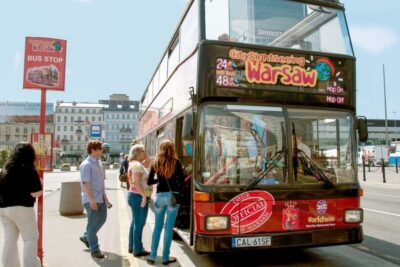

POLIN Museum of the History of Polish Jews Ticket
Read our review →
#1 Pub Crawl Warsaw with Optional Premium 1 Hour Open Bar
Read our review →