Reviewed · WARSAW TOURS
Warsaw for WWII Buffs – private tour with hotel pickup
Warsaw’s WWII story is not confined to a museum. It is under apartment blocks, along old property lines, beside ordinary streets, and in memorials tucked into today’s city. This private tour connects those places in a retro Żuk minibus, with guides such as Marcin, Tom, Karol, Martin, and Lukas offering a local view of occupation, resistance, the Warsaw Ghetto, and the 1944 uprising.
I like the way the tour reaches places you could easily miss on your own, including fragments of the Ghetto Wall and the ruined tenement on Waliców Street. I also like the private format, which lets you ask questions and shape the discussion around your interests. The main drawback is time: three hours passes quickly, and hotel transfers count toward the tour.
Key points to know
- A vintage Żuk minibus gives the tour its character, but some vehicles are bumpy, lack air conditioning, and may not have seat belts.
- The route covers both Jewish and Polish wartime experiences, from the Warsaw Ghetto to the 1944 Warsaw Uprising.
- Private groups can adjust the focus, which is useful if you already know the basic story or have a special interest.
- Hotel pickup is included within 3 kilometers of central Warsaw, though a distant pickup can reduce sightseeing time.
- The tour visits outdoor memorials and street sites, so comfortable shoes and weather-ready clothing matter.
- The $169.38 per-person price buys a private three-hour experience, not an admission-ticket package.
Warsaw’s wartime story from a vintage Żuk
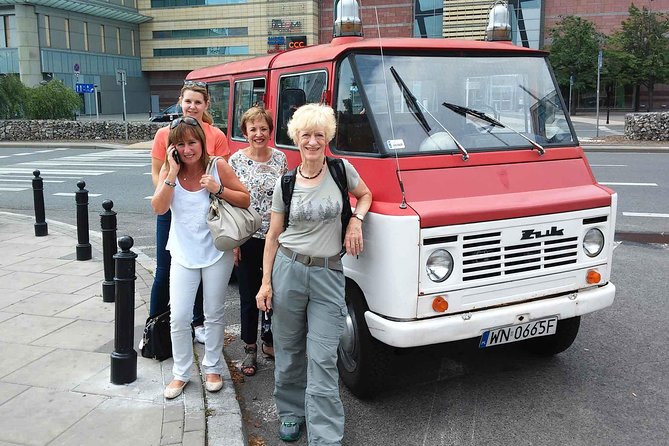
The old Żuk is more than a way to get from one stop to the next. It gives the outing a strong sense of place. This Polish communist-era minibus is used mainly for transfers, while you get out and walk at the important locations.
Expect a ride with some bumps and character. The vehicles are historic, not modern coaches. Some have no air conditioning, and some do not have seat belts, which is allowed for historic vehicles. Heating is available in winter, but summer passengers should dress for the weather.
Each minibus holds up to eight people, and the operator has a fleet of five. Since this is a private tour, only your group takes part. That makes a real difference when you are standing beside a memorial and want to pause, ask a difficult question, or spend more time on one subject.
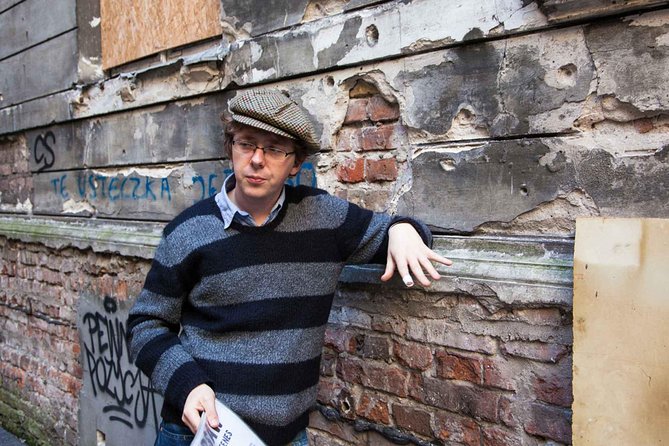
The English-speaking guides are the heart of the experience. Marcin, Tom, Karol, Martin, Konrad, Lukas, and others are named by the operator as guides for different departures. The strongest descriptions focus on their ability to explain complicated politics in plain English, use old photographs, answer questions, and adjust the route when a group has already seen the main sights.
A few more Warsaw half days to consider
- Warsaw: Chopin Concert in the Old Town
★ 4.8 · 2,287 reviews - Warsaw: Traditional Galar Cruise on The Vistula River
★ 4.6 · 1,640 reviews - Warsaw: Old Town Highlights Walking Tour in English
★ 4.7 · 1,516 reviews
From the 1939 invasion to a city under two occupations
The opening section sets up the political crisis of the late 1930s, then moves into Germany’s invasion of Poland in 1939 and the Soviet occupation of eastern Poland. This is essential background, since Warsaw’s wartime experience cannot be understood through the German occupation alone.
You will hear how the two invasions shaped daily life and helped create a wide resistance movement. The early stops are not built around admission tickets or grand interiors. Instead, the guide uses the streets and the ride to build a clear timeline.
I appreciate this approach because it avoids treating the war as a string of disconnected monuments. A good guide can show you how the invasion led to repression, how repression fed resistance, and how later events grew from those first years.
The subject is heavy. This is not a light sightseeing drive with a few war stories added for atmosphere. The tour deals with mass murder, forced removal, deportation, destruction, and political control. You should be ready for a serious afternoon.
Waliców Street and the remaining Ghetto Wall
The Warsaw Ghetto section begins with the fate of Poland’s Jewish population. Before the war, about three million Jews lived in Poland, including roughly 300,000 in Warsaw. In 1940, Nazi Germany created the Warsaw Ghetto and forced nearly half a million people into its confined area.
At Waliców Street, the guide points out one of the remaining fragments of the Ghetto Wall. It is an important kind of memorial because it is not a polished monument. The fragment survives between modern buildings and along old property lines, where the boundary can be easy to miss.
That setting helps you understand how the ghetto divided a living city. The wall was not an abstract line on a map. It controlled movement, separated families and neighborhoods, and became part of the daily machinery of persecution.
There is no admission charge at the stop, but its value depends heavily on explanation. Without a guide, you might walk past the fragment without realizing what it marks. Bring questions, and allow the guide to connect the physical remains with the wider story.
Chłodna Street and the bridge over the ghetto
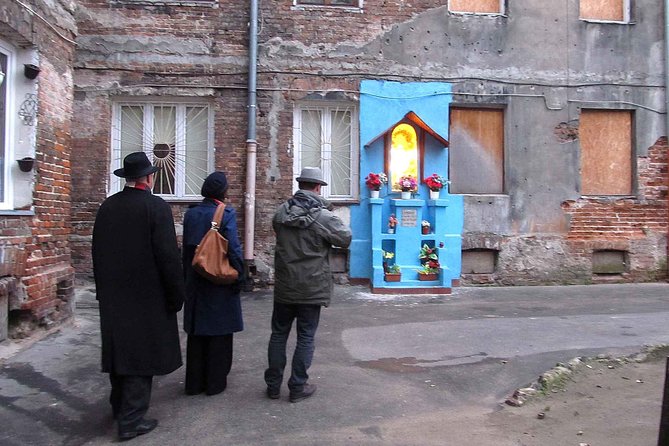
Chłodna Street offers one of the tour’s most striking examples of how occupation changed the shape of Warsaw. In 1941, the ghetto was split into two sections by the street, which carried east-west traffic.
A wooden bridge was built near the junction of Chłodna and Żelazna streets. It linked the two ghetto areas above the road, while trams, German military vehicles, and cars passed below. The bridge reached the third floor of nearby buildings, creating the strange and cruel image preserved in wartime photographs.
Today, you will not see the original bridge. The stop is about using the street, the surrounding buildings, and the guide’s images to picture what once occupied this space. If you have trouble visualizing vanished structures, ask to see the historic photographs mentioned in the tour descriptions. One guide, Tom, is specifically noted for bringing photographs to help explain the past.
The stop is brief, about ten minutes, so the guide needs to keep the story focused. That is useful for a three-hour tour, though you may wish for more time if architecture or wartime urban planning interests you.
A different kind of day in Warsaw:
- Warsaw Concert: Chopin – Painted by Candlelights with Wine
★ 4.8 · 1,442 reviews - Warsaw: City Sightseeing Hop-On Hop-Off Bus Tour
★ 3.6 · 1,415 reviews - Warsaw: POLIN Museum of the History of Polish Jews Ticket
★ 4.7 · 1,142 reviews - #1 Pub Crawl Warsaw with Optional Premium 1 Hour Open Bar
★ 5.0 · 790 reviews
The Waliców ruin and Muranów’s buried past
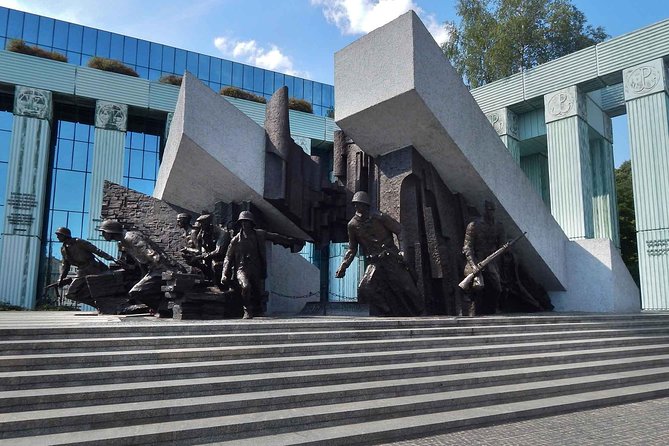
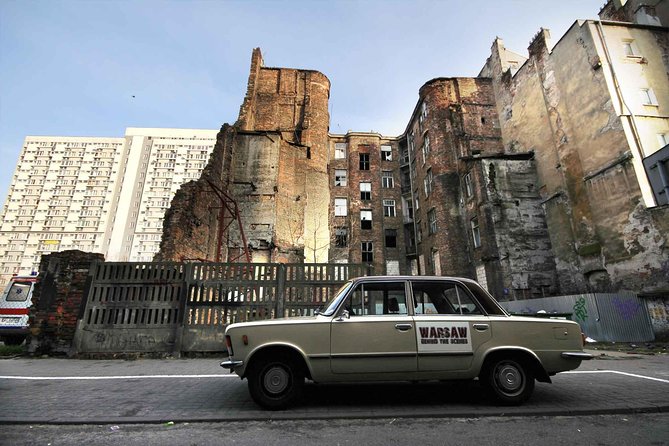
The Waliców tenement is described as the last ghost of the Ghetto. It remains a ruin, with another preserved fragment of the Ghetto Wall nearby. Unlike a newly built memorial, the damaged building gives you a direct look at the physical destruction left behind.
From there, the tour continues into Muranów. At first, Muranów looks like a regular district of square apartment blocks. That ordinary appearance is exactly what makes the stop important. Much of the former ghetto was destroyed, rebuilt, or covered by later housing, so the past is not always visible at street level.
Your guide supplies the missing context. The district becomes a place where you learn to read the city beneath its modern form. You may find the short walking stops more affecting than a long drive, since you are asked to look carefully at what remains and what has disappeared.
Wear good shoes. The vehicle handles the longer distances, but this is still a walking tour in sections, with stops on city streets and around memorial sites.
The Ghetto Heroes Monument and POLIN
The Monument to the Ghetto Heroes is one of the central memorial sites in Warsaw. The tour also brings you near the POLIN Museum of the History of Polish Jews. Museum admission is not included, and this experience does not function as a guided museum visit. Instead, the guide explains the importance of the area from the outside.
The monument and museum stand near the place where the first armed clashes of the 1943 Ghetto Uprising took place. That uprising became a symbol of Jewish resistance against the Nazis, even though the ghetto’s defenders faced overwhelming force.
This area also carries a wider message about remembrance and relations among Polish, Jewish, and German communities. The tour does not reduce Warsaw’s wartime past to one national story. It gives space to Jewish suffering and resistance, Polish resistance, Soviet deportations, and the difficult political years that followed.
If you plan to visit POLIN separately, this tour can give you useful orientation first. You will arrive with a clearer sense of why the surrounding streets and monument matter. If your schedule allows only three hours, the outdoor visit gives you a meaningful introduction without adding museum time.
Soviet deportations and the eastern story
The Monument to the Fallen and Murdered in the East shifts attention from Nazi crimes to Soviet repression. The tour explains the Soviet attack on Poland on September 17, 1939, two weeks after Germany invaded from the west.
The monument honors Poles deported to Siberian gulags, people killed in executions, and victims of the Katyń massacres. This stop is valuable because visitors who know the Warsaw Ghetto and Warsaw Uprising stories may have less background on what happened in eastern Poland.
It also helps explain why Poland’s wartime memory remained complicated after 1945. The defeat of Nazi Germany did not bring full independence. The Soviet Union’s role shaped Poland’s borders, politics, public memory, and family stories for decades.
The stop lasts about ten minutes. That is enough for a clear introduction, but not enough for every detail of Soviet occupation and postwar censorship. If this subject matters most to you, tell your guide at the start. The private format gives you the best chance of spending more time on it.
The Warsaw Uprising Monument and the ruined capital
The final major chapter concerns the Warsaw Uprising of 1944. Polish resistance fighters tried to retake the city before the Red Army entered. After the uprising failed, German forces systematically destroyed much of Warsaw.
The Soviet army entered the ruins in January 1945, beginning a new period of communist rule. The Warsaw Uprising Monument provides a powerful endpoint because it brings together military defeat, civilian suffering, destruction, and the loss of independence.
I like the way the route ends here rather than treating 1945 as a simple finish line. The war did not resolve Poland’s political future in the way many people assume. The city was liberated from German occupation, but Soviet power followed.
The monument stop is short, around ten minutes. Your guide may have more to say than the schedule allows, especially if you ask about the uprising’s military planning, the city’s destruction, or the postwar rebuilding of Warsaw.
What $169.38 per person gets you
At the stated price of $169.38 per person, you are paying for a private three-hour tour, an English-speaking local guide, transportation, and hotel pickup and drop-off within three kilometers of the city center. There are no admission tickets included, but most listed stops are free outdoor sites.
The value depends on your group size. For one or two people, the price is a sizable investment for three hours. For a larger private group, the cost is easier to justify because the guide’s attention is reserved for you rather than divided among a large coach group.
The tour also saves time. Warsaw’s WWII sites are spread across different districts, and reaching the Ghetto Wall, Chłodna Street, Muranów, eastern memorial, and Uprising Monument by public transport would require planning. The Żuk handles the transfers while the guide keeps the story connected.
Pickup is available from hotels, Airbnb properties, and apartments within three kilometers of the center. If your accommodation is farther away or difficult for a vehicle to reach, you will be offered a nearby meeting point. Since transfer time counts toward the three hours, a central meeting point may give you more actual sightseeing time.
The tour can be booked for adults and children over 150 centimeters tall. Polish law requires booster seats for shorter children, so you need to contact the operator before booking for a child under that height.
Who will get the most from this tour
I would choose this tour if you want the main WWII story in a short window and prefer a personal conversation to a large group lecture. It suits first-time visitors, serious military-history readers, and people who want to understand why Warsaw’s modern streets look the way they do.
You do not need to arrive as a specialist. Several guides are praised for explaining the subject in an informal way rather than giving a dry lecture. The private setting also works well for teenagers, especially when the guide uses stories, photographs, and links between wartime events and present-day questions.
It is also a good choice if you have already visited the Old Town or Warsaw Uprising Museum. The guides can adjust the route and find less familiar locations. One particularly useful feature is the chance to request a focus on the Ghetto Uprising, the 1944 uprising, Soviet Poland, or sites away from the usual tourist route.
I would think twice if you need modern vehicle comfort, air conditioning, or guaranteed seat belts. The Żuk is part of the experience, but its vintage design means narrow access, firm seats, and a bumpy ride. A senior passenger with limited mobility may find getting in and out difficult.
Practical ways to prepare
Wear comfortable shoes and clothing suited to the weather. You will walk at each stop, and the minibuses are not air-conditioned.
Keep the time limit in mind. The route contains more history than three hours can hold. Tell the guide what matters most to you before setting off, and do not hesitate to ask for a slower explanation at the sites that affect you most.
If you are staying farther than three kilometers from central Warsaw, compare the pickup option with meeting downtown. A long transfer can use up time better spent at the memorials.
Free cancellation is available if you cancel at least 24 hours before the local start time. Changes or cancellations made later are not refunded.
Should you book it?
Book it if you want a focused, private introduction to Warsaw’s WWII story, especially if your schedule is tight. The route links the Ghetto Wall, Chłodna Street, Muranów, the Ghetto Heroes Monument, the eastern memorial, and the Warsaw Uprising Monument in a way that makes the city itself part of the lesson.
The strongest reason to book is the guide. The right guide can tailor the discussion, use photographs, answer detailed questions, and take you beyond the obvious sights. The main caution is the vehicle and the short duration. You are choosing atmosphere and flexibility over modern comfort and a slow museum visit.
For history-minded visitors, families with older children, and anyone wanting a local perspective, this is a strong use of three hours. If you want a full study of Warsaw’s wartime past, use it as an introduction and add POLIN or another museum separately.
FAQ
How long is the Warsaw for WWII Buffs tour?
The tour lasts approximately three hours, including the vehicle transfers and walking stops.
Is hotel pickup included?
Pickup and drop-off are included for hotels, Airbnb properties, and apartments within a 3-kilometer radius of central Warsaw. A nearby meeting point may be suggested if your accommodation is farther away or hard for the vehicle to reach.
What language is the tour offered in?
The tour is offered in English with a professional English-speaking local guide.
How many people can ride in the minibus?
Each vintage minibus accommodates up to eight passengers. A fleet of five minibuses is available.
Is the vintage minibus comfortable and air-conditioned?
The historic minibuses do not have air conditioning, and some do not have seat belts. They do have heating for winter use. The vehicles are used mainly for transfers, with walking at each stop.
Can children join the tour?
Adults and children over 150 centimeters tall can book online. For a child under 150 centimeters, contact the operator in advance to check booster-seat availability, since boosters are required by Polish law.
Recently added in Warsaw
- Warsaw Wolf’s Lair with St. Lipka and Mamerki Private Guided★ 4.2 · 3 reviews
- Taste of Poland, food tour and guided walk with 12 tasting★ 5.0 · 3 reviews
- Discover Warsaw’s most Photogenic Spots with a Local★ 5.0 · 3 reviews
- Lodz Small Group Tour from Warsaw with Lunch★ 4.0 · 3 reviews
- Jewish heritage in Warsaw★ 4.5 · 3 reviews
- Warsaw Outdoor Paintball with Transfers (all year round)★ 5.0 · 3 reviews
- Electric Scooter Tour: Full Tour – 3-Hours of Magic!★ 5.0 · 3 reviews
- Skip-the-Line Polin Museum Warsaw Jewish History Tour★ 5.0 · 3 reviews
Warsaw Tours, compared.
Traditional Galar Cruise on The Vistula River
Read our review →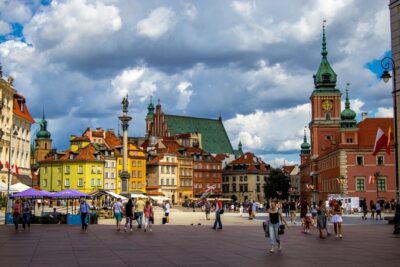
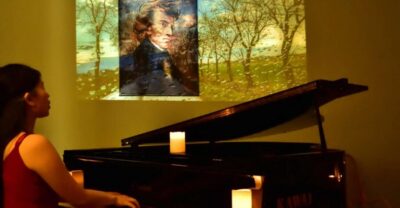
Warsaw Concert: Chopin – Painted by Candlelights with Wine
Read our review →
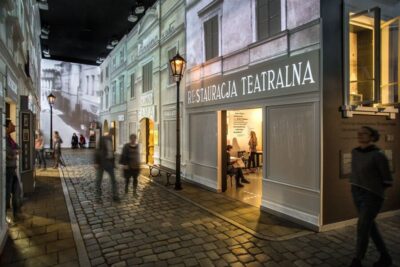
POLIN Museum of the History of Polish Jews Ticket
Read our review →
#1 Pub Crawl Warsaw with Optional Premium 1 Hour Open Bar
Read our review →