
Reviewed · WALKING TOURS
Jewish Warsaw Walking Tour
Warsaw’s Jewish past is easiest to understand when you see how little remains. This 2.5-hour walking tour links surviving traces, former ghetto boundaries, memorials, and streets where the guide helps you picture a community largely erased by Nazi Germany and World War II. Guides including Olivia, Jacek, Andrew, and Tomas have been praised for clear explanations, strong storytelling, and a dry sense of humor.
I like the route for two reasons: it begins with a few genuine pre-war remnants, including Nozyk Synagogue, and it ends at POLIN Museum and the Ghetto Heroes Monument, giving you a natural next step for further study. I also like the question-friendly style, with guides such as Olivia and Andrew making room for detail and discussion. The main drawback is practical: you will spend much of the tour outside and on your feet, with little chance to sit, so cold, wind, rain, or heat can affect the experience.
Key points to know before you book
- Only one pre-war synagogue remains: Nozyk Synagogue is the sole surviving pre-war synagogue in Warsaw.
- The route explains the ghetto through its edges: Waliców and Chłodna Street help you understand the former borders and divisions.
- The tour is mainly outdoors: Dress for the forecast, since it runs in all weather and includes long periods of standing.
- The storytelling carries much of the experience: Physical remains are limited, so the guide’s ability to rebuild the past with words matters greatly.
- The end point is useful: You finish at POLIN Museum, beside the Monument to the Ghetto Heroes.
- The advertised price is $26.59: This covers the reservation and guide payment for the general pay-as-you-wish format, not just a basic booking fee.
Why Jewish Warsaw needs a guided walk
Jewish Warsaw cannot be read like a preserved old quarter. Much of the former ghetto was destroyed, rebuilt, or absorbed into the modern city. You may pass an ordinary street corner without realizing that it once marked a ghetto boundary, a crossing point, or a place tied to the wartime Jewish community.
That is why a guide matters here. The tour uses what remains, then supplies the missing context through dates, stories, maps in your mind, and explanations of how the area changed. One especially useful point is that the experience does not pretend the physical evidence is greater than it is. The guide has to make sense of absences.
I would choose this walk early in a Warsaw visit if Jewish history is important to you. It gives you the basic geography first. Then, if you have time, you can visit POLIN Museum afterward with a better sense of where the former community lived and how the city was reshaped.
The guides are a major part of the experience. Olivia is described as especially strong at answering questions and presenting the past accurately. Jacek is praised for painting a vivid picture of Jewish Warsaw, while Andrew brings a large amount of detail in fluent English. Tomas is also noted for making Polish Jewish history accessible. The tone can be serious, but humor is used carefully to keep a long outdoor lesson from becoming flat or exhausting.
More Walking Tours in Warsaw
- Warsaw: Old Town Highlights Walking Tour in English
★ 4.7 · 1,516 reviews - Warsaw: Old Town Guided Walking Tour
★ 4.9 · 599 reviews - Half-Day Polish Food Walking Tour with Guide and Dinner
★ 4.5 · 381 reviews
Grzybowski Square: starting with one of the few surviving areas
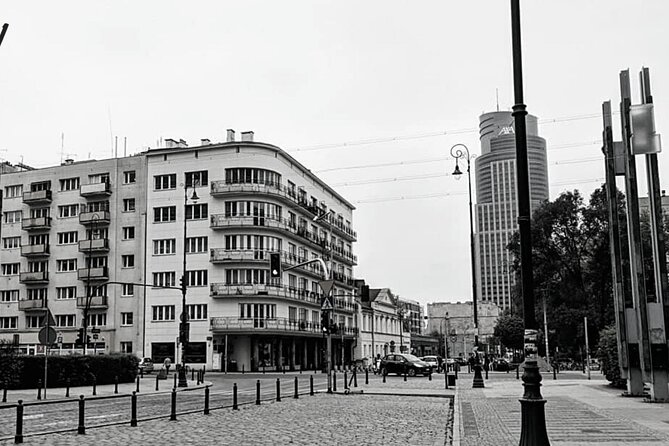
The meeting point is All Saints Church at Grzybowski Square, where the tour begins at 10:00 a.m. The square is one of the very few parts of Warsaw that survived the destruction of the Warsaw ghetto. That makes it a useful starting point, since you are not beginning with a reconstruction or an abstract museum display.
Expect about 20 minutes here. The guide sets the scene and explains why the square matters. You begin to see the city in layers: the pre-war Jewish community, the wartime ghetto, the destruction, and the modern streets that followed.
There is no admission charge at this stop. The value comes from the explanation, not from entering a major attraction. If you arrive early, you can get your bearings around the church and square before the group gathers.
Nozyk Synagogue: the rare surviving interior and exterior landmark
The next stop is Nozyk Synagogue, the only surviving pre-war synagogue in Warsaw. This is one of the most important physical links to the city’s Jewish life before World War II.
The scheduled time is about 30 minutes. The stop is free, but do not assume that the walk includes an interior visit. One point raised by the tour feedback is a wish to enter the synagogue, even briefly. In practice, you should treat this as an outside explanation unless your guide confirms that entry is possible on the day.
That limitation matters. A synagogue visit could give the tour a stronger sense of place, but the building still anchors the discussion in something tangible. After hearing about the destruction of the ghetto, seeing a pre-war synagogue that survived gives you a sharp reminder that the city’s Jewish story did not begin in 1939.
Waliców: reading the former ghetto border
At Waliców, the guide focuses on the former ghetto boundary. This is a stop where the city may look less dramatic than you expect. You are not walking through a perfectly preserved historic district, and there may be no single grand sight to photograph.
That is also the point. The guide explains how a border worked in daily life and how the division shaped movement through Warsaw. You gain a better sense of the ghetto as a controlled urban space rather than a vague area on a map.
The tour allows about 30 minutes here, enough for context and questions. This is one of the places where a strong guide makes a clear difference. Andrew’s detail-heavy style or Jacek’s story-led approach would suit this kind of stop, since the meaning depends on connecting a present-day street to events that are no longer visible.
A different kind of day in Warsaw:
- Warsaw: Chopin Concert in the Old Town
★ 4.8 · 2,287 reviews - Warsaw: Traditional Galar Cruise on The Vistula River
★ 4.6 · 1,640 reviews - Warsaw Concert: Chopin – Painted by Candlelights with Wine
★ 4.8 · 1,442 reviews - Warsaw: City Sightseeing Hop-On Hop-Off Bus Tour
★ 3.6 · 1,415 reviews
Chłodna Street and the lost footbridge
Chłodna Street brings one of the tour’s clearest visual stories. A monument here recalls the footbridge that once connected separate parts of the Warsaw ghetto.
The footbridge was not simply a piece of wartime construction. It represented the forced division of the ghetto and the need to move between sections without using the street below. The monument lets the guide explain that arrangement in a way that is easier to picture than a spoken description alone.
The stop lasts about 20 minutes. It is another outdoor point, so you will be standing while listening. On a cold or windy day, this can feel longer than the clock suggests. Wear shoes that can handle a steady city walk and bring a warm layer even if the morning starts mild.
POLIN Museum and the Ghetto Heroes Monument
The route finishes at POLIN Museum of the History of Polish Jews, on Mordechaja Anielewicza Street. Nearby is the 1948 Monument to the Ghetto Heroes, one of the most important memorials connected with the Warsaw ghetto.
The listed time here is about 20 minutes, followed by another 30-minute stop at the Monument to the Heroes of Warsaw, described in the tour details as the Monument to the Ghetto Heroes. The descriptions overlap, so the guide may treat the museum and memorial area as the closing section of the route rather than as two completely separate sights.
This ending works well. You finish beside a major museum instead of being dropped in an isolated area. If the subject has captured your attention, you can continue with a museum visit on your own. The walking tour does not include museum admission, so plan for that separately if you want to go inside.
The memorial also gives the tour a quiet final focus. Much of the route asks you to imagine what has disappeared. Here, the public monument gives the story a visible place of remembrance.
What the storytelling is really worth
Physical remnants are limited, and that can disappoint anyone expecting a preserved Jewish quarter full of intact buildings. The strongest part of this experience is the guide’s ability to explain what the streets once held.
The best guides appear to combine firm historical detail with a human tone. Olivia is praised for her passion, accuracy, and willingness to answer questions. Jacek is described as exceptionally informed and effective at helping you picture the past. Andrew is noted for vivid delivery and careful documentation, while Tomas receives praise for making the history of Polish Jews understandable.
Several useful details emerge from the feedback. Guides may look for places where the group can sit during the talk, but you should not count on regular seating. One guide even used small chocolate rewards for correct answers, a light touch that can help children and families stay engaged without making the subject feel casual.
The humor is usually described as dry rather than loud. That is a good fit here. You are dealing with persecution, forced separation, and mass death. A guide who can ease the pace with a restrained joke may help you stay focused, but the tour remains a serious history lesson.
Group size, pace, and physical demands
The maximum group size is 40 people. That is not a private walk, and a group of that size can make questions or street-corner explanations harder to hear. On the other hand, a larger group may suit you if you want a lower-cost introduction rather than a highly personal tour.
The experience lasts about two and a half hours. It is described as a lot of walking, but standing is just as important. At several stops, you listen while remaining outdoors. One account notes that the experience felt long in cold, windy weather and that sitting came only near the end.
I would rate the physical requirement as moderate, which matches the official guidance. Children must be accompanied by an adult, and service animals are allowed. The tour operates in all weather, so your clothing choice is not a minor detail. Comfortable shoes, a rain layer, and protection from cold or sun can make the difference between a thoughtful afternoon and a tiring one.
The route begins at Grzybowski Square and ends at POLIN Museum. Hotel pickup and drop-off are not included, and you arrange your own transport to and from the starting and ending points. The route is near public transportation, which helps with access, but the tour itself does not provide transport between stops because it is a walking experience.
Is $26.59 good value?
At $26.59 per person, the tour is reasonably priced for a two-and-a-half-hour guided history walk, especially if you want a clear introduction before visiting POLIN Museum. You are paying for a local professional guide, a planned route, and historical interpretation that would be hard to assemble from street signs alone.
The payment structure needs a little care. This is a general pay-as-you-wish tour, and the stated price covers the reservation fee and the guide’s payment. The guide may still explain the tipping system and ask you to consider an additional tip. If you prefer a fixed-price experience with no discussion of gratuity, that could feel awkward.
A smaller private tour can be arranged by contacting the provider, but the standard experience is the group walk with up to 40 people. I would see the standard price as good value for history-minded visitors who want orientation, storytelling, and a serious introduction. It is less suitable if you mainly want entry into buildings or a long list of photo stops.
Who should book this walk?
I would recommend it to you if you want to understand Warsaw through its Jewish history rather than simply collect sightseeing stops. It suits first-time visitors, history students, families with older children, and anyone planning to visit POLIN Museum.
It is also useful if you have already walked around Warsaw but felt that important places lacked explanation. The tour connects locations that can seem unrelated when seen alone. You may pass sites later in your trip and recognize why they matter.
I would think twice if you dislike outdoor tours, have difficulty standing for long periods, or expect a preserved quarter with frequent indoor visits. The synagogue may not be entered, the route is mainly historical rather than architectural, and the subject is painful. You need to be ready for a serious account of persecution and destruction.
Practical details for your morning
The start time is 10:00 a.m. at All Saints Church, Pl. Grzybowski 3/5. The finish is at POLIN Museum, Mordechaja Anielewicza 6. Confirmation arrives at booking, and free cancellation is available until 24 hours before the start time. Cancellations or changes inside that window are not refunded or accepted, and a minimum group requirement applies.
Bring water, dress for the forecast, and arrive ready to walk and listen. If you want to enter POLIN Museum afterward, allow extra time and budget for its separate admission, since the walking tour does not include it.
Should you book Jewish Warsaw Walking Tour?
Book it if you want a serious, guide-led explanation of Jewish Warsaw and understand that much of the experience depends on spoken history rather than surviving buildings. The route is well chosen, the final stop at POLIN Museum is useful, and guides such as Olivia, Jacek, Andrew, and Tomas bring different strengths in storytelling, detail, and questions.
Skip it if you need a mostly indoor activity, dislike group tours, or want guaranteed synagogue access. For most visitors who can manage two and a half hours outside, the $26.59 price buys a meaningful orientation to a part of Warsaw that is easy to miss and difficult to understand alone.
FAQ
Where does the Jewish Warsaw Walking Tour begin?
It begins at All Saints Church, Pl. Grzybowski 3/5, 00-115 Warszawa, Poland.
What time does the tour start?
The tour starts at 10:00 a.m.
Where does the tour end?
It ends at POLIN Museum of the History of Polish Jews, Mordechaja Anielewicza 6, 00-157 Warszawa, Poland.
How long does the tour last?
The tour lasts approximately 2 hours and 30 minutes.
What is the price?
The listed price is $26.59 per person.
Is the tour offered in English?
Yes. The tour is offered in English.
Is transportation included?
No. Transportation to and from the attractions is not included. Hotel pickup and drop-off are also not included.
Is admission to the stops included?
The listed stops have free admission, but the tour does not include admission to POLIN Museum. The tour information also does not guarantee entry inside Nozyk Synagogue.
Is the tour suitable for children?
Children must be accompanied by an adult.
What happens if I need to cancel?
You can receive a full refund if you cancel at least 24 hours before the experience start time. Cancellations or changes made less than 24 hours before the start are not accepted for a refund.
Recently added in Warsaw
- Warsaw Wolf’s Lair with St. Lipka and Mamerki Private Guided★ 4.2 · 3 reviews
- Taste of Poland, food tour and guided walk with 12 tasting★ 5.0 · 3 reviews
- Discover Warsaw’s most Photogenic Spots with a Local★ 5.0 · 3 reviews
- Lodz Small Group Tour from Warsaw with Lunch★ 4.0 · 3 reviews
- Jewish heritage in Warsaw★ 4.5 · 3 reviews
- Warsaw Outdoor Paintball with Transfers (all year round)★ 5.0 · 3 reviews
- Electric Scooter Tour: Full Tour – 3-Hours of Magic!★ 5.0 · 3 reviews
- Skip-the-Line Polin Museum Warsaw Jewish History Tour★ 5.0 · 3 reviews
Walking Tours, compared.
Gdańsk City Sights & History Guided Walking Tour in English
Read our review →
Where else this one turns up