

Reviewed · OLD TOWN TOURS
Private Walking Tour of Gdansk Old Town
Gdansk reveals itself best on foot, where ornate gates, brick churches, old civic buildings, and the former port sit close together. This private walk follows the city’s grand Royal Way and ends beside the Motlawa River, giving you a clear first look at the places that define Gdansk. I especially like the private format, which lets your group ask questions and set the pace, and the compact route, which covers major sights without wasting time on transport. The main tradeoff is simple: two hours goes quickly, so you will see the key exteriors but may not have time for long museum visits or every interior.
The tour costs $159.70 per group of up to 15 people, not per person. That can be fair value for a family or larger group, but less attractive for one or two people. The exact guide is not named in the booking details, though guides connected with this operator have included Martin, Olga Libura, Michael Maj, Agnieszka Syroka, and Basia Lasota. The meeting point is the Highland Gate, and the walk returns there.
Key points at a glance
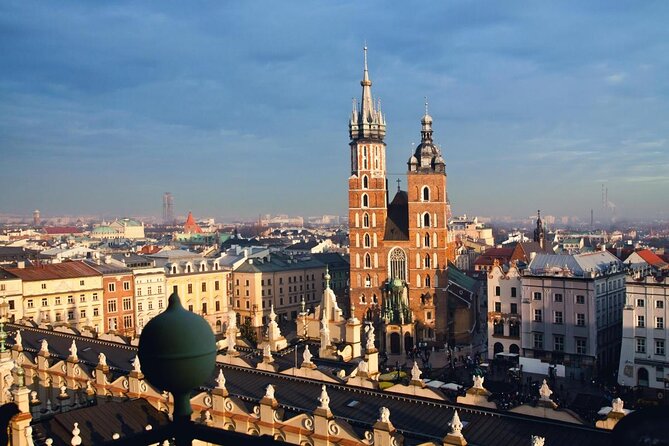
- Follow the Royal Way on foot: Walk the route once used by Polish kings during visits to Gdansk.
- See eight major stops: The Golden Gate, Great Armoury, St. Mary’s Basilica, Neptune’s Fountain, Main Town Hall, Crane, and Motlawa waterfront all fit into the route.
- Get a private guide: Only your group takes part, with room for questions and a more flexible pace.
- Expect an outdoor city introduction: Most of the experience happens in streets and squares, with admission listed as free at each stop.
- Allow for steady walking: A moderate level of fitness is recommended, and children must be with an adult.
- Use it as a first-day orientation: The guide can add local suggestions while showing you where the main sights are clustered.
Starting at the Highland Gate
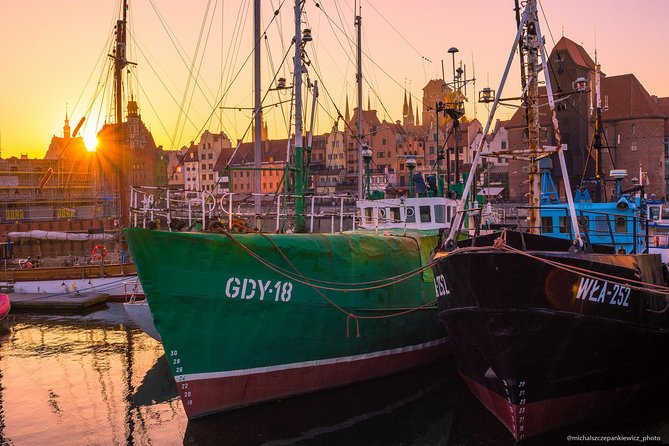
The walk begins at the Highland Gate, also called the Upper Gate, at Wały Jagiellońskie 2A. This is a practical starting point because it places you at the entrance to the ceremonial route through the historic center.
From here, you are not being driven between scattered attractions. You move through the streets in the same general direction as the city’s grand processions. That matters in Gdansk, where the sequence of gates, streets, townhouses, churches, and riverfront buildings creates much of the experience.
The tour is offered in English and uses a mobile ticket. Confirmation arrives when you book, so you have a clear meeting arrangement before the day begins. Since the walk ends back at the starting point, you do not need to plan a pickup at the waterfront.
The route is outdoors and takes around two hours. Wear comfortable shoes and expect a steady walk over city streets. The tour is not presented as a strenuous hike, but anyone who dislikes extended walking should consider the pace and duration before booking.
More Old Town Tours in Gdansk
- Gdańsk: Sightseeing EcoCruise around the Old Town of Gdansk
★ 4.6 · 719 reviews - Gdańsk: Old Town Private Walking Tour with Legends and Facts
★ 4.9 · 245 reviews - Gdansk Old Town 2-Hour Walking Tour
★ 4.5 · 94 reviews
Golden Gate and Great Armoury: a strong architectural opening
The first listed stop is Langgasser Tor, better known as the Golden Gate. It is not simply a gateway to pass through. Its design carries a civic message, with inscriptions and allegorical sculptures expressing the ideals Gdansk associated with its city and citizens.
Your guide can help you read the building rather than treating it as a quick photo stop. The gate was designed by Abraham van den Block and built by Hans Strakowski, and its architecture reflects the importance the city placed on public decoration. This is one of the places where a local explanation adds real value, since the symbols can otherwise look like attractive details without a clear purpose.
The planned stop lasts about 10 minutes. That is enough for an explanation and photographs, but not a long architectural study. Admission is listed as free.
The next stop is the Great Armoury on Piwna Street, another 10-minute pause. It is one of Poland’s notable Dutch Renaissance buildings and gives the walk an early dose of Gdansk’s grand civic style. The building also marks the Coal Market area, adding a sense of how public squares and major streets were organized.
I like this opening because it gives you two different kinds of architecture right away: a ceremonial gate with political symbolism and a decorative civic building with strong Renaissance character. If you want extensive indoor visits, though, this short tour is not designed around them.
The Royal Way and the city’s ceremonial center
The Royal Way receives about 20 minutes, making it one of the longer sections of the walk. This was the route used by Polish kings during their periodic visits to Gdansk, and it links several of the city’s most recognizable buildings.
The value here is not one single monument. It is the way the route brings together streets, façades, public buildings, and open spaces. You get a sense of how Gdansk presented itself to important visitors and how the historic center was meant to be seen.
This is also a good place to ask your guide for help with orientation. Gdansk has several names for the same area, including Old Town and Main Town in common use, and its dense center can be confusing on a first visit. A private guide can pause to explain where you are and point out places worth returning to later.
The tour’s short duration makes the Royal Way especially useful. You get a focused introduction instead of spending your first hours wandering without context. If you have only one day in Gdansk, this route puts several major sights in front of you quickly.
St. Mary’s Basilica and the scale of brick construction
St. Mary’s Basilica is scheduled for about 15 minutes. It is described as the largest brick church in the world, and even a short look helps explain why it is such a powerful part of Gdansk’s skyline and identity.
Inside, the vault is supported by 37 windows, and the church contains more than 300 tombstones and 31 chapels. It can hold up to 25,000 people. Those figures give the building a sense of scale that is easy to miss if you only walk past the exterior.
The church also has a modern political connection. During martial law from 1981 to 1983, members of the Solidarity movement sought refuge there. That detail links the medieval church to Poland’s more recent struggle and gives your guide an opening to connect architecture with civic life.
The stop is listed with free admission, but the overall schedule still matters. Fifteen minutes may allow an explanation and a brief look, not a complete examination of 31 chapels or the church’s many memorials. If St. Mary’s is a top priority, you may want to return after the tour for more time.
One useful strength of a guide-led visit is learning how to look at the building. One past guide, Agnieszka Syroka, was especially noted for explaining technical subjects such as brick-making in a clear way. That kind of detail can change how you see Gdansk’s buildings for the rest of your trip.
More Walking Tours in Gdansk
- Gdańsk City Sights & History Guided Walking Tour in English
★ 4.8 · 876 reviews - Main Town Gdańsk Walking Tour
★ 5.0 · 644 reviews - Discover Gdansk Walking Tour
★ 5.0 · 495 reviews - Gdańsk Old Town Private Walking Tour with Legends and Facts
★ 5.0 · 65 reviews
Neptune’s Fountain and Artus Manor
Neptune’s Fountain gets another 15 minutes on the Long Market. It stands in front of Artus Manor, in one of the city’s most representative public spaces.
The fountain’s creation was started by Mayor Bartłomiej Schachmann and the city council in 1633. That civic beginning is worth noting. The fountain was not placed here by accident. It was part of the city’s effort to give its main square a formal symbol and a strong visual center.
This is likely to be one of the busiest photo stops on your walk because the fountain, Artus Manor, and surrounding façades create a classic Gdansk view. A guide helps by moving the focus beyond the photograph and explaining how the square functioned as a public and ceremonial setting.
The stop also shows why walking works better than a bus for this part of town. A vehicle can bring you close, but it cannot give you the same clear sequence of looking from the fountain toward Artus Manor, then along the street fronts and adjoining squares.
Main Town Hall and civic power
The Main Town Hall of Gdansk is scheduled for 15 minutes. This spectacular building once served as the seat of city authorities, and its form includes references to the city’s multicultural connections.
Its shape and main decorative elements resemble the Hanseatic House, or Osterlinghaus, in Bruges. That comparison helps place Gdansk in a wider northern European network rather than treating it as an isolated Polish city.
I would pay close attention here to the guide’s explanation of the building’s civic role. The architecture is impressive, but the more useful question is what it says about the city that commissioned it. A private format gives you a better chance to ask about trade, government, and the relationship between Gdansk and other European port cities.
The listed stop is free, though the title includes Museum of Gdansk. The tour information does not promise an interior museum visit or entrance time, so you should treat this as a guided stop rather than assume you will explore the full collection. If you want to go inside, ask the guide about returning later.
The Crane and Gdansk’s port past
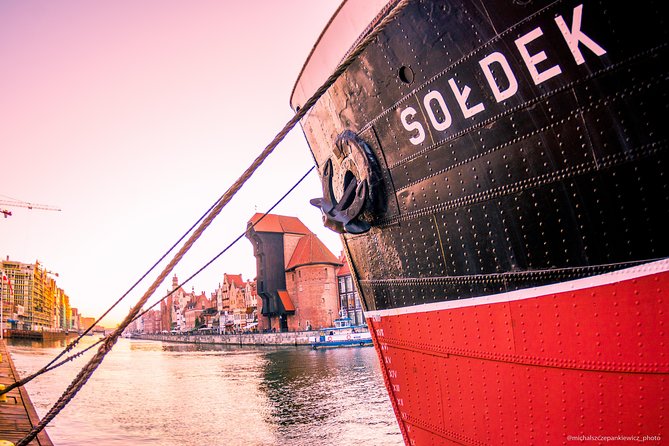
The Crane is one of Gdansk’s best-known symbols, especially when the city’s maritime past comes into view. It was a former port crane, and its location by the water makes the connection between the city and its harbor easy to understand.
The stop lasts about 15 minutes. That should give you time to hear about the crane, take photographs, and begin looking toward the riverfront. The building is particularly useful for visitors who want more than a sequence of churches and façades. It points to the work that made Gdansk an important port.
The information provided describes an exhibition devoted to activities at the former Gdansk port. However, this two-hour walking experience does not specify a museum entrance, so do not count on a full indoor visit during the tour. Think of the Crane as a guide-led landmark stop, with the option to investigate more afterward if time allows.
This part of the route also helps balance the earlier civic architecture. The Golden Gate and Main Town Hall show public ambition. The Crane shows the practical business of moving goods through a port.
The Motlawa embankment and the final view
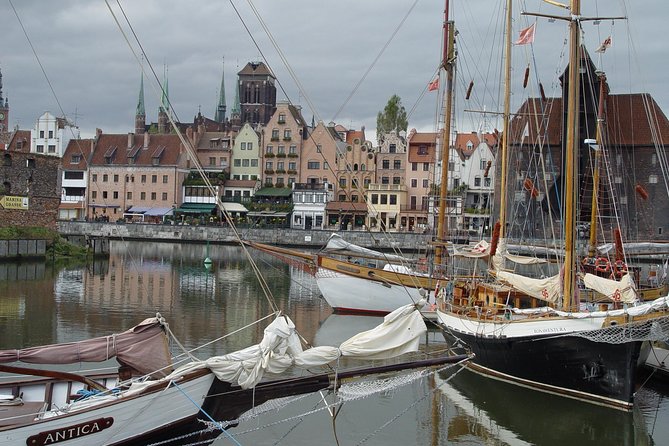
The longest listed stop is the Motlawa River Embankment, or Dlugie Pobrzeze, with about 20 minutes. This was Gdansk’s historic harbor, described as a place where as many as 300 ships moored each day in the seventh century.
The waterfront is where the route’s themes come together. You have seen the royal route, civic buildings, religious architecture, and port machinery. Here, they meet beside the river, giving you a useful picture of how public life and trade were tied together.
I like ending at the water because it gives the walk a natural finish. You can look back toward the Crane and the waterfront façades, then decide which areas deserve a return visit. The tour ends back at the Highland Gate rather than at the embankment, so remember that the experience includes the walk back or a return through the route as arranged by the guide.
The waterfront stop is also a good moment for local tips. The tour advertises advice about Gdansk, and this is where you can ask what to see next, which streets to revisit, or how to use the rest of your day. The information does not promise restaurant recommendations or a specific list of places, so keep the question open and let the guide tailor suggestions to your group.
What the private format is worth
The price is $159.70 for the entire group, with up to 15 people allowed. For a group of 10 or 15, that works out to roughly $16 to $11 per person. For four people, it is about $40 each. For two people, it is close to $80 each, so the value depends heavily on your group size.
The private setup is the main reason to pay more than you might for a shared walk. You are not sharing the guide with strangers, and the tour can be more conversational. If someone in your group wants to ask about Polish history, architecture, amber, port life, or the Solidarity movement, there is less pressure to save every question for the end.
Past guiding has included Martin, Olga Libura, Michael Maj, Agnieszka Syroka, and Basia Lasota. Michael Maj was noted for speaking several languages, including Mandarin, English, Norwegian, and Russian, while Olga Libura was praised for combining history with humor. The assigned guide for your booking is not specified, so you should not assume you will receive one of these particular guides.
The walk can also be adjusted in spirit to your group’s pace. One extended experience with Michael included a coffee break and extra time because the group wanted to continue. That does not mean a break or extension is guaranteed here, but it shows the kind of flexibility a private arrangement may allow. Confirm any changes directly with the operator.
Who should book this Gdansk walk?
I would recommend it to first-time visitors who want a clear map of the historic center without spending half a day figuring out the route. It also fits cruise passengers well, especially those with only a short window in Gdansk. The compact path covers the Golden Gate, Royal Way, St. Mary’s Basilica, Neptune’s Fountain, Main Town Hall, Crane, and waterfront in one outing.
Families and larger groups may find the price appealing because it is charged per group. Children must be accompanied by an adult, and everyone should be ready for moderate walking.
History-minded visitors should benefit most from the guide’s explanations. The tour connects architecture with royal ceremonies, city government, religious life, port work, and Poland’s modern political past. You will get more from it if you ask questions rather than simply follow along with a camera.
I would be less likely to book it if you want long interior visits, detailed museum time, or a slow photographic study of every building. The advertised duration is about two hours, and the eight stops leave limited time at each one. In that case, use this walk as an orientation, then return on your own to St. Mary’s Basilica, the Main Town Hall, or the Crane.
Free cancellation is available if you cancel at least 24 hours before the local start time. Cancellations made later are not refunded, and changes within that period are not accepted.
Should you book the Private Walking Tour of Gdansk Old Town?
Book it if you want a private, English-language introduction to Gdansk’s most important central sights, especially if you are visiting for one day or traveling with a group. The route is efficient, the historic setting does the heavy lifting, and a good guide can turn decorative façades into understandable pieces of the city’s story.
Skip it if you are traveling alone or as a couple and the group price feels too high, or if your main goal is lengthy museum exploration. For most first visits, though, this is a practical way to get your bearings fast and learn where to spend the rest of your time.
FAQ
How long does the Private Walking Tour of Gdansk Old Town last?
The tour lasts approximately two hours.
How much does the tour cost?
The price is $159.70 per group.
How many people can join one private group?
Up to 15 people can participate in the group.
Is the tour offered in English?
Yes. The experience is offered in English.
Where does the tour begin?
The meeting point is the Highland Gate at Wały Jagiellońskie 2A, 80-887 Gdańsk, Poland.
Where does the tour finish?
The activity ends back at the meeting point.
Which main sights are included?
The route includes the Golden Gate, Great Armoury, Royal Way, St. Mary’s Basilica, Neptune’s Fountain, Main Town Hall, Crane, and Motlawa River Embankment.
Are admission tickets included at the stops?
Admission is listed as free for each scheduled stop.
Is the tour suitable for children?
Children must be accompanied by an adult. Participants should have a moderate level of physical fitness.
Can I cancel for a full refund?
Yes, if you cancel at least 24 hours before the experience’s start time. Cancellations or changes made less than 24 hours before the start are not accepted for a refund.
Recently added in Gdansk
- Szymbark: Kashubian Switzerland 5-Hour Private Tour★ 3.7 · 3 reviews
- Segway Tour Gdańsk: Shipyard Tour – 1,5-Hour of Magic!★ 5.0 · 3 reviews
- Stutthof Concentration Camp and Museum of WWII: Private Tour★ 4.7 · 3 reviews
- Sopot Sunset Cruise with Welcome Drink★ 3.5 · 3 reviews
- Gdansk: Basic Bike Tour★ 4.3 · 3 reviews
- Gdansk: Bubble Football with Hotel Transfers★ 5.0 · 3 reviews
- Artus Court and Gdansk Old Town Private Tour with Tickets★ 4.7 · 3 reviews
- Gdansk: Oliwa Zoo with Tickets and Roundtrip Transportation★ 5.0 · 3 reviews
Old Town Tours, compared.




Bike Tour of Old Town, Jewish Quarter and the Ghetto
Read our review →

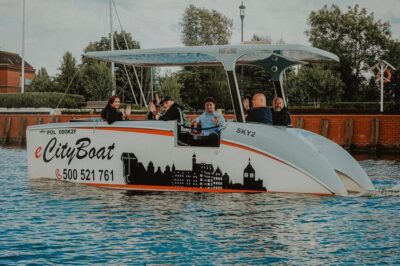
Sightseeing EcoCruise around the Old Town of Gdansk
Read our review →
Where else this one turns up