
Reviewed · HISTORICAL TOURS
Gdansk Guided City Cruise on Historical Polish Boat
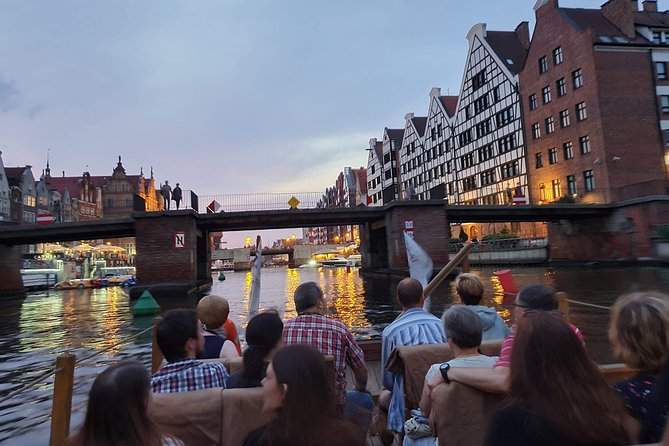
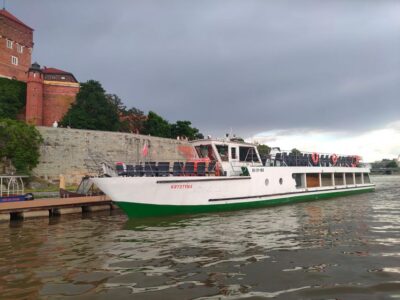
Gdansk makes the most sense from the water. On this small, 12-seat boat, you pass beneath the city’s old water gates, look up at the famous 15th-century Crane, and see the old waterfront from the same river that once carried grain, timber, and other goods. I especially like the way the route joins medieval Gdansk with its shipbuilding past, then loops around Ołowianka and Granary islands.
I also like the live guide commentary, which adds names and stories that are easy to miss on a walk. Guides including Simon and Damian have been praised for clear, funny presentations, and blankets help when the open boat turns chilly. The main drawback is simple: this is an open boat, so wind, rain, fog, or a long wait at a lock can affect the ride.
Key points to know before you book
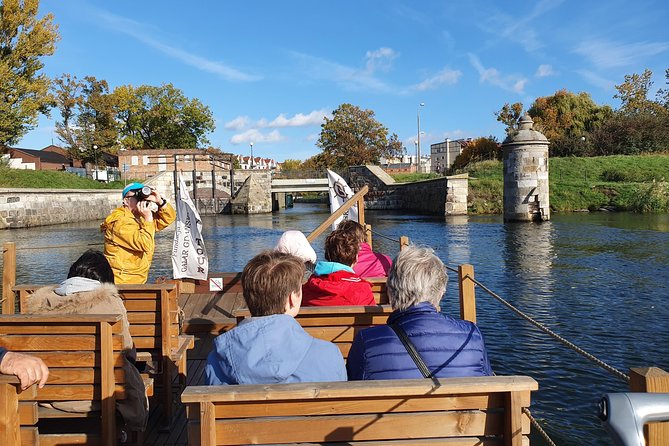
- The boat holds 12 people: This gives the cruise a personal feel and lets it reach narrow waters that larger vessels cannot.
- The route begins near the former Imperial Shipyard: You see working cranes, specialist ships, yachts, and the industrial side of Gdansk before reaching the old town.
- The 70-minute loop covers major waterfront sights: Expect the Motława Embankment, medieval gates, the Crane, Ołowianka Island, and Granary Island.
- Guides make the difference: The strongest part of the experience is the spoken history, often delivered with humor by guides such as Simon or Damian.
- Blankets and umbrellas are available: They help in cool weather, but they cannot turn an open boat into a weatherproof one.
- Allow extra time to find Dokowa 1: The departure point is near the post-shipyard area and can be hard to spot when you walk there.
Why the Motława is the right place to begin
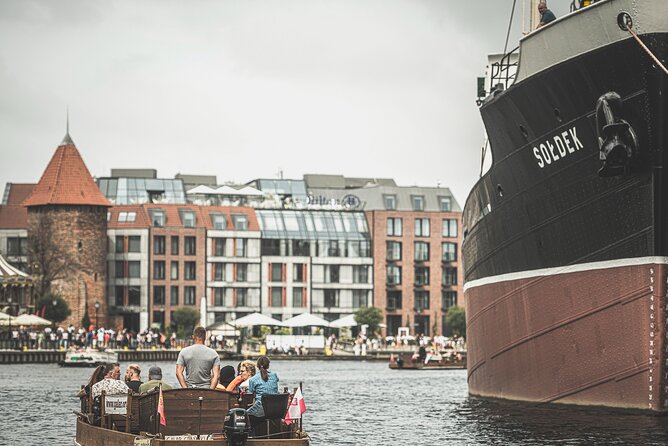
The cruise starts at Dokowa 1, near Gdansk’s former Imperial Shipyard. That location is useful because it gives you more than a polished old-town view right from the start. You first see the working port atmosphere, with cranes, specialist vessels, yachts, and traces of the shipbuilding industry.
This part of the route helps explain why Gdansk grew into such an important port. The city is not only its handsome Main Town facades. Its story also involves shipyards, trade, engineering, and water routes that connected the Baltic with inland Poland.
The former Imperial Shipyard has a particularly notable connection with submarine production. The cruise begins close to the area where u-boats were built, so the first part of the ride has a more industrial character than the postcard views farther along the river.
I like this start because it gives you a quick contrast. You move from working maritime Gdansk toward the old waterfront, where medieval gates and reconstructed granaries line the river. If you only walk the center, you can miss how closely the old city and port remain tied together.
Give yourself plenty of time to reach the dock. The departure point is somewhat out of the way, and the final approach is not always clearly marked. Walking directions can get you close without making the boat itself obvious, so arriving early is sensible.
More Boat Tours in Gdansk
- Gdansk: City Cruise on Historical Polish Boat
★ 4.8 · 2,913 reviews - Gdańsk: Sunset Cruise on a Historic Polish Boat
★ 4.9 · 977 reviews - Gdansk: Guided Round-Trip Cruise to Westerplatte
★ 4.3 · 865 reviews
Along the Motława Embankment and beneath the old gates
Once the boat reaches the long Motława Embankment, the city’s historic center opens up in a different way. From the water, you can see the old facades as a connected waterfront rather than as separate streets and squares.
The guide points out remnants of the Teutonic Castle wall, including the Swan Tower. These remains are easy to overlook from land, where shops, restaurants, and the busy pedestrian flow compete for your attention. From a low boat, the waterline becomes your viewing platform.
The route also passes several water gates. These were not simply decorative entrances. They controlled movement between the river and the city, and they show how Gdansk’s defenses and trade system were tied to the water.
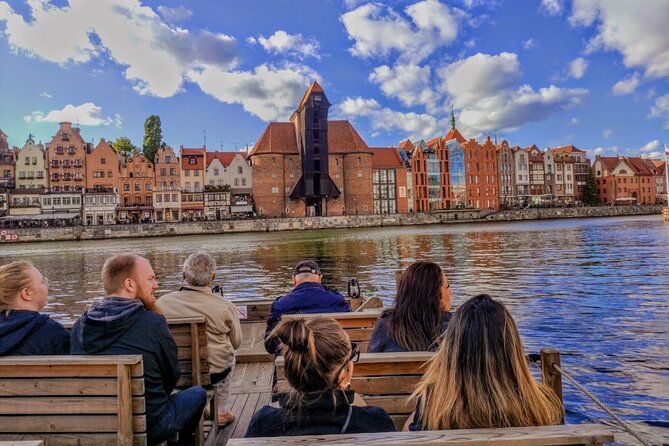
The most famous landmark is the medieval Crane. Its large timber structure and brick towers make it one of Gdansk’s unmistakable sights. From the river, you get the view that best explains its purpose: this was a working port machine positioned directly beside the water, not just an attractive building placed along a promenade.
You will also see St. Mary’s Gate, described as the most beautiful of the gates on this stretch, along with the Green Gate, the oldest gate in the group. The guide’s commentary matters here because the buildings can look similar when you first see them. Names, functions, and small historical details help you sort out what you are looking at.
The boat’s small size is a real advantage along this section. Larger sightseeing vessels can give you a broad view, but this traditional-style craft feels closer to the river and can reach places that taller or wider boats cannot. The tradeoff is less room to move around, so you should not expect a spacious upper deck or a choice of many viewing positions.
Ołowianka Island, where music and maritime history meet
The cruise then works around Ołowianka Island. Its use has changed over time, which makes it a good place for the guide to connect old Gdansk with the modern city.
From the water, you can see the Polish Baltic Philharmonic, the Royal Granary, the National Maritime Museum, and the Stonemason’s Bridge. These sights give the island a different mood from the main old-town waterfront. Instead of a long run of urban facades, you get a mix of cultural buildings, maritime institutions, and historic structures.
The National Maritime Museum is especially fitting from a boat. Even without entering the museum, its position beside the river reinforces the city’s dependence on ships, cargo, navigation, and the Baltic Sea.
Ołowianka also helps make the route feel like a proper circuit rather than a short out-and-back ride. You see the Main City from another angle, then turn around the island and gain fresh views of the buildings you may already have passed.
This is one of the calmest parts of the cruise. The ride is generally smooth, and the 70-minute length gives you enough time to watch the waterfront without turning the outing into an all-day commitment. If you like a gentle orientation ride at the beginning of a city break, this timing works well.
Granary Island and the story behind its name
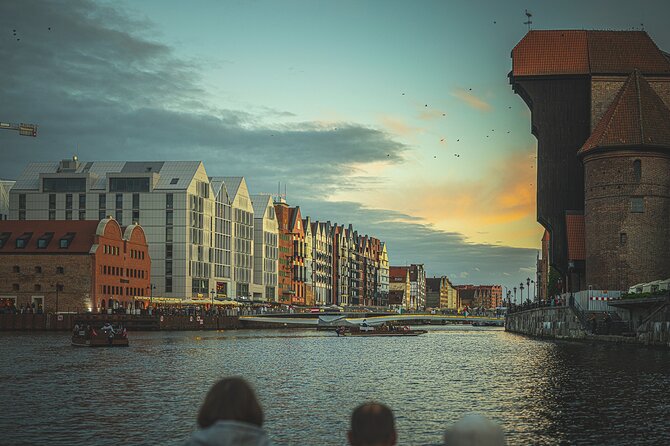
The next major section is Granary Island, reached visually through the Green Bridge. The name tells you what the island was for: it held storehouses where goods were kept before being moved through the port.
The old granaries were badly affected during the Second World War, but parts remain, including the Blue Lamb, one of the best-preserved examples. Alongside those older structures, you see the island’s modern reconstruction.
That mixture is important. Gdansk’s historic center is not an untouched medieval set. Much of what you see today was rebuilt after wartime destruction. From the boat, the contrast between surviving walls, restored buildings, and newer development is especially clear.
The guide can also point out how the island fitted into the city’s trading system. From street level, you may notice attractive buildings. From the water, you can understand why the island existed and how goods moved through the city.
I find this section valuable if you want more than a photo ride. The boat provides the view, but the explanation gives the view a purpose. You are not simply passing a row of old warehouses. You are seeing a former storage and shipping district that has been adapted for modern Gdansk.
More History Tours in Gdansk
- Gdańsk City Sights & History Guided Walking Tour in English
★ 4.8 · 876 reviews - Historic City Center Tour Gdansk in German
★ 4.6 · 455 reviews - Gdansk Legends & Cocktails Tour: Historic Tales and Tasting
★ 5.0 · 11 reviews - Boat Tour in Gdańsk – Explore the Historic Motława River
★ 5.0 · 8 reviews
The guide sets the tone
The boat and route are appealing, but the guide is the part most likely to shape your experience. The strongest presentations combine clear English, local history, and a light touch of humor.
Simon has been singled out for bringing the city’s story to life, while Damian has also led engaging trips. You should not assume you will receive one particular guide, but the available commentary is intended to cover both the city’s past and its present.
Good guiding matters on a short cruise. Seventy minutes does not leave room for a long lecture on every building, so the guide must choose useful details and keep the pace moving. The best moments come when a joke makes you look up, or a short explanation turns an ordinary wall or gate into part of Gdansk’s working history.
English delivery has generally been strong, though one passenger found that the narrator sometimes mumbled. If you are seated farther away or if the wind picks up, hearing every word may be harder. Sit where you can hear the guide clearly, and do not hesitate to ask questions when the boat is stopped or moving slowly.
The tone is informal rather than academic. That suits this experience. You get a lively introduction to the city, not a formal museum talk. If you want a detailed architectural lecture or a specialist maritime history tour, this may feel too light. If you want useful context without spending half a day indoors, it hits a good middle ground.
Weather, seating, and the real comfort level
This is an open boat. That is part of its charm, since you get unobstructed views and a close feel for the river. It also means the weather has a direct effect on comfort.
Blankets are provided for cooler periods, and umbrellas may be available. Those are welcome touches, especially when the wind moves across the water. Still, a blanket will not solve everything on a wet or windy day.
A clear day gives you the best chance of seeing the waterfront details. Fog can make the ride atmospheric, but it may hide parts of the skyline. Rain is the bigger concern because the boat is open, and poor weather can lead to cancellation.
The cruise requires good weather. If the operator cancels because conditions are unsuitable, you can choose another date or receive a full refund. For your own planning, avoid placing this activity at the very end of a short trip if seeing Gdansk from the river is a priority.
One unusual possibility is a delay at a lock gate. A boat can be held for around 20 minutes, depending on river operations. That cuts into the moving time, but it can also become part of the experience as you watch the waterway work rather than simply passing through it.
Seasickness is listed as a consideration. The route is on city waterways rather than open sea, but anyone prone to motion sickness should plan accordingly. Choose a day when you feel well, keep your eyes on the horizon when needed, and remember that the ride is not entirely stationary.
What the $21.92 price gives you
At about $21.92 per person, this is a fair-priced introduction to Gdansk. You get roughly 70 minutes on the water, a guide, a historical-style boat, and views that would be difficult to match from land.
The value comes from combining sightseeing with orientation. A standard walk can show you the Crane, Green Gate, and waterfront buildings up close. This cruise shows you how those sights relate to the river, islands, port, and trade routes.
The price also makes sense if you have only one or two days in Gdansk. You can cover the main waterfront in just over an hour, then return to the city center and explore the buildings you found most interesting on foot.
Do not book it expecting luxury. The boat is small, open, and practical. You are paying for access, scale, and commentary, not a restaurant, enclosed cabin, or long-distance excursion.
The experience has a 4.6 rating from 230 reviews, with 90 percent recommended. Those numbers fit the main strengths: the unusual boat, the guide-led storytelling, the smooth ride, and the city views. The main complaints are practical ones, especially unclear directions to the dock, occasional mumbling, and poor conditions in wet or windy weather.
Who will get the most from this cruise
I would recommend this for first-time visitors who want to get their bearings quickly. The route covers the old waterfront, the shipyard area, two islands, gates, granaries, and maritime landmarks without requiring a full day of walking.
It also suits repeat visitors. A second visit to Gdansk can feel fresh from the river, especially when the guide points out details you passed without noticing on your first trip.
Families and small groups should find the format appealing. The ride is short enough for children who may not manage a long walking tour, and the boat’s intimate size keeps the experience focused. Service animals are allowed, and most people can participate.
I would be more cautious if you dislike open boats, have strong seasickness, or need guaranteed shelter from rain. You should also reconsider it if you need a fully private tour, since the experience can have up to 48 people in total, even though the boat described for the ride has 12 seats.
The departure point is near public transportation, but you still need to plan the final walk. This is not a dock you should rush toward five minutes before departure.
Should you book the Gdansk historical boat cruise?
Book it if you want a short, good-value introduction to Gdansk’s waterfront and enjoy hearing local stories while moving through the city. The strongest reason to choose it is the combination of a small historical-style boat and guides who make the information fun, with Simon and Damian among the names associated with especially strong presentations.
Skip it if you need an enclosed cabin, dislike weather-dependent plans, or want a full architectural tour on land. For most people with a free hour and decent weather, though, the boat offers something a walking tour cannot: the chance to see why Gdansk grew where it did, with the river itself explaining the city.
FAQ
How long is the Gdansk boat cruise?
The cruise lasts approximately 1 hour and 10 minutes. It begins and ends at the meeting point near Dokowa 1.
Where does the cruise start?
The meeting point is Dokowa 1, 80-863 Gdańsk, Poland, in the post-shipyard area near the former Imperial Shipyard.
What sights will I see from the boat?
The route includes the former shipyard area, the Motława Embankment, the remains of the Teutonic Castle wall, the Swan Tower, several water gates, the 15th-century Crane, St. Mary’s Gate, the Green Gate, Ołowianka Island, and Granary Island.
Is the boat covered?
The boat is open. Blankets are provided during cooler periods, and umbrellas may be available, but the experience can be less comfortable in rain or strong wind.
How many people can join the experience?
The boat is described as a historical 12-seater. The activity itself has a maximum capacity of 48 participants.
Can I cancel for a refund?
You can cancel at least 24 hours before the local start time for a full refund. Cancellations or changes made within 24 hours are not refunded or accepted. If poor weather causes the operator to cancel, you can receive a full refund or choose another date.
Recently added in Gdansk
- Szymbark: Kashubian Switzerland 5-Hour Private Tour★ 3.7 · 3 reviews
- Segway Tour Gdańsk: Shipyard Tour – 1,5-Hour of Magic!★ 5.0 · 3 reviews
- Stutthof Concentration Camp and Museum of WWII: Private Tour★ 4.7 · 3 reviews
- Sopot Sunset Cruise with Welcome Drink★ 3.5 · 3 reviews
- Gdansk: Basic Bike Tour★ 4.3 · 3 reviews
- Gdansk: Bubble Football with Hotel Transfers★ 5.0 · 3 reviews
- Artus Court and Gdansk Old Town Private Tour with Tickets★ 4.7 · 3 reviews
- Gdansk: Oliwa Zoo with Tickets and Roundtrip Transportation★ 5.0 · 3 reviews
Historical Tours, compared.

POLIN Museum of the History of Polish Jews Ticket
Read our review →

Gdańsk City Sights & History Guided Walking Tour in English
Read our review →

Small-Group Historical Guided Tour of Warsaw with pick up/drop off. Public Tour.
Read our review →Where else this one turns up