Reviewed · KRAKOW TOURS
Krakow Jewish District and Ghetto Guided Tour in a Small Group
Krakow’s Jewish story becomes easier to follow when you walk it in sequence, from Szeroka Street in Kazimierz to the former ghetto across the river. This small-group tour connects synagogues, meeting places, memorials, and a surviving wall fragment in about two hours.
I like the 10-person limit, which should make it easier to hear the guide and ask questions. I also like the route’s range: you see both the older Jewish quarter and the wartime ghetto, rather than focusing on only one part of Krakow’s past.
The main consideration is pace. With many stops packed into two hours, several synagogues are viewed only from outside, and the tour does not include entry tickets. At $60.21 per person, you are paying mainly for explanation, structure, and a small group.
Key points at a glance
- Szeroka Street begins the story in the oldest part of Krakow’s Jewish quarter.
- Five historic synagogues appear along the route, though the listed visit is outside only.
- Jan Karski’s statue adds a personal wartime perspective to the walk.
- Plac Nowy and the Jewish Community Center show that Kazimierz is more than a collection of monuments.
- The Eagle Pharmacy and Plac Bohaterow Getta shift the focus to life in the Krakow ghetto.
- The group is capped at 10 people, with mobile tickets and English-language guiding.
From Szeroka Street into Kazimierz
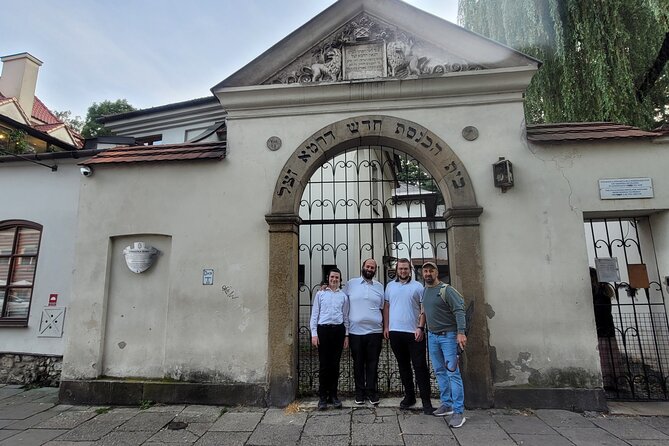
The tour begins at Szeroka 6, in the heart of Kazimierz, Krakow’s historic Jewish quarter. Szeroka Street is described as the oldest part of the district, making it a useful place to begin because the setting itself gives you immediate context before the guide starts linking individual buildings to the wider story.
You spend about 10 minutes here. That is not long, so expect an introduction rather than a detailed architectural study. I would use this opening to get your bearings, listen for the guide’s outline of the neighborhood, and note the meeting point in case you want to return later on your own.
The route then moves through several synagogues. The Remuh Synagogue, dating from the 16th century, receives about 15 minutes from the outside. The Old Synagogue follows for about 10 minutes, also from outside. These short stops are useful for understanding how concentrated religious and community life once was in this part of town.
The tour also includes the 16th-century Wolf Popper Synagogue, with about five minutes allocated to it. The supplied details do not promise interior access, so you should plan on exterior viewing throughout this part of the walk. That matters if you are hoping to see religious objects, painted interiors, or museum displays. This experience is primarily a guided street tour.
A few more Krakow half days to consider
- From Krakow: Auschwitz-Birkenau Guided Tour & Hotel Pickup
★ 4.5 · 33,358 reviews - From Krakow: Auschwitz-Birkenau Guided Tour & Hotel Pickup
★ 4.5 · 29,340 reviews - Krakow: Auschwitz Guided Tour with Optional Hotel Pickup
★ 4.5 · 15,280 reviews
Historic synagogues, seen at a walking pace
Several more buildings appear as the route continues: a 19th-century synagogue, the High Synagogue, and the 17th-century Izzak Synagogue. The listed times range from five to 10 minutes. Taken together, these stops give you a broad look at the district’s religious architecture without asking you to spend a full afternoon inside one building.
I like this approach for a first visit. You get a map of the quarter and a sense of how the buildings relate to one another. You can then decide which places deserve a return visit, perhaps with more time for interior details.
The limitation is clear: exterior stops depend heavily on the guide’s commentary. Without a guide, a synagogue façade can be easy to pass without understanding its age or role. With a guide, the same building becomes part of a connected story. Since the tour is in English, it suits you if you want historical explanation while walking rather than reading signs on your own.
The group limit of 10 is especially useful here. Narrow streets, busy public spaces, and several brief stops can make a large group awkward. A capped group should help you remain close to the guide and hear the explanation before the walk moves on.
Plac Nowy and the living side of Kazimierz
The route reaches Plac Nowy, described as a former center of trade for Krakow’s Jewish community. The stop lasts about 10 minutes. This is an important change of focus, since the tour is not only about worship and persecution. Trade and daily community life also shaped the district.
You will want to listen for how the guide connects this market square to the surrounding quarter. The value here is not a ticketed sight. It is the setting and the explanation of how people used the space in earlier centuries.
The tour also stops at JCC Krakow, the Krakow Jewish Community Center, for about five minutes. That stop brings the story into the present day. It reminds you that Jewish life in Krakow is not only a subject found in memorials and historic buildings.
Because the tour covers both historic and current community locations, it offers a wider view than a walk limited to wartime sites. Still, the short stop means you should not expect an extended visit or a program inside the center. The details provided include the location as a stop, not an admission or activity there.
Jan Karski and the moral weight of the route
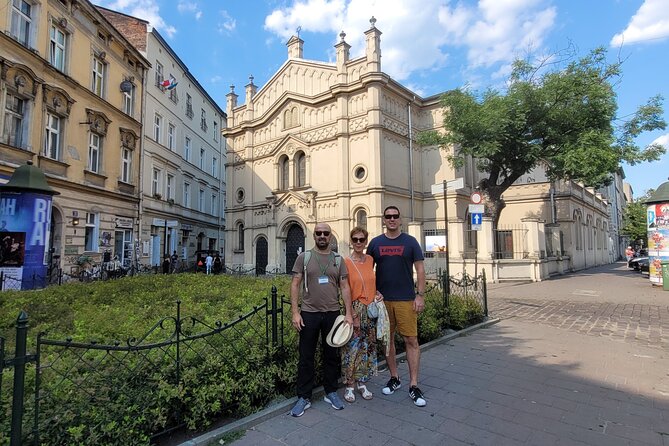
The statue of Jan Karski, described as the man who tried to stop the Holocaust, receives about five minutes. This is one of the route’s most meaningful points because it places a named individual within a much larger and painful history.
Five minutes is brief, but a guide can use the statue to explain who Karski was and why he is remembered. I find named memorials helpful on a historical walk because they give you something specific to focus on instead of leaving the subject at the level of dates and general events.
The experience does not appear to include an indoor museum session or a long lecture. If you want extensive documentation, photographs, or exhibits, you should allow time for a separate museum visit. The walking tour works better as an organized introduction and geographic framework.
The route’s high rating, 5 out of 5 from 12 ratings, and its 100 percent recommendation figure suggest strong satisfaction so far. The sample feedback also emphasizes the need to book ahead for a popular museum with lines around the block. That advice applies to planning your day: do not assume this outdoor walk replaces the time needed for Krakow’s major museums.
A different kind of day in Krakow:
- Krakow–Zakopane: Cable Car, Chocholow Baths, Cheese & Vodka
★ 5.0 · 10,720 reviews - Krakow: Auschwitz-Birkenau Guided Tour with Pickup & Lunch
★ 4.5 · 9,800 reviews - From Krakow: Wieliczka Salt Mine Tour
★ 4.6 · 9,393 reviews - Krakow: Auschwitz-Birkenau Guided Tour Pickup/Lunch Options
★ 4.5 · 9,057 reviews
Crossing from Kazimierz to the Krakow ghetto
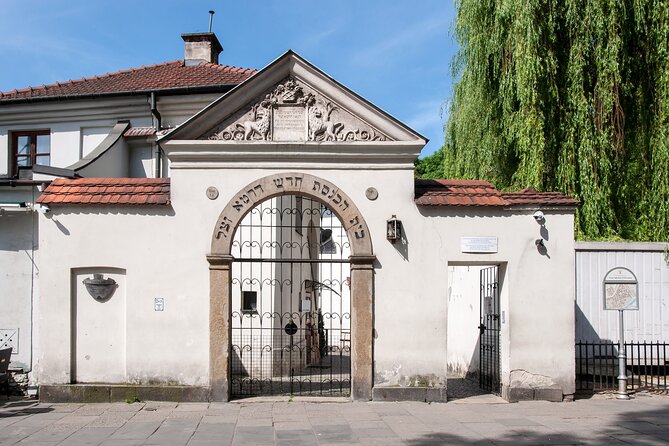
The tour then shifts from the Jewish quarter to the former Krakow ghetto. The Eagle Pharmacy is viewed from outside for about 10 minutes. Its place on the route signals the change from community life in Kazimierz to the wartime history of the ghetto.
This is where the guide’s role becomes especially important. A pharmacy building may not explain its own historical importance to you. The stop is designed to attach the site to the people and events connected with the ghetto, rather than treating it as another façade on a walking route.
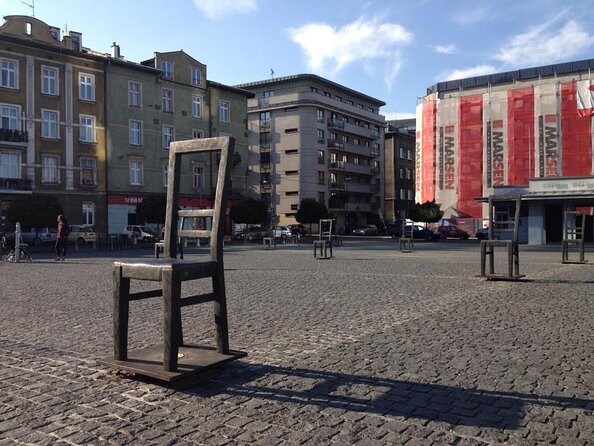
The final main stop is Plac Bohaterow Getta, the Square of Ghetto Heroes, for about 10 minutes. The square is identified as the main place of the Krakow ghetto. The tour ends here, at Plac Bohaterow Getta, 30-527 Kraków.
Ending at this square gives the walk a clear emotional and geographic conclusion. You begin among synagogues and market spaces, then finish at a place tied directly to deportation and wartime loss. That sequence makes the two-hour route feel purposeful instead of like a collection of unrelated addresses.
You should be prepared for a serious subject. This is not a light sightseeing stroll, and the itinerary includes places connected with the Holocaust. The supplied details do not describe the guide’s exact tone or level of historical detail, so you may want to ask questions if you need more context at a particular stop.
The remaining ghetto wall fragment
The last listed stop is a fragment of the Krakow ghetto wall, with about five minutes allotted. The surviving section gives you a physical reminder of the boundaries imposed on the ghetto.
As with the other exterior stops, the value comes from combining the object with the guide’s explanation. On its own, a short wall fragment can be easy to overlook. In the sequence of this tour, it follows the pharmacy and the main square, so it helps complete the picture of how the ghetto was physically marked.
The route ends at Plac Bohaterow Getta rather than returning to Szeroka Street. That is convenient if you plan to continue exploring the ghetto area, but you need to arrange your own way back to Kazimierz or elsewhere in Krakow. The meeting and ending points are different, so check your plans before booking another activity immediately afterward.
What $60.21 buys you
At $60.21 per person, this is not the cheapest way to walk between Krakow’s Jewish quarter and former ghetto. The price is easier to justify if you value a fixed route, English commentary, and a group no larger than 10.
You are not paying for attraction admissions. The inclusions list only the guide service and the small-group format. Gratuities are optional, and there is no mention of food, transport, or entry tickets.
I would compare the cost with your own priorities. If you enjoy reading plaques and planning historic walks yourself, you may find the price high for a two-hour outdoor route. If you want someone to organize the sequence and explain why each place matters, the fee buys convenience and context.
The format also saves you from navigating between Kazimierz and the ghetto on your own. The route includes many stops, and a guide can keep the walk moving while giving each location a purpose. That is particularly useful if your time in Krakow is limited.
Timing, group size, and practical planning
The tour lasts about two hours. Since the route lists more than a dozen points, the schedule is brisk. You will spend roughly five to 15 minutes at individual locations, with walking time between them.
Wear comfortable shoes and expect a walking-focused experience. The supplied information does not give a distance, so I would not plan around an exact mileage figure. Near public transportation, the start and end points are both in accessible city areas, but transport is not included in the tour.
A mobile ticket is provided, and confirmation arrives at booking. The experience is offered in English. Most people can participate, but the information does not give specific details about wheelchair access, seating, restrooms, or the surface of every street. If you have mobility concerns, contact the provider before booking.
The provider is Krzysztof Blaszczyk Hussar Travel. No individual guide’s name is supplied, so you should not book expecting a particular named guide. The small group is the clearest service feature: the maximum is 10 people.
The tour is booked, on average, 33 days ahead. That does not guarantee that every date sells out, but it is a useful planning signal. If your Krakow dates are fixed, booking early makes sense, especially because the group is intentionally small.
Who will get the most from this walk
I would choose this tour if you are visiting Krakow for the first time and want a guided introduction to Kazimierz and the ghetto in one compact outing. It suits you if you prefer historical context while standing at the actual sites, rather than a long indoor presentation.
It is also a good fit if you want to ask questions. A group of 10 is small enough to feel more personal than a large city walk, though the actual experience will still depend on the guide assigned that day.
You may want something else if you need interior synagogue access, museum admission, or a slower photography stop. The route gives most sites only a few minutes and lists the synagogues from outside. For a fuller study, pair this walk with separate museum and synagogue visits.
I would also think carefully about the emotional content. The route includes the Jan Karski statue, the Eagle Pharmacy, Plac Bohaterow Getta, and the ghetto wall. It is valuable, but it asks you to give the subject your full attention.
Should you book it?
Book this tour if you want a short, structured introduction to Krakow’s Jewish quarter and former ghetto, with an English-speaking guide and no more than 10 people. The route covers an impressive number of significant places in about two hours, and the start-to-finish movement gives the history a clear shape.
Skip it if your priority is entering historic buildings or spending an hour at each site. At $60.21, the value lies in the guide and the organization, not included admissions. For most first-time visitors with limited time, that trade can make sense. For repeat visitors or independent walkers, a self-guided route may offer better value.
FAQ
How long does the tour last?
The tour lasts approximately two hours.
How much does the tour cost?
The listed price is $60.21 per person.
What language is the tour offered in?
The tour is offered in English.
How many people can join the group?
The group has a maximum of 10 people.
Where does the tour begin?
The meeting point is Szeroka 6, 31-053 Kraków, Poland.
Where does the tour end?
The tour ends at Square of Ghetto Heroes, Plac Bohaterów Getta, 30-527 Kraków, Poland.
Are synagogue admission tickets included?
No. The included service is the tour guide service in a small group. The synagogue stops are listed as outside visits.
Is transportation included?
No transportation is listed as included. The tour starts and ends near public transportation.
Are gratuities included?
Gratuities are optional and are not included in the listed tour inclusions.
Can I cancel for a full refund?
Yes, if you cancel at least 24 hours before the experience start time. Cancellations made less than 24 hours before the start time are not refunded, and changes within that period are not accepted.
Recently added in Krakow
- Auschwitz-Birkenau and Krakow Private Car Trip from Katowice★ 4.3 · 3 reviews
- Wawel Castle, Old Town with St. Mary’s Church Guided Tour★ 5.0 · 3 reviews
- From Krakow: Chocholow Thermal Hot Springs (hotel pick up)★ 5.0 · 3 reviews
- Private tour to Zakopane and Thermal Baths from Krakow★ 5.0 · 3 reviews
- Wawel Castle, Cathedral, Rynek Underground Tour with Lunch★ 5.0 · 3 reviews
- Legends of Cracow ROBOTIC SHOW★ 4.0 · 3 reviews
- From Krakow: Zakopane and Thermal Pools Guided Trip★ 5.0 · 3 reviews
- Guided Beer Tour in Krakow★ 4.5 · 3 reviews
Krakow Tours, compared.
Auschwitz-Birkenau Guided Tour & Hotel Pickup
Read our review →Auschwitz Guided Tour with Optional Hotel Pickup
Read our review →
Zakopane: Cable Car, Chocholow Baths, Cheese & Vodka
Read our review →
Auschwitz-Birkenau Guided Tour with Pickup & Lunch
Read our review →
Krakow to Auschwitz Birkenau Guided Tour with Transfer and Ticket
Read our review →
Wieliczka Salt Mine Guided Tour with Transport
Read our review →