
Reviewed · JEWISH QUARTER & KAZIMIERZ TOURS
The Jewish Quarter – Walking Tour
Krakow’s Kazimierz is far more than a pretty district lined with cafes. It was once a place where Jewish and Christian communities lived side by side, and this two-hour walk follows that shared past through synagogues, old streets, memorials, and World War II sites. The most striking point is how much of Jewish life in Poland is tied to this small part of the city.
I like the way the tour connects Jewish and Christian history instead of treating Kazimierz as a single-theme attraction. I also like the focus on real places, including the Remuh Synagogue, the old cemetery, Helena Rubinstein’s birthplace, and several Schindler’s List filming locations. The main consideration is that admission tickets and public transportation are not included, so the $33 price covers the guide and walking experience rather than every entrance.
- A two-hour walk through Kazimierz: The route covers the district’s main square, historic streets, synagogues, cemeteries, and memorials.
- Jewish life before and during World War II: You get a broad account of settlement, coexistence, persecution, and the changes that reshaped Poland.
- Several Schindler’s List locations: The tour places the film’s scenes within the actual streets and buildings of Kazimierz.
- Licensed English-speaking guides: ZeeTour provides guiding services with a live guide in English.
- Important buildings from the 1400s to the 1900s: The route includes a medieval building, a 16th-century mikveh, synagogues, and modern memorials.
- A flexible, accessible introduction: The tour is wheelchair accessible, offers free cancellation up to 24 hours ahead, and allows you to reserve without paying at once.
Why Kazimierz tells Krakow’s larger story
The useful thing about this walk is that it does not reduce Jewish Krakow to wartime tragedy. You begin with the longer story: why Jewish communities settled in Poland, how Jewish life developed, and how Kazimierz became a place of contact between Jewish and Christian residents.
That wider frame matters. If you visit only memorials and World War II sites, you can leave with an incomplete picture. Jewish life in Poland existed for centuries before the Holocaust, with religious institutions, businesses, families, scholarship, and neighborhood traditions. The guide’s job is to put those layers in the right order.
The tour also points out that Poland once held a very large share of the world’s Jewish population. The stated figure is especially striking: in the 16th century, around 75 percent of the world’s Jewish population lived in Poland. That fact gives Kazimierz importance far beyond Krakow. You are walking through one district, but the subject reaches across European Jewish history.
Starting at Kazimierz’s Main Square
The walk begins around Kazimierz’s Main Square, a practical place to get your bearings. From here, the district’s layout helps explain how religious, residential, and commercial life fit together.
You can expect the opening section to establish the relationship between Kazimierz and Krakow. Kazimierz was historically a separate city, and its identity developed alongside Krakow. The tour then moves toward Miodowa Street, where you can see remnants connected with the former city walls of Kazimierz.
This early section is valuable because it turns streets into evidence. Rather than simply hearing dates, you begin to understand that the neighborhood’s boundaries and buildings shaped daily life. Miodowa Street also provides a useful transition from the city’s physical structure to its religious institutions.
More Walking Tours in Krakow
- Old Town Krakow & Wawel Castle Walking Tour
★ 5.0 · 1,508 reviews - Creepy Krakow: 2-Hour City Walking Tour
★ 4.7 · 1,131 reviews - Krakow: The Old Town Walking Tour
★ 4.8 · 794 reviews
Tempel, Kupa, and Izaak’s synagogues
The route includes the Tempel Synagogue, the Kupa Synagogue, and Izaak’s Synagogue. Even when you are not entering each building, seeing them in sequence helps you compare the religious and architectural life of the district.
The Tempel Synagogue is part of the story of changing Jewish communities and religious practice. Kupa Synagogue adds another layer to the neighborhood’s institutional life, while Izaak’s Synagogue connects the district with prominent individuals and older traditions.
You should pay attention to the guide’s explanation of what each building represents rather than treating the synagogues as a quick photo stop. Their names, locations, and continued presence show that Kazimierz was not a symbolic quarter created for modern tourism. It was a working community with multiple congregations and distinct religious identities.
The practical limitation is simple: admission tickets are not included. The tour information does not promise entry into every synagogue, so you should regard the walk as a guided introduction to the sites. If a particular interior matters to you, ask the guide about current access and any separate ticket before the tour begins.
The oldest building and the 16th-century mikveh
One stop is described as the oldest building inside the Jewish Quarter, dating from the 1400s. That gives the walk a useful physical anchor. You are not dealing only with reconstructed or modernized streets. At least some of the district’s story reaches back to the late medieval period.
The route also includes a mikveh, a ritual cleansing bathhouse for women from the 16th century. This is one of the more unusual stops because it helps explain religious practice in concrete terms. A mikveh is not simply another old building. Its purpose reveals how faith shaped domestic routines, community rules, and the organization of Jewish life.
I find stops like this more useful than a long run of facades because they answer a basic question: how did people actually live? A synagogue tells you where communal worship happened. A mikveh points to private and family religious practice. Together, they make the neighborhood easier to picture.
Szeroka Street and the people behind the names
Szeroka Street is one of the central addresses on the route. Here, the tour continues the connection between place and person, including the birthplace of Helena Rubinstein.
Rubinstein’s birthplace offers a reminder that Kazimierz produced people whose lives reached far beyond Krakow. Her name is now linked with an international cosmetics company, but the point of the stop is her origin in this Jewish district. It brings an individual story into a walk that could otherwise become too focused on institutions and dates.
The tour also visits a monument connected with the Nissenbaum Family Foundation. This introduces the effort to preserve and mark Jewish sites in Poland. Memorials are not just decoration. They show how later generations have tried to remember places and people after war, destruction, and decades of political change.
At this point, you may notice a recurring pattern: the route keeps moving between the old and the modern. Medieval buildings, religious sites, family names, memorials, and film locations all occupy the same streets. That layering is one of the strongest reasons to take the walk with a guide.
Other Jewish Quarter and Kazimierz walks:
- Krakow: Jewish Quarter and Former Ghetto Tour
★ 4.9 · 1,441 reviews - Krakow: Bike Tour of Old Town, Jewish Quarter and the Ghetto
★ 4.9 · 1,155 reviews - Krakow: Kazimierz Jewish Quarter Walking Tour
★ 4.8 · 571 reviews - Krakow: Kazimierz, Schindler’s Factory & Ghetto Guided Tour
★ 4.8 · 460 reviews
A statue honoring resistance during the Holocaust
The itinerary includes a statue of a man who tried to stop the Holocaust. This is an emotionally serious part of the walk, and it deserves more than a quick photograph.
The exact meaning of such a memorial depends on the story the guide provides. You should listen for the person’s actions, the danger involved, and the limits of what one individual could do during the Nazi persecution. The broader lesson is that Holocaust history includes victims, perpetrators, bystanders, rescuers, and people who resisted. A good explanation should help you distinguish those roles instead of flattening them into a single wartime story.
This stop also gives the World War II section a human scale. The tour does not treat the war only as a sequence of dates. It links events to people and places in the neighborhood.
Remuh Synagogue and the Jewish Cemetery
The Remuh Synagogue and Jewish Cemetery are among the key stops in Kazimierz. Together, they offer one of the clearest links between religious life and burial traditions.
A cemetery can explain a community in a way that a street sign cannot. Names, stones, family connections, and the age of graves all point to generations that lived here before the war. The Remuh site also helps you understand why Kazimierz remains central to Jewish memory in Krakow.
You should be prepared for a quieter, more reflective part of the walk. The cemetery is not simply another attraction to rush through. Give yourself time to look carefully and listen. If you want to return later for a longer visit, this tour can serve as a first orientation, showing you where the site fits within the wider district.
The route also includes Popper’s Synagogue and the Old Synagogue. These stops broaden the picture again. Instead of seeing one famous building and assuming it represents all of Kazimierz, you encounter several institutions with different histories and roles.
From Popper’s Synagogue to the Old Synagogue
The Old Synagogue is one of the most important historical buildings on the route. Its presence helps explain the age and scale of Jewish communal life in Krakow.
Popper’s Synagogue adds another point of comparison. The value here is not just collecting names. It is seeing how a district supported several religious buildings within a compact area. That density tells you something about the size, organization, and permanence of the Jewish community.
For a two-hour tour, this is an ambitious number of stops. You will not receive a full lecture on every building. Instead, the guide has to choose the most useful facts and link them into a clear story. That format suits you if you want a strong introduction before deciding which sites deserve a longer independent visit.
It may feel fast if you want to inspect every facade or photograph each detail. The route is designed as a walking overview, not a museum visit. Wear comfortable shoes and expect to keep moving.
Finding Schindler’s List on the actual streets
The film locations are a major draw, but they work best when treated as part of the history rather than as the whole reason for the tour. The walk includes numerous places used in Schindler’s List, linking recognizable screen images with the real streets of Kazimierz.
That connection can help you visualize the past. Film sets and historical locations are not identical, and the movie is a dramatization, but standing in the actual district gives the story a stronger sense of place. You can also see how modern Krakow exists alongside reminders of wartime destruction and survival.
If you have watched the film recently, these stops will likely be especially useful. If you have not, you can still follow the tour because the main subject is the history of Jewish Krakow and World War II. The film references add context and recognition, but they do not replace the historical explanation.
What the World War II section adds
The World War II material is woven through the district rather than saved for one final stop. That is the right approach. The Holocaust changed the population, buildings, families, and memory of Kazimierz so completely that wartime history cannot be separated from the streets themselves.
The tour helps you understand what existed before the war and what was lost during it. That contrast is crucial. Without the prewar background, the Holocaust can seem like an isolated event. With it, you begin to grasp the scale of the destruction: not only lives, but homes, religious communities, family networks, and an entire way of life.
The guide is licensed, and the experience is offered in English. Recent feedback singled out guide Z, also referred to as Zee, for going beyond the planned route and showing more than expected. That suggests you should feel comfortable asking questions, particularly if you want more detail on wartime events, Jewish-Christian relations, or the film locations.
Is $33 a fair price for two hours?
At $33 per person, this is not the cheapest way to stroll through Kazimierz, since you can walk the streets on your own for free. The value comes from the organization and explanation: one guide connects buildings, religious practice, Polish history, World War II, memorials, and cinema into a single route.
I consider that fair if you are new to Krakow or want a clear starting point. The tour covers many sites in two hours, and a guide can help you avoid seeing the district as a collection of attractive buildings with disconnected labels.
The price is less appealing if you already know Jewish Krakow well or plan to spend hours inside museums and synagogues. Since entrance fees and public transportation are separate, budget extra if you want to visit interiors afterward. Still, the walk can save time by showing you what deserves a closer look.
The strongest value is educational, not luxurious. You are paying for a licensed guide and a thoughtfully connected route, not for transportation, meals, or included admissions.
Who should book this walk?
I would recommend it to first-time visitors who want historical footing before exploring Kazimierz alone. It also suits anyone interested in Jewish history, World War II, Polish cultural change, or the locations used in Schindler’s List.
Couples and small family groups can use it as a gentle introduction to difficult material. The tour is also wheelchair accessible, which makes it a practical option for many visitors, though the information provided does not describe the exact street surfaces or building entrances.
You may want a different format if you prefer a slow museum visit, a food tour, or a highly specialized academic lecture. Two hours allows for a lot, but not every stop can receive equal attention. Think of this as a guided framework for the district, with clear leads for further exploration.
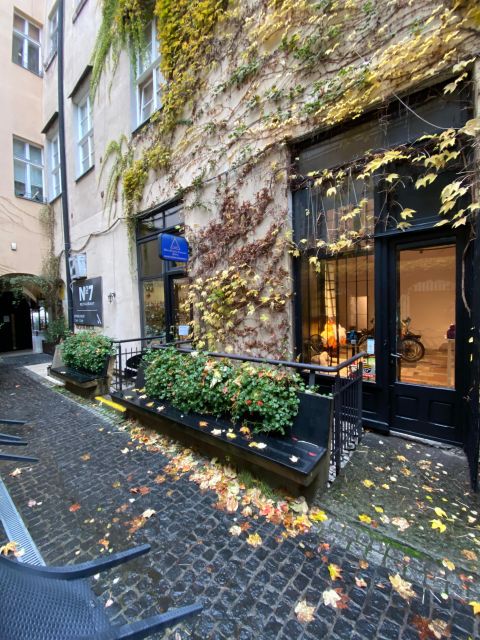
The meeting point is at Restaurant No7. Enter the building and look for ZeeTour’s office in the courtyard, the second shop on the left. Allow a little time to find it, since the office is not simply on the main street frontage.
Should you book The Jewish Quarter Walking Tour?
Book it if you want the main story of Kazimierz explained by a licensed English-speaking guide, especially if the district is new to you. The combination of synagogues, the cemetery, the mikveh, memorials, Jewish-Christian history, World War II, and Schindler’s List locations gives you a solid two-hour introduction.
Skip it if you want every synagogue admission included or prefer to explore at your own pace. For most visitors, though, $33 is a reasonable price for turning a complicated district into a story you can follow. The tour is particularly useful at the start of a Krakow stay, when it can help you decide where to return and what deserves more time.
FAQ
How long does The Jewish Quarter Walking Tour last?
The tour lasts two hours.
How much does the tour cost?
The listed price is $33 per person.
What language is the tour offered in?
The tour is offered in English with a live English-speaking guide.
Are licensed guides provided?
Yes. ZeeTour provides guiding services with licensed guides.
Are admission tickets included?
No. Admission tickets are not included in the tour price.
Is public transportation included?
No. Public transportation is not included.
Where is the meeting point?
Meet at Restaurant No7. Enter the building and find ZeeTour’s office in the courtyard, the second shop on the left.
Can I cancel the tour for a full refund?
Yes. You can cancel up to 24 hours in advance for a full refund.
Recently added in Krakow
- Auschwitz-Birkenau and Krakow Private Car Trip from Katowice★ 4.3 · 3 reviews
- Wawel Castle, Old Town with St. Mary’s Church Guided Tour★ 5.0 · 3 reviews
- Wawel Castle, Cathedral, Rynek Underground Tour with Lunch★ 5.0 · 3 reviews
- From Krakow: Chocholow Thermal Hot Springs (hotel pick up)★ 5.0 · 3 reviews
- Private tour to Zakopane and Thermal Baths from Krakow★ 5.0 · 3 reviews
- Legends of Cracow ROBOTIC SHOW★ 4.0 · 3 reviews
- From Krakow: Zakopane and Thermal Pools Guided Trip★ 5.0 · 3 reviews
- Guided Beer Tour in Krakow★ 4.5 · 3 reviews
Jewish Quarter & Kazimierz Tours, compared.

Bike Tour of Old Town, Jewish Quarter and the Ghetto
Read our review →
Kazimierz, Schindler’s Factory & Ghetto Guided Tour
Read our review →
Bike Tour of the Old Town, Kazimierz, and the Ghetto
Read our review →

Jewish Quarter and Ghetto Electric Golf Cart Tour
Read our review →
Where else this one turns up