
Reviewed · GOLF CART & SEGWAY TOURS
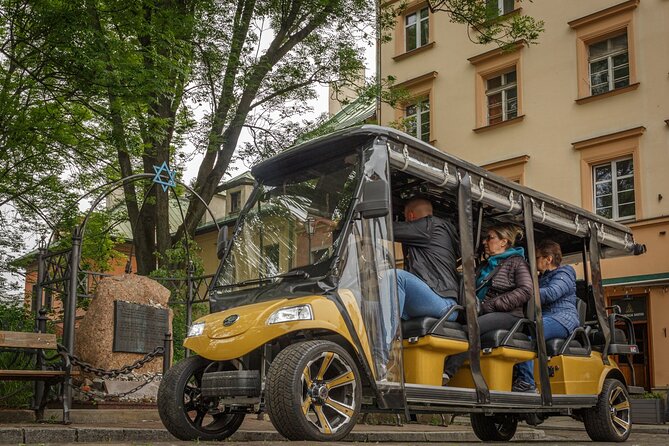
Krakow: City Sightseeing Tour Eco Electric Buggy Golf Cart
Krakow’s electric buggy tour is at its best in Kazimierz and Podgórze, where a short ride connects Jewish heritage sites, wartime landmarks, churches, and quiet squares that would take much longer to cover on foot. In about 90 minutes, you get a useful first look at two districts with very different stories.
I like the wide-ranging route and the chance to rest your legs while still seeing a large part of the city. I also like the mix of live guiding and recorded narration, plus the warm buggies, blankets, and time for photos at selected stops.
The main catch is that this is an outside view tour, not a museum visit. You pass Schindler’s Factory but do not tour it, and the ride can feel cramped or bumpy when the buggy is full. Book it early in your stay, preferably in daylight.
Key points to know before booking
- About 24 sights in 90 minutes: The route covers Kazimierz, Podgórze, synagogues, churches, squares, and ghetto landmarks.
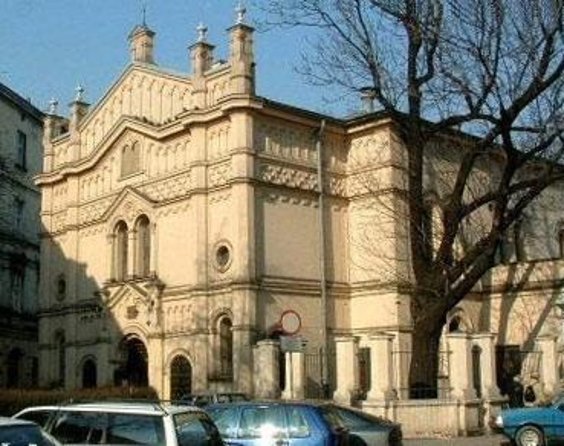
- A strong introduction to Kazimierz: You pass the Old Synagogue, Remuh, Kupa, Izaak, Tempel, High, and Wolf Popper synagogues.
- Schindler’s Factory is viewed from outside: The buggy passes the former enamel factory, but admission to its museum is not included.
- Warm in cold weather: Heating and blankets are available, a useful feature in Krakow’s winter.
- English live guide plus audio: Guides such as Olivia, Natalie, Philip, Jacob, and Oskar have led tours, though the specific guide is not guaranteed.
- Group size can affect comfort: The maximum is 50 people, and a packed buggy may feel tight for adults in heavy coats.
What this Krakow buggy tour actually covers
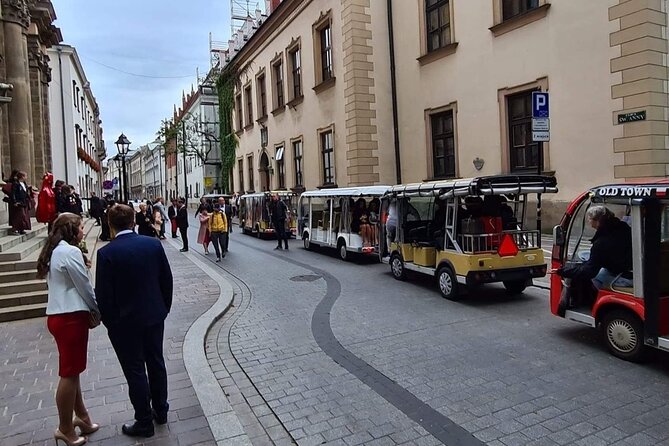
This is not a classic Old Town circuit focused on Wawel Castle and the Main Market Square. Its real subject is the south side of Krakow, especially the former Jewish district of Kazimierz and the Podgórze area across the river.
That focus is important. Some people book expecting every major Krakow sight in one loop and feel let down when the route spends much of its time around Jewish heritage and World War II locations. If you want the castle, Cloth Hall, St. Mary’s Basilica, and the full medieval center, this is not the right single tour.
For Kazimierz and Podgórze, though, the buggy makes sense. You can cover a broad area without spending the whole afternoon walking between sites. The driver-guide explains what you are seeing, and the audio system adds more background. At some stops, you get out for photographs or a brief look inside a church.
The group limit is listed as 50 people, but the practical issue is the size of the buggy itself. One account described 12 people packed into a vehicle, including nine large adults and a family of three, with winter clothing making the seats feel especially tight. If the vehicle feels uncomfortable, tell the driver at once. The operator says groups can be separated in such cases.
More golf cart and segway routes in Krakow:
- Krakow: City Sightseeing Tour by Electric Golf Cart
★ 4.5 · 3,264 reviews - Krakow: City Sightseeing Tour Eco Electric Buggy Golf Cart
★ 4.7 · 3,143 reviews - Krakow: Extended City Sightseeing Tour – Eco Buggy Golf Cart
★ 4.7 · 794 reviews
Starting at Zyblikiewicza 2 near Krakow’s Old Town
The meeting point is the 24-hour Krakow Old Town car park at Mikołaja Zyblikiewicza 2, close to the center. It is described as easy to find, though one passenger had trouble locating it at first.
A useful landmark is Westerplatte, a wide main street. Zyblikiewicza is just off it, and the pickup point is across from a Żabka shop. Arrive with a little time to spare, especially if you are unfamiliar with Krakow or carrying luggage.
Pickup is offered, but the listed start point is this car park. The tour returns there at the end, so you do not need to plan a separate ride back. Confirmation arrives when you book, and the activity is offered in English with a mobile ticket.
The ride lasts about one hour and 30 minutes. That is long enough to get a feel for several districts, but too short for long visits at each site. Think of it as a moving orientation tour, not a series of full guided admissions.
Skałka and the church beside the Vistula
The first listed stop is the Church on the Rock, or Skałka, formally the Basilica of Saint Michael the Archangel and Saint Stanislaus the Bishop and Martyr.
The site has an important place in Polish history. In 1079, Bishop Stanislaus of Szczepanów was killed here on the orders of King Bolesław II the Bold. The conflict helped drive the king into exile, and Stanislaus was later made a saint.
You have around 10 minutes at this stop, with admission listed as free. That short pause is enough to take in the setting and hear the basic story, but not enough for an extensive look at the church and monastery. If religious architecture interests you, note the location so you can return later at your own pace.
The tour also includes another church stop, identified in the route details as the Basilica of Corpus Christi. Construction began around 1340 and continued into the mid-15th century. Its large grounds make sense once you know it was built as a monastery church, with a monastic cemetery beside it.
The church visits are among the strongest parts of the experience. They break up the street ride and give you a chance to see interiors rather than only facades. Still, the exact amount of time inside can depend on the guide, traffic, and the pace of the group.
Plac Wolnica and the old heart of Kazimierz
Plac Wolnica was once the main market square of Kazimierz. When Kazimierz was founded in 1335, the square was nearly as large as Krakow’s Main Market Square and served as the town’s commercial and civic center.
Trade took place here, and the town hall once housed Kazimierz’s highest administrative and judicial authorities. Stalls, scales, and a shearing room also occupied the area. Its name comes from forum liberum, referring to the right to sell meat outside the regular stalls.
This is the kind of stop that benefits from a guide. A square may look simple at first glance, but its former role explains the street pattern and the importance of Kazimierz as a separate city before it became part of Krakow.
The route then moves through the former Jewish quarter, where the story changes from medieval town life to the religious and social world of Krakow’s Jewish community.
A few more Krakow half days to consider
- From Krakow: Auschwitz-Birkenau Guided Tour & Hotel Pickup
★ 4.5 · 33,358 reviews - From Krakow: Auschwitz-Birkenau Guided Tour & Hotel Pickup
★ 4.5 · 29,340 reviews - Krakow: Auschwitz Guided Tour with Optional Hotel Pickup
★ 4.5 · 15,280 reviews - Krakow–Zakopane: Cable Car, Chocholow Baths, Cheese & Vodka
★ 5.0 · 10,720 reviews
Seven synagogues, seven different pieces of Kazimierz
The synagogue portion is the tour’s main strength. You pass a remarkable cluster of historic buildings in a short time:
- Tempel Synagogue: A major place of worship and a center for Jewish cultural events, concerts, meetings, and the Jewish Culture Festival.
- Kupa Synagogue: A 17th-century synagogue that remains connected with religious ceremonies and cultural events.
- Izaak Synagogue: Built in 1644 and funded by Izaak Jakubowicz, a banker known as Isaac the Rich.
- High Synagogue: Also called the Tall Synagogue, it is notable for its height and its former upstairs prayer hall.
- Old Synagogue: The oldest surviving synagogue building in Poland and one of Europe’s important Jewish architectural landmarks.
- Wolf Popper Synagogue: Once an ornate house of prayer, it now contains a bookshop and an art gallery in the former women’s section.
- Remuh Synagogue: A small 16th-century synagogue named for Rabbi Moses Isserles. It is one of only two active synagogues in Krakow.
You should not expect to enter all seven. The buggy passes them as part of a sightseeing circuit, with the guide explaining their place in Kazimierz. If you want to visit interiors, choose one or two and return later.
The Remuh area also has a cemetery connection and a particularly strong sense of place. The Old Synagogue is now associated with museum displays, while other buildings continue to serve religious or cultural purposes. Taken together, these stops show that Kazimierz is not one single attraction. It is a district shaped by worship, trade, scholarship, persecution, and renewed cultural life.
The route also touches on the Rubinstein family, connected with Krakow and with the famous pianist and writer Helena Rubinstein. This small detail adds a personal thread to the broader story of Jewish life in the city.
From Kazimierz to Podgórze and the ghetto memorials
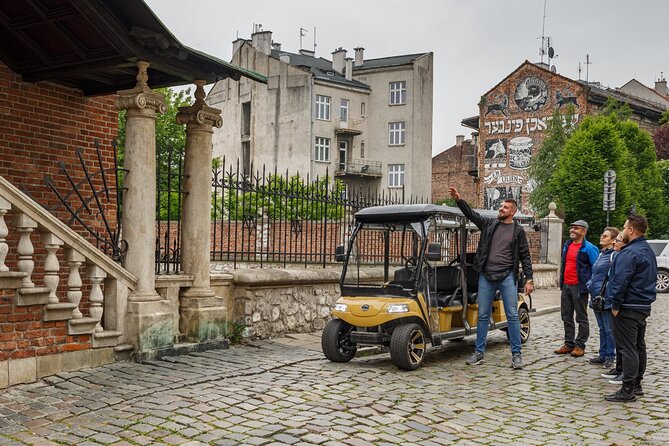
The buggy then crosses toward Podgórze, the district where the German occupation authorities established the Krakow ghetto in 1941.
At Ghetto Heroes Square, you see the place where Krakow’s Jewish population was concentrated before many people were transported to concentration camps. The square was known as Plac Zgody during the wartime period and later received its current name.
The Pharmacy Under the Eagle, at number 18, is central to this history. Tadeusz Pankiewicz, a Polish pharmacist, ran the pharmacy and was the only Pole with permission to remain inside the ghetto. The pharmacy served Jewish residents before and during the ghetto period and is now a museum.
The buggy passes the Eagle Pharmacy Museum, but a full museum visit is not part of the 90-minute ride. If you want a closer look at wartime life in the ghetto, make a separate visit. The tour gives you the location and the basic context, which can make a later museum visit easier to understand.
The old ghetto wall is another brief but powerful stop. Little remains, so the guide’s explanation matters. You are looking at a physical fragment of a boundary that separated people from the rest of the city, not at a complete preserved site.
Schindler’s Factory, with an important limitation
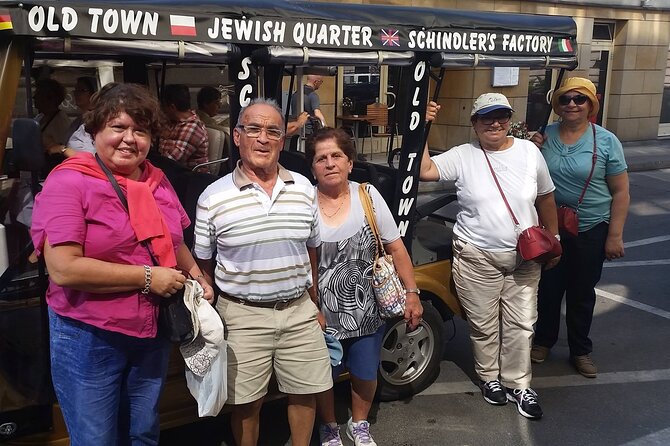
The former enamel factory associated with Oskar Schindler is at Lipowa 4 in Zabłocie. The factory originally produced enamelware and metal goods, and during the German occupation it became known through Schindler’s efforts to protect Jewish workers.
Today the complex contains the Museum of Contemporary Art in Krakow and a branch of the Historical Museum of the City of Krakow. The historical museum is the one connected with the former administrative building and with the story shown in the film Schindler’s List.
The buggy passes the factory, but you do not enter the museum. This is the single most important expectation to set before booking. If Schindler’s Factory is a main reason for your Krakow visit, reserve a separate museum ticket and allow proper time for it.
The outside stop still has value. It places the factory within the wider route from Kazimierz to the ghetto and shows how close these districts are. But an outside view cannot replace the museum’s exhibitions.
St. Joseph’s Church and the final stretch
The route ends its Podgórze section at St. Joseph’s Church on Podgórski Square. The church sits on the northern slopes of the Krzemionki foothills and is one of the area’s most recognizable landmarks.
Its tall, detailed facade gives the square a different mood from the synagogue streets and ghetto memorials. Seeing these religious buildings in one tour helps you compare the architectural and social layers of Krakow rather than treating each district as a separate postcard stop.
The tour then returns to the starting point at the Old Town car park. Because the vehicle does the long connections, you can spend the rest of your day walking only the sites that caught your interest.
Guides, audio, and the quality of the explanation
The live guide is a major part of the experience. Names associated with recent departures include Olivia, Natalie, Philip, Jacob, and Oskar. You cannot choose a particular guide when booking, but the strongest departures combine clear English, careful driving, humor, and sensitivity when discussing the ghetto and wartime persecution.
Olivia is especially noted for clear English, humor, and a thoughtful way of presenting difficult material. Natalie has been praised for careful driving and for using photos on her phone to help explain places. Philip is described as clear and well prepared, while Jacob and Oskar are also associated with informative introductions to the city.
The recorded narration adds another layer. It is useful when the driver is focused on traffic or when the vehicle passes a site without stopping. Check your earphones early, since one poor departure had several headphones that did not work.
The best approach is to treat the guide’s talk as an introduction. You will hear many names, dates, and events quickly. Write down the places that interest you and return to them later.
Is $28.88 good value for 90 minutes?
At $28.88 per person, the tour is reasonably priced if you value transport, orientation, and live explanation. You are paying to cover a large area quickly, not for admission to museums or a long walking tour.
The value is strongest when:
- You are visiting Krakow for the first time.
- Walking long distances is tiring or difficult.
- You have only a few hours to get a broad sense of the city.
- You want to decide which synagogues, churches, or museums deserve a later visit.
- Cold or wet weather makes a walking tour less appealing.
The value is weaker if you already know Kazimierz and Podgórze, or if you want long interior visits. You can see the outside of many sights, but your time at each is brief.
The tour is booked, on average, about 13 days ahead. That suggests you should reserve around two weeks before your visit if your schedule is fixed, especially for a popular departure time. Free cancellation is available up to 24 hours before the start time. Inside that window, the fare is not refunded and changes are not accepted.
Comfort, weather, and group size
The electric buggy is more practical than glamorous. It lets you rest your legs, and the enclosed vehicle can be a real help in winter. Heating and blankets have been available, and one wet-day departure remained comfortable because the buggy was warm.
The ride is not always smooth. Krakow’s streets can make the experience bumpy, and a full vehicle may leave little room for bulky coats. Ask about seating before setting off if comfort is a concern.
The tour is offered in English. Service animals are allowed, the meeting point is near public transportation, and most people can participate. The stated maximum is 50 people, but the buggy itself is the more important limit for comfort.
Daylight is the better choice if you want to see facades, wall fragments, and square layouts clearly. A night ride can still be useful for history and orientation, but darker conditions make some sights harder to appreciate.
Who should book this Krakow electric buggy tour?
I would choose this tour early in a Krakow visit. It gives you a map in your head, shows how Kazimierz connects with Podgórze, and helps you plan later visits to the Old Synagogue, Remuh Synagogue, the Eagle Pharmacy, or Schindler’s Factory.
It also suits anyone who wants a break from walking, including families, older visitors, and people working around a short schedule. The warm buggy is a practical bonus in cold or wet weather.
I would not choose it as your only Krakow sightseeing experience if the Main Market Square, Wawel Castle, or museum interiors are your priorities. I would also avoid booking it at the end of a tight itinerary if you want deep time at each stop.
Should you book it?
Book it if you want a quick, well explained introduction to Krakow’s Jewish quarter and ghetto districts, with transport between widely spaced sites. The route is broad, the live guides can be excellent, and the price is fair for a 90-minute overview.
Skip it if you expect a full Old Town tour, entry into several synagogues, or a visit inside Schindler’s Factory. For the best experience, book near the start of your stay, choose daylight, check the audio equipment, and use the tour to mark the places you want to explore on foot afterward.
FAQ
How long is the Krakow electric buggy tour?
The tour lasts approximately one hour and 30 minutes.
Where does the tour start?
It starts at the 24-hour Krakow Old Town car park at Mikołaja Zyblikiewicza 2, 31-029 Kraków.
Where does the tour finish?
The activity ends back at the original meeting point.
Is the tour offered in English?
Yes. The experience is offered in English and includes a live driver-guide with recorded narration.
Does the tour enter Schindler’s Factory?
No. The buggy passes Oskar Schindler’s former enamel factory, but the museum visit is not included.
How many sights does the route cover?
The tour stops at or passes nearly 24 sights, including churches, squares, synagogues, ghetto landmarks, the old ghetto wall, and Schindler’s Factory.
What is the maximum group size?
The stated maximum is 50 people. The actual comfort of the ride depends on how many people are placed in the buggy and how much winter clothing passengers are wearing.
Can I cancel for a refund?
Yes. You can cancel at least 24 hours before the experience begins for a full refund. Cancellations or changes made less than 24 hours before the start time are not refunded.
Recently added in Krakow
- Auschwitz-Birkenau and Krakow Private Car Trip from Katowice★ 4.3 · 3 reviews
- Wawel Castle, Old Town with St. Mary’s Church Guided Tour★ 5.0 · 3 reviews
- Wawel Castle, Cathedral, Rynek Underground Tour with Lunch★ 5.0 · 3 reviews
- From Krakow: Chocholow Thermal Hot Springs (hotel pick up)★ 5.0 · 3 reviews
- Private tour to Zakopane and Thermal Baths from Krakow★ 5.0 · 3 reviews
- Legends of Cracow ROBOTIC SHOW★ 4.0 · 3 reviews
- From Krakow: Zakopane and Thermal Pools Guided Trip★ 5.0 · 3 reviews
- Guided Beer Tour in Krakow★ 4.5 · 3 reviews
Golf Cart & Segway Tours, compared.
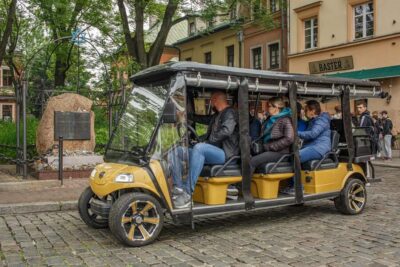
Extended City Sightseeing Tour – Eco Buggy Golf Cart
Read our review →
City Sightseeing Tour by Golf Cart/Buggy Guided Tour
Read our review →
Krakow Old Town Segway Tour 2hr with Training, Safety Gear, Guide
Read our review →
Jewish Quarter and Ghetto Electric Golf Cart Tour
Read our review →
Krakow Grand City Tour by golf cart – All 3 districts
Read our review →
Where else this one turns up