
Reviewed · WROCLAW TOURS
Famous Islands of Wroclaw – Cathedral Island and Sand Island Private Tour
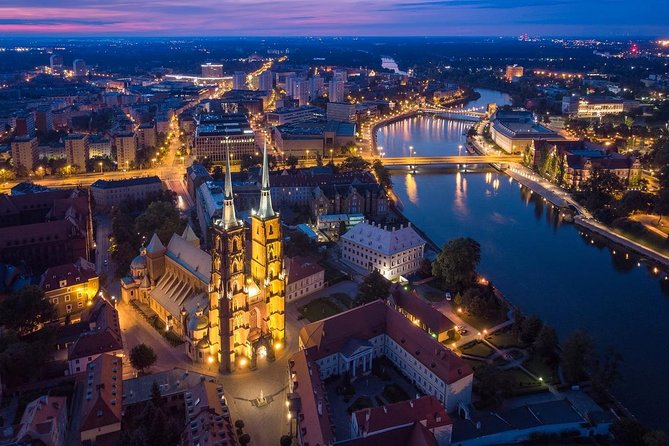
Wroclaw’s two historic islands pack a surprising amount into a short walk. On this private tour, you move from the Cathedral’s grand entrance through old church grounds, past the Archbishop’s Palace, and over Tumski Bridge to Sand Island. Along the way, the guide adds the human stories that make the stonework matter.
I like the small private format, since you can focus on the buildings and ask questions without keeping pace with a large group. I also like the unusual stories, especially how a cardinal hid 80 million zloty for the Solidarity movement. The main drawback is simple: at about two hours, this is an overview, not a full church-by-church tour.
Key points at a glance
- Cathedral Island begins at Wroclaw Cathedral, giving you an easy, central meeting point.
- St. Giles is Wroclaw’s oldest existing church, a useful anchor for understanding the area.
- The 80 million zloty story adds modern political drama to the medieval setting.
- Tumski Bridge marks an old church boundary and leads you toward Sand Island.
- The route ends at the Church of Our Lady on the Sand, Wroclaw’s biggest Gothic church.
- A private English-language walk lasts about 1 hour 40 minutes to 2 hours, with group discounts available.
Starting at Wroclaw Cathedral
The tour starts outside the main entrance of Wroclaw Cathedral at Plac Katedralny 18. That is a practical meeting point, especially if you are already exploring the Cathedral Island area. You do not need to search for a hotel pickup or wait for transportation. You simply arrive at the cathedral and begin walking.
The cathedral gives the tour an immediate sense of scale. From here, the guide leads you around the island, explaining how dukes and clergy once chose this protected religious district as their home. The setting helps you see why the area mattered. It was not just a collection of churches. It was a place where religious authority and political power lived side by side.
One of the first useful bits of context concerns the island itself. Cathedral Island is not technically an island anymore. The name survives from an earlier period, when waterways shaped the area differently. That small correction is exactly the kind of detail that can make a familiar-looking district more interesting.
You will also hear about a time when wrongdoers could escape justice by reaching the island. The idea reflects the special authority once held by church territory. It is a memorable way to understand that medieval law was not the same everywhere, even within one city.
A few more Wroclaw half days to consider
- Wroclaw: E-Car Tour and Audio Guide
★ 4.6 · 1,738 reviews - Wroclaw: 2-Hour Private Guided Tour by Electric Car
★ 4.8 · 805 reviews - Wrocław: Old Town and Ostrów Tumski Walking Tour in English
★ 4.8 · 311 reviews
St. Giles and the oldest surviving church
The route brings you to the Church of St. Giles, described as the oldest existing church in Wroclaw. This is an important stop because it gives you a direct link to the city’s earliest surviving religious architecture.
You should not expect a long interior visit at every church. The tour is built around walking through the district and hearing the story of its buildings. That makes it a good choice if you want orientation and context rather than a formal worship service or an extended architectural study.
Nearby, you will see Wroclaw’s Leaning Tower. The name promises a dramatic sight, but the real value is the contrast it creates with the surrounding churches and older buildings. Your guide can connect these landmarks so you are not simply checking off isolated photo stops.
The Dumpling Gate adds a lighter touch to the route. Its name is more playful than the grand religious titles around it, and it helps break up the procession of Gothic façades. This is one reason the walk should appeal to you if you like local details as much as major monuments.
The 19th-century Botanical Gardens are also close by. The tour does not present the gardens as a main stop, but the location is useful to know if you want to return later for a separate visit. If you enjoy parks and plants, consider adding that visit before or after the walking tour rather than expecting the gardens to take up much of this experience.
The Archbishop’s Palace and a daring Solidarity story
One of the tour’s strongest moments comes at the Archbishop’s Palace. Here the guide tells the story of a cardinal who hid 80 million zloty in 1980 to support the Solidarity movement.
That story gives the walk a needed modern edge. Without it, the tour could feel like a procession of medieval and Gothic buildings. Instead, you get a reminder that Cathedral Island also played a role in Poland’s more recent political struggle.
The amount of money is startling, but the important point is what the story reveals about church figures and opposition activity during a tense period. The guide also explains what happened to the money afterward, adding a clear narrative arc rather than leaving you with a vague reference to Solidarity.
This is the kind of stop I find especially valuable on a city tour. You can look up dates and architectural styles later, but a story involving secret money, a brave cardinal, and the fate of the funds is easier to remember. It gives the district a human scale.
Two churches in one Gothic complex
Across from the palace, the tour pauses at the two-tier Church of the Holy Cross and Bartholomew. Its unusual stacked design makes it one of the most distinctive churches in the Silesia region.
The building also contains a copy of the Turin Shroud. The tour uses this detail as a way into the church’s religious and architectural character. You will hear stories about other important buildings nearby, including the Orphanotropheum, a former orphanage.
This section is a good example of why a guide adds value. If you walked alone, you could admire the church’s shape and perhaps read a plaque. With a guide, the building becomes part of a larger neighborhood story involving church authority, charitable institutions, and the way religious complexes were organized.
Still, keep your expectations in check. The experience lasts less than two hours, and the route covers several important sites. You are getting explanations at many places, not a long lecture inside each one. If your main goal is detailed art history, you may want a separate visit to the churches that interest you most.
A different kind of day in Wroclaw:
- Wroclaw: Private Old Town Guided Walking Tour (2 hours)
★ 4.8 · 275 reviews - Old Town Wrocław Walking Tour
★ 5.0 · 249 reviews - Wroclaw: City Tour Sightseeing By Golf Cart Shared Or Privat
★ 4.8 · 189 reviews - Auschwitz-Birkenau Tour from Wrocław
★ 5.0 · 129 reviews
Crossing Tumski Bridge to Sand Island
The tour finishes by passing over Tumski Bridge. The bridge once represented the border of the church’s jurisdiction, making it more than a useful crossing between the two districts.
For you, it also creates a natural change in mood. Cathedral Island feels tied to the cathedral, palace, and church authorities. Crossing the bridge shifts the focus toward Sand Island and its own collection of religious buildings and old residential traces.
This is a pleasant point for photographs, though the tour’s value is not limited to the view. The bridge helps explain how Wroclaw’s historic areas were divided and controlled. It also gives the walking route a clear sense of progress, ending in a new part of the city rather than returning you to the starting point.
The tour ends at Sand Bridge, also known as Most Piaskowy. That finish is convenient if you want to continue exploring on foot. It is less convenient if you need to return immediately to Cathedral Island, since you will need to make your own way back.
Our Lady on the Sand and the last old homes
On Sand Island, you will see the Church of Our Lady on the Sand, identified as the biggest Gothic church in Wroclaw. The scale of the building provides a strong final landmark for the tour.
You will also see the former Augustinian monastery and charming tenement houses. These homes are especially interesting because they are described as the only remaining traces of the old residential buildings on Sand Island. That detail gives you a clearer sense of loss and change. The island is not just old. It has also been altered over time, with much of its former housing disappearing.
I like ending here rather than at another grand church on Cathedral Island. The final section widens the story from religious power to ordinary urban life. The monastery, church, and tenements show several layers of the district in a compact area.
As with the earlier stops, the tour is primarily an outdoor walking experience. Church access can vary, and the supplied details do not promise extended interior visits or a particular service schedule. If seeing every interior is essential to your plans, confirm the arrangements before booking.
What the private format adds
This is a private activity, so only your group participates. That matters most in a historic district where the interesting details are easy to miss. You can ask why Cathedral Island lost its island status, request more information about the Solidarity story, or spend a little longer at a building that catches your eye.
The private format also avoids the stop-and-start feel of a large group. You are not listening to a guide speak over several dozen people, and you do not have to worry about losing the guide in a crowded square.
There is a tradeoff. A private tour does not automatically mean a fully customized itinerary. The route is clearly shaped around Cathedral Island and Sand Island, and the listed duration is fairly fixed. You should book it for the focused route and personal attention, not because you expect a completely bespoke Wroclaw program.
The tour is offered in English. No guide name is provided, so you cannot choose a specific guide in advance. The experience has a 4.9 rating from 13 submitted ratings, with 100 percent recommending it, but the small sample means you should treat that as encouraging rather than final proof of every possible experience.
Is $75 per person a fair price?
At $75 per person, this costs more than a basic self-guided walk. The price can make sense if you are traveling with family or friends and value a private guide who can explain the churches, bridge, palace, and political stories in a compact visit.
Group discounts may improve the value for a larger party. Since only your group participates, the per-person cost may also feel more reasonable when split among several people. For a solo visitor or a couple on a tight budget, the price deserves more thought.
The strongest value comes from the guide’s interpretation. You are paying for the connections between places: why clergy lived here, how church jurisdiction worked, what happened to the money hidden for Solidarity, and why Sand Island’s old houses matter. If you would otherwise walk past these sites without context, the tour does useful work.
The weaker value appears if you mainly want entry to churches or a long architectural lecture. The route is short, and several locations are seen from the outside or covered briefly. In that case, a self-guided walk followed by individual church visits could suit you better.
Timing, walking, and weather
The tour lasts approximately 1 hour 40 minutes to 2 hours. That is long enough for a clear introduction to both islands without taking up half a day. You should wear comfortable shoes, since the experience is a continuous walking tour between several stops.
The meeting and ending points are different. You begin at Wroclaw Cathedral and finish at Sand Bridge. Plan your next activity from the Sand Island side of the route rather than assuming you will end where you started.
The tour requires good weather. If poor weather causes cancellation, you will be offered another date or a full refund. You can cancel for a full refund up to 24 hours before the start time, while cancellations or changes made less than 24 hours ahead are not accepted. Cutoff times follow local time.
Confirmation arrives when you book. Service animals are allowed, public transportation is nearby, and most people can participate. The supplied information does not give a precise accessibility description for every surface or church entrance, so anyone with mobility concerns should confirm the walking conditions before reserving.
Who should book this Wroclaw walk?
I would choose this tour if you want a short, focused introduction to Wroclaw’s religious quarter. It suits first-time visitors who want the main landmarks explained without spending an entire day on a formal sightseeing program.
It is also a good fit for history-minded visitors who prefer stories over lists of dates. The escape-from-justice tale, the cardinal’s hidden money, and the old jurisdiction boundary give you memorable details that help the churches stick in your mind.
Families and small groups may appreciate the private format. You can keep the pace together and ask questions freely. The easy walking route also received strong praise for being manageable, though the available feedback comes from only one detailed written account.
I would be more cautious if you want extensive time inside every church, a specialist architectural tour, or a flexible route built around your personal interests. The experience covers a lot in under two hours, so its strength is breadth with explanation, not exhaustive detail.
Should you book it?
Book this tour if you want to understand Cathedral Island and Sand Island quickly, with a private English-speaking guide and a handful of memorable stories. The best parts are the clear route, the four major church areas, the Tumski Bridge crossing, and the surprising Solidarity-era money story.
Skip it if you prefer to wander alone, need guaranteed interior access, or think $75 per person is too much for a short walk. For everyone else, especially small groups who value context and an easy central meeting point, it offers a useful first look at one of Wroclaw’s most historic districts.
FAQ
Where does the tour start?
The tour starts outside the main entrance of Wroclaw Cathedral at Plac Katedralny 18, 50-329 Wroclaw, Poland.
Where does the tour end?
The tour ends at Sand Bridge, also called Most Piaskowy, in Wroclaw.
How long does the tour last?
The experience lasts approximately 1 hour 40 minutes to 2 hours.
Is this a private tour?
Yes. Only your group participates in the activity.
What language is the tour offered in?
The tour is offered in English.
What sites are included?
The route includes Cathedral Island, St. Giles Church, Wroclaw’s Leaning Tower, the Dumpling Gate, the Archbishop’s Palace, the Church of the Holy Cross and Bartholomew, Tumski Bridge, the Church of Our Lady on the Sand, the former Augustinian monastery, and old tenement houses on Sand Island.
Can I cancel for a full refund?
Yes. You can cancel at least 24 hours before the start time for a full refund. Cancellations and changes made less than 24 hours before the start time are not accepted. If poor weather cancels the tour, you will be offered another date or a full refund.
Recently added in Wroclaw
- CITY QUEST WROCLAW: unlock the mysteries of this city!★ 5.0 · 3 reviews
- Wroclaw: Old City Walk and Cruise with Small Gondola★ 4.7 · 3 reviews
- Private Transfer from Wroclaw (WRO) Airport to Wroclaw city centre★ 5.0 · 3 reviews
- Wroclaw : Walking Custom Tour with a Local Guide★ 4.8 · 3 reviews
- Wrocław: Ostrów Tumski and Old Town Highlights Private Tour★ 5.0 · 3 reviews
- Wroclaw Jewish Quarter Private Guided Tour★ 5.0 · 3 reviews
- Electric Scooter Tour: Full Tour (Old Town + Ostrów Tumski)★ 5.0 · 3 reviews
- Segway Tour Wroclaw: Ostrów Tumski Tour – 1,5-Hours of Magic!★ 5.0 · 3 reviews
Wroclaw Tours, compared.

Old Town and Ostrów Tumski Walking Tour in English
Read our review →

City Tour Sightseeing By Golf Cart Shared Or Privat
Read our review →

Where else this one turns up