
Reviewed · GDANSK TOURS
Cruises on the Motlawa River
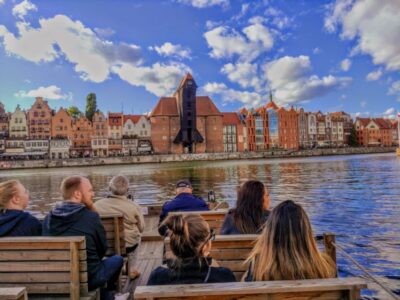
Gdansk’s waterfront makes far more sense from the Motlawa River. From a small boat, you get a clear view of the medieval crane, the old water gates, Granary Island, and the church towers rising behind the riverside buildings. I like the way this short cruise connects the city’s grand sights with its working-port past.
I also like the retractable canopy, which gives you open-air views when the weather behaves, and the low price of $19.86. The main drawback is the small boat: sound can be hard to follow, and the English information may come through a printed sheet rather than a strong live commentary.
Key points about the Motlawa River cruise
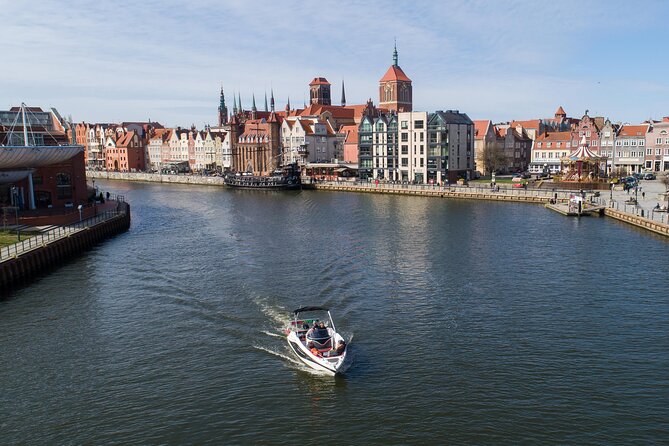
- The medieval crane is the star sight: You see Europe’s largest medieval crane from an unusually good angle on the water.
- The route covers several islands: Granary Island and Olowianka Island reveal different chapters of Gdansk’s port and industrial story.
- The boat is small: The maximum group size is 10, which feels personal, but limited space can make the ride less comfortable.
- The canopy opens fully: Choose a clear-weather departure if photography matters to you.
- The cruise returns to the Green Bridge: You finish where you started, near Gdansk’s central waterfront.
- The price is modest: At $19.86 per person, this is a useful sightseeing add-on rather than a major splurge.
Seeing Gdansk from the Motlawa River
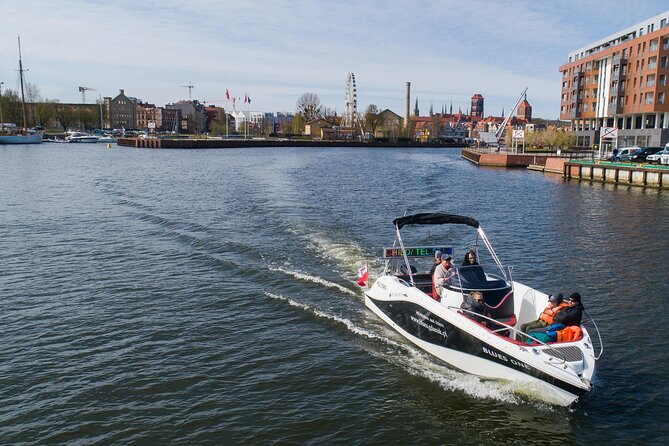
Gdansk’s central waterfront is handsome from land, with the Long Seacoast, colorful facades, and busy walking routes. From the river, though, you see the city in its proper setting. The Motlawa was not simply a pretty strip of water. It was the route that tied Gdansk’s warehouses, gates, mills, shipyards, and trading centers together.
The cruise lasts about 45 minutes. One account describes a ride closer to 50 minutes, so I would allow roughly an hour for boarding and the full outing. That makes it easy to fit between a museum visit, lunch, or a walk through the Old Town.
The boat departs from the Green Bridge on the Stara Motlawa. You return to the same meeting point, a useful arrangement if you do not want to work out transport from a distant dock. The boat is near public transportation, and the experience is offered in English.
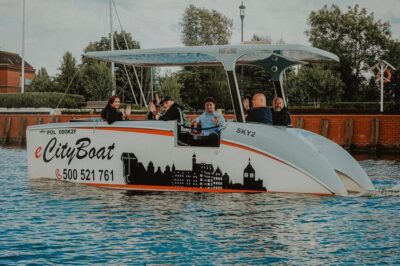
This is not a large sightseeing vessel with a grand upper deck. The boat is a small private motorboat, limited to 10 people. That has two sides. You get a closer, quieter ride than you would on a crowded vessel, but the interior can feel tight, and the guide’s voice may not carry well.
A few more Gdansk half days to consider
- Gdansk: City Cruise on Historical Polish Boat
★ 4.8 · 2,913 reviews - Gdańsk: Sunset Cruise on a Historic Polish Boat
★ 4.9 · 977 reviews - Gdańsk City Sights & History Guided Walking Tour in English
★ 4.8 · 876 reviews
The Green Bridge and the first river views
The Green Bridge is a practical starting point and one of the easiest landmarks to recognize along the Motlawa. From here, the route moves past the waterfront and the marina before returning along the river.
I recommend arriving with the boat location in mind rather than relying only on a general waterfront address. One family had trouble finding the correct spot, and the captain called to make sure they were still coming. That is a reassuring detail, but it is still wiser to keep your phone available and allow a little extra time.
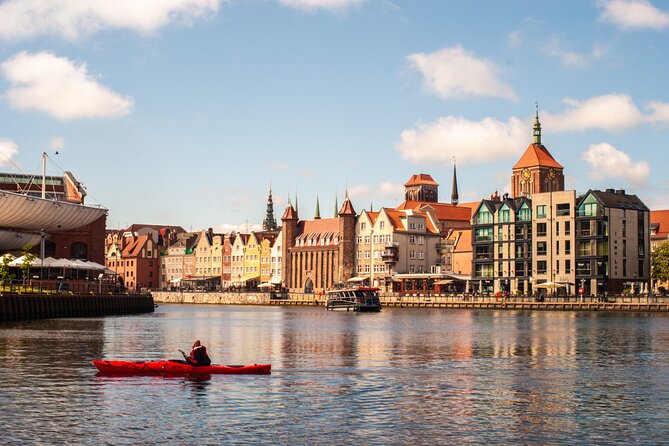
As the boat leaves the bridge, look back toward the riverside frontage. The Long Seacoast, known in Polish as Dlugie Pobrzeze, is lined with historic water gates. These gates once allowed access between the river and the city. They give the waterfront its distinctive rhythm, and the water-level view makes their practical purpose easier to understand.
The cruise also passes the Fish Market. Gdansk once had more fish markets than it does today, so this part of the route helps explain how closely daily trade was tied to the river. It is not the most imposing sight, but it adds useful detail to the larger story.
The medieval crane from the water
The most memorable sight is the famous crane, known as the Zuraw. It is described as the largest medieval crane in Europe, and the river gives you a direct view of its broad timber structure and brick towers.
From the waterfront, the crane can blend into the busy line of buildings. From the boat, you see how it projected over the river and handled cargo. Its size becomes easier to grasp when you are looking up from the water rather than standing opposite it on the quay.
This is also one of the moments when a printed English explanation can be useful. Several parts of the cruise rely on written information, and the audio or spoken commentary may not be easy to hear across the small boat. If the guide’s voice fades, read the sheet as you go and keep the key sights in view.
The crane is more than a photo stop. It explains why Gdansk’s waterfront developed where it did. Warehouses, gates, markets, and islands were arranged around the movement of goods. The cruise gives you that basic structure without taking much time from your day.
Granary Island and its preserved warehouses
The route continues toward Granary Island, one of the most important parts of the river view. The island once held storage buildings that served Gdansk’s trading economy. You can still see a preserved wall of the Long Way granary, a reminder of the large warehouse structures that once filled this part of the city.
The river offers a helpful contrast here. From the boat, you see the island as a separate working zone, divided from the main city by water. On foot, it can be easy to think of the island as just another section of central Gdansk. The boat shows why it had its own role.
I would pay attention to the mix of old and repaired structures. The preserved wall carries the historical weight, while other parts of the island show how the waterfront has changed. The experience does not turn this into a long architectural lecture, but it gives you enough context to notice what you are seeing.
Stagiewna Street crosses Granary Island and begins at the Green Bridge. Seeing the street from the water helps you understand how the island links back to the main center. The route is especially useful early in your visit because it gives you a mental map for a later walk.
A different kind of day in Gdansk:
- Gdansk: Firearm Shooting Experience with Instructor
★ 4.8 · 866 reviews - Gdansk: Guided Round-Trip Cruise to Westerplatte
★ 4.3 · 865 reviews - Gdańsk: Sightseeing EcoCruise around the Old Town of Gdansk
★ 4.6 · 719 reviews - Main Town Gdańsk Walking Tour
★ 5.0 · 644 reviews
Olowianka Island and the Teutonic past
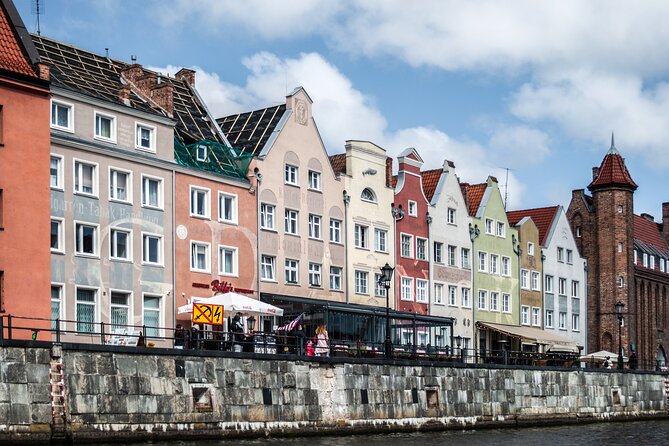
Olowianka Island is another major part of the cruise. Its history reaches back to the Teutonic Order, when the area served as an economic base for the commander’s castle. That detail gives the island a different character from the warehouses of Granary Island.
The river view brings several periods together. You can think about the Teutonic presence, later commercial use, and Gdansk’s changing port life while looking at one compact stretch of water. Olowianka is not simply a scenic island placed between the city and the river. It is one of the places where military, religious, commercial, and civic stories overlap.
The tour also points out remains of the wall of the Teutonic Castle. Do not expect a full castle complex. The value is in seeing a surviving fragment in relation to the river and the surrounding city. That kind of partial view can be more revealing than an isolated monument because it shows how the old stronghold fit into the urban setting.
Olowianka is also a good place to take photographs if the canopy is retracted. The boat’s small size helps you keep sight lines open, though you should still expect other passengers to share the best angles.
Church towers, the town hall, and St. John’s Church
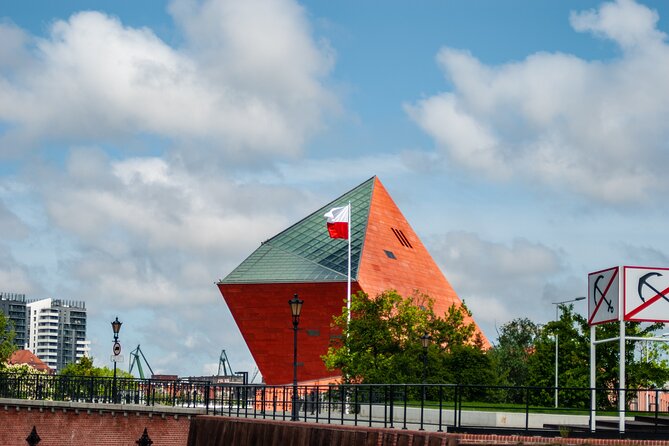
As the boat moves along the Motlawa, church towers and the town hall rise behind the waterfront. Their position above the low riverside buildings gives you a useful sense of Gdansk’s historic center as a layered city.
The view behind St. John’s Church is especially notable. From the river, you can see what is described as the world’s largest brick church. The wording points to St. Mary’s Basilica, whose huge brick mass is easier to appreciate from a little distance than from a narrow street.
This is one reason I prefer taking the cruise after, or before, a walking tour of the center. On foot, you notice doorways, facades, and street details. From the boat, you understand scale and placement. The two views complement each other, and the cruise does not require a full day.
The church and town hall views also show a limitation of the ride. The boat passes through a sequence of sights fairly quickly, so you may not get long viewing time at every building. If one church or civic structure matters greatly to you, plan a separate visit on land.
The postwar ship and Gdansk’s working waterfront
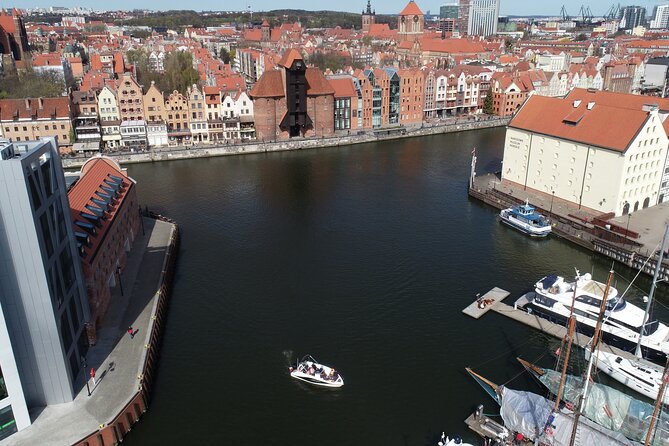
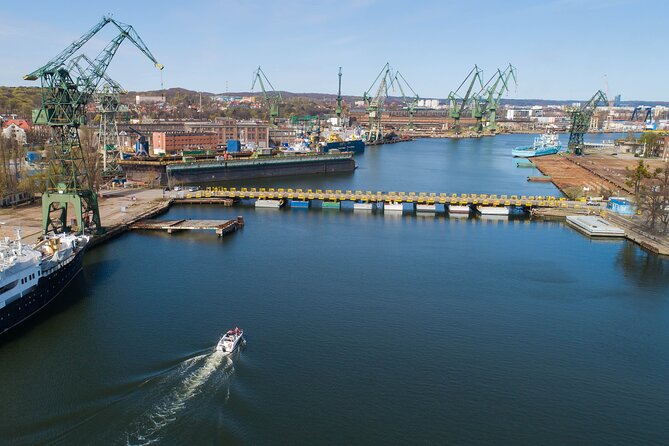
The cruise includes a view of the first ship built in Poland after World War II. That detail shifts the focus from medieval trade to modern Polish industry.
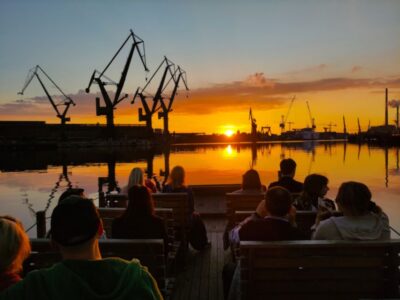
Gdansk is often presented through its older waterfront, but the city’s identity also includes shipbuilding and postwar reconstruction. Seeing a vessel linked to that period gives the river route a broader time span. You move from Teutonic remains and medieval cargo handling to the industrial age without leaving the Motlawa.
The boat also passes the marina. The marina is not the main attraction, but it helps you see how the river functions today. Small pleasure craft sit within the same wider water system once used for trade and heavy work.
I like this range. In less than an hour, the cruise covers military traces, religious buildings, commercial warehouses, fish trade, modern ships, and present-day boating. The commentary may not explain every link in detail, so you will get the most from it if you already know a little about Gdansk or read the supplied English information carefully.
What the small boat is really like
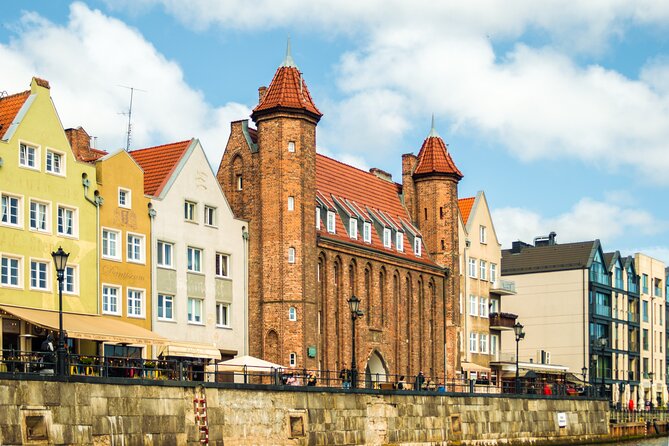
The small motorboat is both the charm and the weak point. With no more than 10 people, the ride can feel friendly and informal. Staff have been described as warm and helpful, and children aged 3 and 9 were given life jackets. Blankets were also provided when the wind picked up.
That does not mean every departure will feel spacious. You should expect limited room and keep your belongings compact. If you want a large deck, a broad choice of seats, or a polished sightseeing presentation, this may feel basic.
The canopy retracts fully when conditions allow. That is excellent for photographs and for seeing the upper parts of the crane and church towers without a roof in the way. If the weather turns cold or wet, the canopy provides useful cover, but the ride depends on good weather and can be canceled in poor conditions.
The sound system is the least dependable part. On some departures, the audio guide was not audible for the whole ride. On others, passengers followed a printed English sheet. I would treat the cruise as a visual tour with supporting information, not as a guaranteed full lecture.
Is $19.86 good value?
At $19.86 per person, this is a reasonably priced way to see the center from the river. The value is strongest if you want orientation, photographs, and a short break from walking rather than a long, specialist history lesson.
One useful price comparison comes from the waterfront itself. Boat rentals next door can cost about three times as much, while this ride includes information about the landmarks. That makes the cruise a sensible choice for a first look at the river, especially if you are visiting Gdansk for only a short time.
The price also works well for families. A 45-minute outing is short enough for children who may not manage a long walking tour, and life jackets are provided. Still, the small boat and uncertain audio mean that the value depends on your expectations.
You are paying for access to the river views and a basic guided experience. You are not paying for a large vessel, elaborate onboard service, or guaranteed spoken commentary at every moment.
Who should book this Gdansk cruise?
I would choose this cruise if you want to understand how Gdansk’s center grew around the Motlawa. It suits first-time visitors who need a quick orientation and photographers who want open views of the crane, islands, gates, and church towers.
It also fits families, couples, and anyone with a busy sightseeing schedule. The flexible departure times make it easier to place the ride between other plans, and the return to the Green Bridge keeps the logistics simple.
I would think twice if you need a fully narrated experience. The English information is available, but the live audio may be difficult to hear, and one version of the experience relied mainly on a printed sheet. The boat is also not the right pick if you dislike tight seating or want a large open deck.
Book at least a day ahead if your schedule is fixed. The experience is often reserved around 20 days before departure, which suggests that popular times can fill. You can cancel free of charge up to 24 hours before the start time. If bad weather cancels the ride, you receive another date or a full refund.
My call: a good short introduction to Gdansk
I would book the Motlawa River cruise for the perspective, not for polished onboard narration. The view of the medieval crane alone is worthwhile, and the route adds Granary Island, Olowianka, the water gates, Fish Market, marina, church towers, and the postwar ship in one compact trip.
At $19.86, it is easy to recommend for a first visit, a family outing, or a low-cost change of pace. Keep your expectations realistic about the small boat and sound quality, arrive early at the Green Bridge, and use the printed English information if the guide is hard to hear. If you want to see how Gdansk’s old center, port, and islands fit together, this is a smart use of 45 minutes.
FAQ
Where does the Motlawa River cruise start?
The cruise starts at the Green Bridge on the Stara Motlawa in Gdansk, Poland.
Where does the cruise finish?
The activity ends back at the Green Bridge, the same place where it starts.
How long does the cruise last?
The scheduled duration is approximately 45 minutes. Some descriptions of the ride put it closer to 50 minutes.
What sights can I see from the boat?
The route includes the Long Seacoast and its water gates, the medieval crane, Granary Island, Olowianka Island, the Fish Market, Stagiewna Street, the marina, church towers, the town hall, the remains of a Teutonic Castle wall, and a ship built in Poland after World War II.
Is the cruise offered in English?
Yes. The experience is offered in English, with information provided during the ride. A printed English sheet may be used, and the audio guide may not be audible throughout the full cruise.
How many people can join the boat?
The maximum group size is 10 people.
Can I cancel for a full refund?
Yes. You can cancel up to 24 hours before the experience starts for a full refund. Cancellations or changes made less than 24 hours before the start time are not accepted, and poor weather may result in a different date or a full refund.
Recently added in Gdansk
- Szymbark: Kashubian Switzerland 5-Hour Private Tour★ 3.7 · 3 reviews
- Segway Tour Gdańsk: Shipyard Tour – 1,5-Hour of Magic!★ 5.0 · 3 reviews
- Stutthof Concentration Camp and Museum of WWII: Private Tour★ 4.7 · 3 reviews
- Sopot Sunset Cruise with Welcome Drink★ 3.5 · 3 reviews
- Gdansk: Basic Bike Tour★ 4.3 · 3 reviews
- Gdansk: Bubble Football with Hotel Transfers★ 5.0 · 3 reviews
- Artus Court and Gdansk Old Town Private Tour with Tickets★ 4.7 · 3 reviews
- Gdansk: Oliwa Zoo with Tickets and Roundtrip Transportation★ 5.0 · 3 reviews
Gdansk Tours, compared.

Gdańsk City Sights & History Guided Walking Tour in English
Read our review →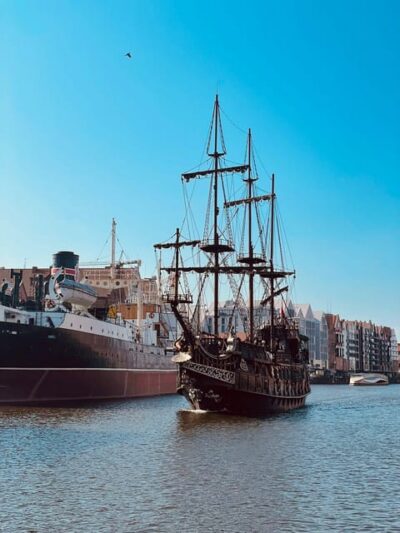
Sightseeing EcoCruise around the Old Town of Gdansk
Read our review →

City Sightseeing Tour by Golf Cart/Buggy Guided Tour
Read our review →Where else this one turns up