
Reviewed · WIELICZKA SALT MINE TOURS
Krakow and Wieliczka Salt Mine Tour from Wroclaw – Local guides included
Krakow’s grand medieval square and Wieliczka’s underground salt church make a powerful pair. One gives you Poland’s royal, academic, and Jewish heritage in the open air. The other takes you 327 meters underground, where miners carved chapels, statues, chandeliers, and tunnels from salt.
I like the private format, which gives you more room to ask questions and adjust the pace than a large coach tour. I also like that the price includes transport, admissions, hotel pickup and drop-off, an English-speaking driver, and trip insurance. The drawback is the long 14-hour day, and one serious booking concern is a reported cancellation only one day before departure.
Key points to know before booking
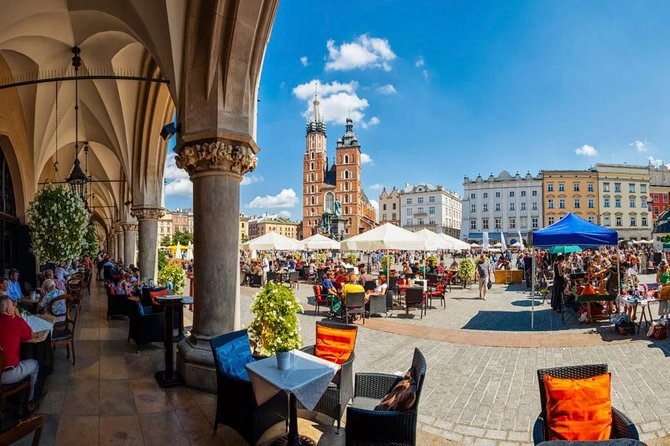
- Krakow’s Main Square gives you a quick but worthwhile look at the city’s medieval heart, with the Cloth Hall and old university buildings nearby.
- Kazimierz adds a more personal historical layer, including the former Jewish district and locations associated with Schindler’s List.
- Wawel Castle connects Krakow to Poland’s royal past, with a dragon sculpture below the hill that breathes fire.
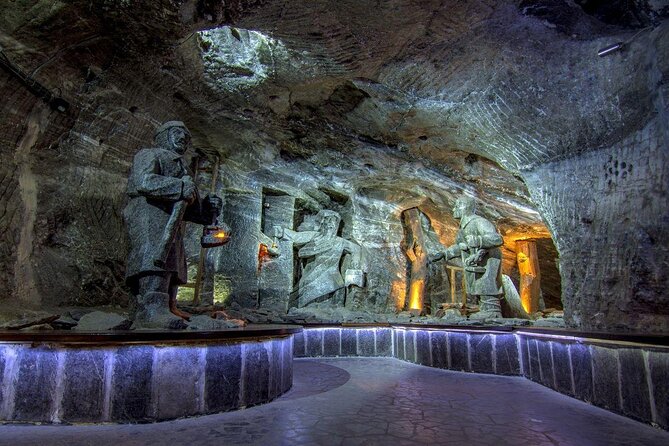
- Wieliczka Salt Mine includes the Chapel of St Kinga, where even the chandeliers and religious carvings are made from salt.
- A 7:00 am departure and 14-hour duration make this an efficient way to combine two major sights, but it is a demanding day.
- The small private group, limited to eight people, is best for visitors who value personal commentary and door-to-door transport.
Why this Krakow and Wieliczka combination works
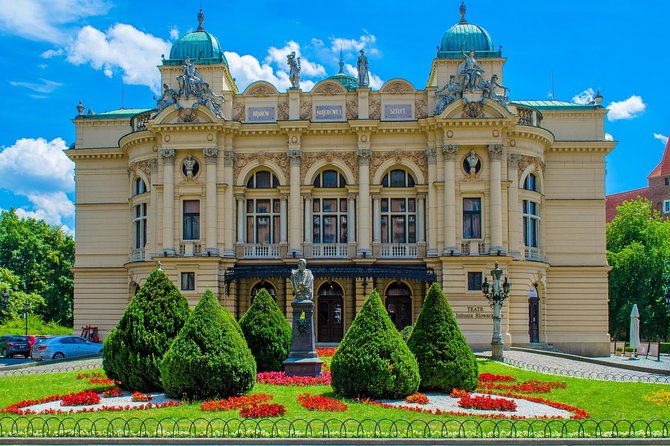
From Wroclaw, Krakow and Wieliczka are not casual side trips. Seeing both in one day requires an early start, organized transport, and a willingness to spend much of the day on the move. This tour handles the basic logistics for you, leaving your attention for Poland’s former royal capital and one of its most unusual historic sites.
The pairing also gives you two very different experiences. Krakow is about streets, squares, churches, university buildings, royal stories, and the atmosphere of old neighborhoods. Wieliczka is enclosed, artificial, and wonderfully strange: a working salt mine transformed over centuries into a subterranean world of art and worship.
I would choose this trip if you have limited time in Wroclaw and want to see two major Polish sights without arranging trains, local transport, timed mine entry, and a return journey on your own. I would think twice if you prefer a relaxed pace or want several hours to explore Krakow independently.
The cost is $311.40 per person, which is high for a day trip but easier to justify for a private service. You are paying for the vehicle, fuel surcharge, hotel transfers, admissions, a driver who speaks English, trip insurance, and a private guide rather than only a seat on shared transport. The value improves for a small group of two to eight people, especially if you would otherwise need separate transport and entry arrangements.
More Wieliczka salt mine visits:
- From Krakow: Wieliczka Salt Mine Tour
★ 4.6 · 9,393 reviews - Krakow: Auschwitz-Birkenau and Salt Mine Guided Tour
★ 4.7 · 9,020 reviews - Krakow: Wieliczka Salt Mine Guided Tour with Transport
★ 4.4 · 7,429 reviews
Leaving Wroclaw at 7:00 am
Pickup begins at 7:00 am from your hotel in Wroclaw. That early departure is not a minor detail. It is what allows the tour to fit both Krakow and Wieliczka into one day, while still leaving time for guided sightseeing at each stop.
You travel in a private, air-conditioned vehicle with an English-speaking driver. The route passes through Polish countryside, and the guide provides background on Krakow’s place in Polish education, art, and national life. Since the total outing lasts about 14 hours, comfort in the vehicle matters almost as much as the sights.
A small group can make the road portion more pleasant. You are not waiting for a large coach to load, and you can ask for clarification when a story catches your interest. One especially positive account describes a patient and flexible driver who helped make the day work smoothly. That is the sort of service you want on a long excursion.
Still, keep your expectations realistic. This is a packed schedule, not a leisurely country drive. You will have limited time for unplanned shopping, extended meals, or wandering down every side street in Krakow. Ask about the day’s meal timing when you meet your guide, since a restaurant stop is not specifically listed.
Krakow’s Main Square and royal center
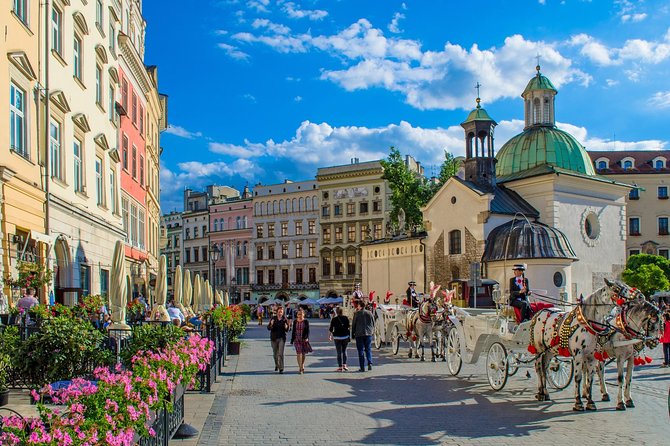
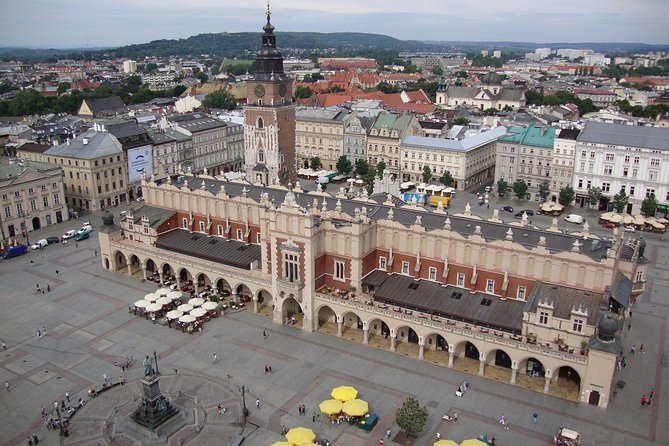
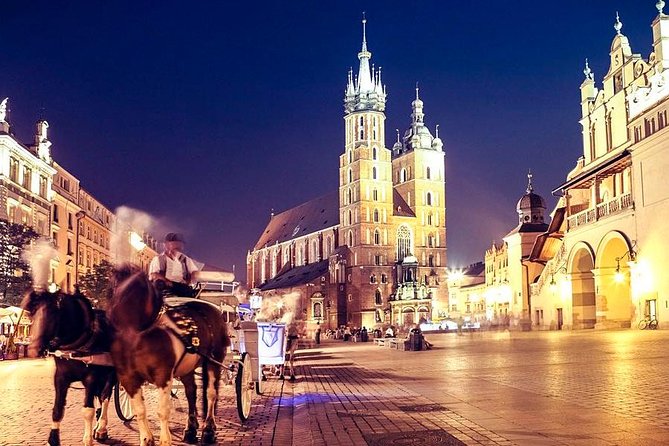
Krakow was once Poland’s royal capital and remains one of the country’s key centers for learning, culture, and the arts. The guided walk begins in the old city, centered on Rynek Główny, the large cobbled Main Square.
The square is the natural starting point because so many parts of Krakow’s story meet here. You can see the Cloth Hall, a long historic market building, and the surrounding townhouses and landmarks. The square’s scale is impressive, but its real appeal comes from the way it still functions as the city’s public center.
Your guide helps turn the buildings into a readable story rather than a quick parade of names. You learn why Krakow became such an important seat of power and why its academic life mattered. The nearby Jagiellonian University is one of the world’s oldest universities, and its presence gives the city a distinctly scholarly character.
The Krakow portion is scheduled for about three hours. That is enough for a guided orientation and the main highlights, but not enough for every museum or interior. The emphasis is on seeing the city’s major landmarks and understanding their place in Polish history.
Wear comfortable shoes. The old center is explored on foot, and the cobblestones can make a long walk more tiring than the distance suggests. You should also keep personal shopping modest, since the later salt mine visit has its own fixed schedule.
Kazimierz and the story behind Schindler’s List
The route continues to Kazimierz, Krakow’s former Jewish district. This is one of the most meaningful parts of the city tour because it adds human scale to the grand royal setting.
Kazimierz has long been tied to Krakow’s Jewish history, and the guide explains the district’s past as you walk through its atmospheric streets. The area is also associated with Schindler’s List, which was filmed partly in Kazimierz. If you know the film, the setting may feel familiar. If you do not, the neighborhood still offers an important look at a different side of Krakow.
This stop is valuable because it prevents the city tour from becoming only a royal greatest-hits visit. Krakow is not just Wawel Castle and grand squares. Kazimierz brings attention to the communities, memories, and cultural layers that shaped the city.
The information provided describes this as a live guided tour, with admission included. It does not specify a separate museum entry in Kazimierz, so expect the focus to be on the district itself and the guide’s commentary rather than a long indoor exhibition.
A few more Wroclaw half days to consider
- Wroclaw: E-Car Tour and Audio Guide
★ 4.6 · 1,738 reviews - Wroclaw: 2-Hour Private Guided Tour by Electric Car
★ 4.8 · 805 reviews - Wrocław: Old Town and Ostrów Tumski Walking Tour in English
★ 4.8 · 311 reviews - Wroclaw: Private Old Town Guided Walking Tour (2 hours)
★ 4.8 · 275 reviews
Wawel Castle and the fire-breathing dragon
Wawel Castle sits on a hill above the city and was home to many Polish kings. The 14th-century complex is one of Krakow’s defining sights, and even a short visit gives you a strong sense of the city’s royal importance.
The castle is more than a photogenic building. It represents the period when Krakow served as the seat of Polish power. Your guide explains the site’s role and points out the connection between the castle hill and the city below.
At the foot of Wawel Hill, you can see the metal sculpture of the Wawel dragon. According to the old legend, a dragon once lived beneath the hill. The modern sculpture breathes fire, providing a lighthearted moment after the heavier historical material.
Do not confuse seeing Wawel Castle on this itinerary with a full museum visit. The tour description emphasizes admiring the hilltop complex and learning its history, but it does not promise entry into every castle interior or collection. If specific rooms or exhibitions matter to you, ask the guide what is included on the day.
That distinction is important. The schedule gives you a broad look at Krakow, not an exhaustive castle study. For many people, that is the right trade-off on a day that also includes Wieliczka.
Entering the Wieliczka Salt Mine
After Krakow, you continue to Wieliczka for a visit lasting about three and a half hours. The mine was built in the 13th century and is protected as a UNESCO World Heritage site. More than a thousand years of mining activity created a network of chambers, tunnels, and carved spaces beneath the town.
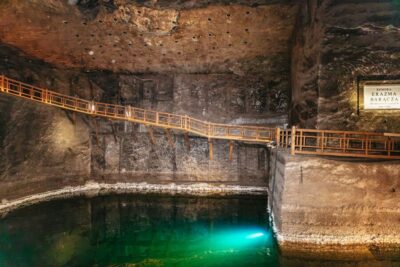
The scale is hard to picture until you are below ground. The mine reaches 327 meters in depth, though your visit covers selected highlights rather than every level. Much of the work was cut by hand from natural salt, which gives the place its unusual mix of industrial labor, religious devotion, and folk art.
You descend by stairs and follow the underground route through chambers and galleries. The physical setting is part of the attraction. Instead of looking at a mine from a platform, you move through the spaces created by generations of miners.
A moderate level of physical fitness is required. The tour includes stairs on the way down, and you should be prepared for a substantial walk underground. The high-speed lift returns you to the surface at the end, which avoids climbing all the way back up.
The mine can feel like a sharp change from Krakow. One moment you are looking at royal buildings and university courtyards. The next, you are surrounded by salt walls and tunnels. That contrast is one reason the combination works so well.
Chapel of St Kinga, where salt becomes art
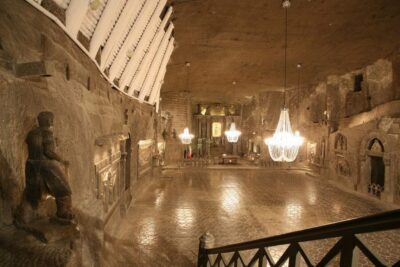
The main showpiece is the Chapel of St Kinga, an underground church carved from salt. Statues, religious details, chandeliers, and other features were made from the mine’s own material.
This is the point where the mine becomes more than an engineering curiosity. Miners did not simply extract salt and leave. They created spaces for worship and filled them with sculpture, giving the underground workplace a spiritual and artistic dimension.
Look closely at the surfaces. The salt is not a decorative afterthought. It is the substance of the walls, carvings, and furnishings. Your guide explains the history of the mine and the mining methods used to create these chambers.
The chapel is likely to be the most memorable part of the day, but it is worth paying attention throughout the route. The smaller galleries and tunnels help you understand how the mine developed over time. Without that context, the chapel could seem like an isolated spectacle. With it, you see the chapel as part of a much larger underground undertaking.
The mine visit includes admission, so you do not need to arrange a separate ticket. Souvenir photos and a DVD are not included and are available to buy, but neither is necessary to understand the visit.
What the private format changes
A private guide can make a major difference on a history-heavy day. You can ask why Krakow became the royal capital, how Kazimierz changed, or how miners shaped salt into religious art. The guide can also adjust explanations to your interests instead of following a fixed script for a large crowd.
The maximum group size is eight people. That is small enough to keep the walk personal while still allowing the tour to operate as a compact group experience. The service is described as including a private guide and an English-speaking driver, so you should expect separate roles, with the driver handling the road journey and the guide leading the sightseeing.
The strongest praise available for this experience focuses on the guides and driver. A particularly positive account describes excellent guides, a well-informed driver, and a patient, flexible approach. Those qualities matter here because the day includes several transitions and a long return to Wroclaw.
There is also a warning you should not ignore. One booking was canceled by the operator only a day before departure, without an explanation. The overall score is 4.2 from five ratings, which suggests a generally favorable but limited record. Because the sample is small, I would confirm the pickup and operating status shortly before the date, even though the stated cancellation policy allows you to cancel for a full refund up to 24 hours before the start time.
Who will get the most from this day
This trip suits you best if you want maximum sightseeing in one day and prefer someone else to handle the driving. It is particularly useful for visitors based in Wroclaw who do not want to arrange separate transport to Krakow and Wieliczka.
It also works well for couples, families with older children, and small groups who value private commentary. Children must be accompanied by an adult, and everyone should be comfortable with walking and stairs.
You may not enjoy it as much if your ideal Krakow visit involves sitting in cafés, visiting several museums, or exploring Kazimierz at your own pace. The three-hour Krakow segment gives you a well-planned introduction, but it cannot cover everything.
The trip is also less suitable for anyone with limited mobility, given the mine’s stairs and walking requirements. The provided details call for moderate physical fitness, so take that seriously rather than treating it as routine fine print.
Is $311.40 a fair price?
The answer depends on how many people share the cost and how much convenience matters to you. At $311.40 per person, this is not a budget excursion. Yet the fee covers a full private day, air-conditioned transport, hotel pickup and drop-off, fuel charges, admissions to the listed sights, an English-speaking driver, and trip insurance.
For two people, the total cost is substantial. For a group of four to eight, the private vehicle and guide service may feel more reasonable, especially compared with piecing together long-distance transport, local taxis, and separate admissions.
You are also buying time and simplicity. Krakow and Wieliczka are easy to combine on paper, but doing so independently requires careful scheduling. Here, the route, transport, and guided visits are arranged around the 14-hour day.
The price makes less sense if you only want a quick look at Krakow or if you plan to spend several days in the city later. In that case, independent travel may give you more control. But if this is your only chance to see Krakow and the salt mine from Wroclaw, the package covers the key costs in one booking.
Should you book this tour?
Book it if you want to see Krakow’s essential landmarks and Wieliczka in a single organized day, especially with a small private group. The Main Square, Kazimierz, Wawel Castle, and Chapel of St Kinga give you a broad introduction to Poland’s royal, cultural, Jewish, and industrial past.
Before paying, make sure you are comfortable with the 7:00 am start, the 14-hour duration, the walking and stairs underground, and the relatively high per-person cost. I would also verify the pickup details close to departure because of the reported last-minute cancellation.
For a time-conscious visitor, this is an ambitious but worthwhile choice. For a slower explorer, it is better treated as an overview, not a complete Krakow visit.
FAQ
What time does the tour start?
The tour starts at 7:00 am.
Where does pickup take place?
Hotel pickup is offered in Wroclaw, followed by hotel drop-off there at the end of the day.
How long does the experience last?
The full trip lasts approximately 14 hours.
How many people can join the tour?
The maximum group size is eight people, and at least two people are required for the tour.
Is transportation included?
Yes. Transport in an air-conditioned vehicle is included, along with the fuel surcharge.
Is a guide included?
Yes. The experience includes a private guide and an English-speaking driver.
Which Krakow sights are included?
The tour includes Krakow’s Main Square, the Cloth Hall area, Jagiellonian University buildings, Kazimierz, and Wawel Castle. It also includes the Wawel dragon sculpture.
Is entry to Wieliczka Salt Mine included?
Yes. Admission to Wieliczka Salt Mine is included.
How physically demanding is the tour?
You should have a moderate level of physical fitness. The mine visit includes stairs and underground walking, followed by a high-speed lift ride back to the surface.
Can I cancel for a full refund?
Yes. You can cancel at least 24 hours before the experience’s start time for a full refund. Changes or cancellations made less than 24 hours before the start time are not accepted for a refund.
Recently added in Wroclaw
- CITY QUEST WROCLAW: unlock the mysteries of this city!★ 5.0 · 3 reviews
- Wroclaw: Old City Walk and Cruise with Small Gondola★ 4.7 · 3 reviews
- Private Transfer from Wroclaw (WRO) Airport to Wroclaw city centre★ 5.0 · 3 reviews
- Wroclaw : Walking Custom Tour with a Local Guide★ 4.8 · 3 reviews
- Wrocław: Ostrów Tumski and Old Town Highlights Private Tour★ 5.0 · 3 reviews
- Wroclaw Jewish Quarter Private Guided Tour★ 5.0 · 3 reviews
- Electric Scooter Tour: Full Tour (Old Town + Ostrów Tumski)★ 5.0 · 3 reviews
- Segway Tour Wroclaw: Ostrów Tumski Tour – 1,5-Hours of Magic!★ 5.0 · 3 reviews
Wieliczka Salt Mine Tours, compared.
Wieliczka Salt Mine Guided Tour with Transport
Read our review →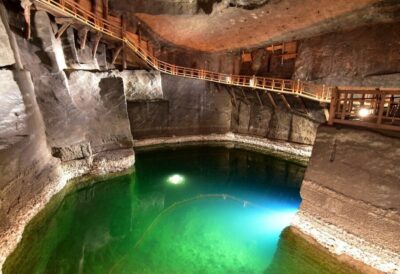
Wieliczka Salt Mine Fast-Track Ticket & Guided Tour
Read our review →
Day Trip: Auschwitz-Birkenau and Wieliczka Salt Mine from Krakow
Read our review →
Wieliczka Salt Mine Tour & Skip the Line Ticket
Read our review →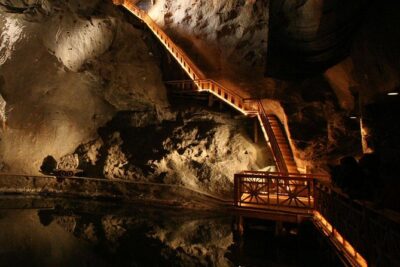
Krakow to Wieliczka: Salt Mine Guided Tour with Ticket & Transfer
Read our review →
Auschwitz-Birkenau & Salt Mine Full-Day Guided Tour
Read our review →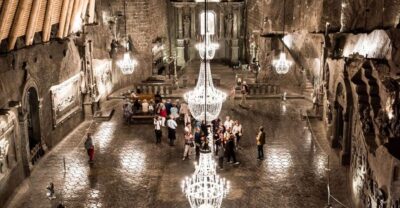
Wieliczka Salt Mine Tour Including Hotel Pick-Up
Read our review →Where else this one turns up