
Reviewed · POZNAN TOURS
The Birthplace of Poland: A Self-Guided Audio Tour of Poznań
Poznań’s Cathedral Island is where Poland’s early story feels especially close at hand. This self-guided walk links Mieszko’s palace remains, the country’s oldest Polish cathedral, a rebuilt bridge, medieval churches, and modern museums in less than 90 minutes. The route gives you a clear historical thread, rather than a string of disconnected sights.
I like the freedom to pause, replay, or walk at your own speed, and I like the low $8.99 price for lifetime access to the English tour. The main consideration is the technology: GPS audio can misbehave, and one user found the guide unclear about the route. Download everything first and contact VoiceMap support quickly if the app fails.
Key points at a glance
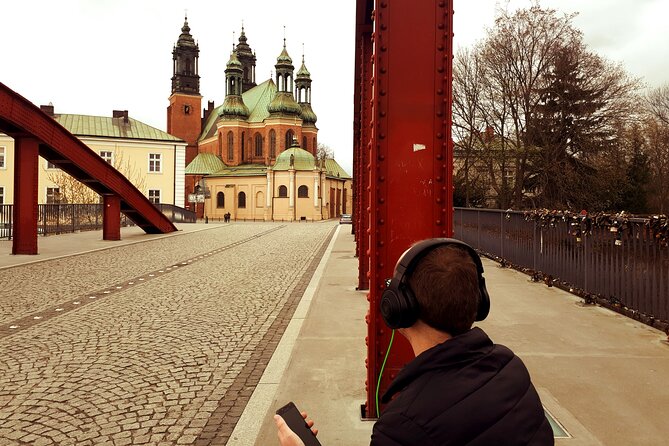
- Mieszko’s palace remains: Hear about the large relics beneath the Church of Our Lady in Summo, tied to the beginnings of Poland’s Christian state.
- Two historic districts: Walk from Cathedral Island across Jordan Bridge into Śródka, an area that was once independent from the rest of Poland.
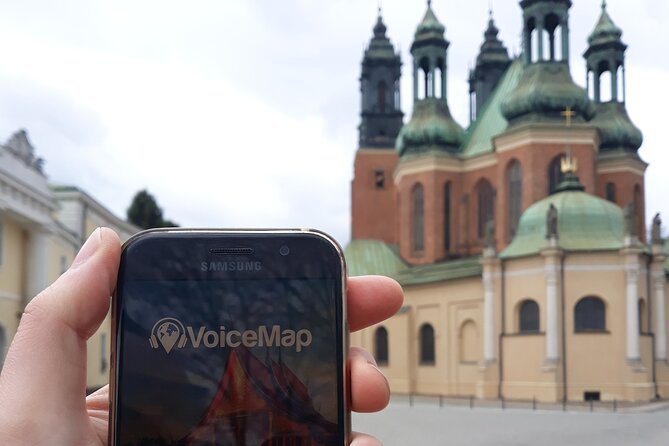
- GPS-triggered narration: The VoiceMap app plays the next section as you reach the right location, with offline audio, maps, and route data.
- A short, flexible walk: The route takes about 45 minutes to 1 hour 15 minutes, but you can pause and continue later.
- Architecture and street art together: The tour pairs Saint Margaret Church and the Archbishop’s Palace with Śródka’s famous wall mural.
- A modest price: At $8.99 per person, it costs less than a conventional guided walk, though entrance fees are not included.
Starting at the Ostrów Tumski scale model
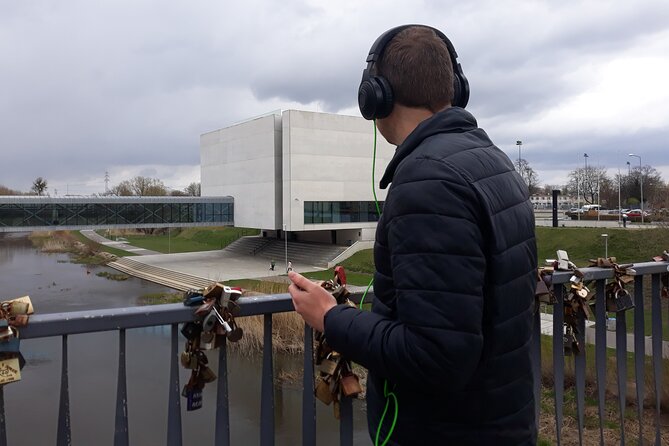
Your walk begins at the scale model of Ostrów Tumski, or Cathedral Island, at Ostrów Tumski 9. This is a sensible starting point because the model helps you understand the island before the buildings and waterways begin to blur together.
The first audio section explains the island and shows you how VoiceMap works. That introduction matters. A self-guided audio tour is only useful if you know when the narration will play, where to walk, and what you are meant to notice. The GPS system is designed to trigger the right guidance as you reach each location.
You need your own smartphone and headphones. The tour includes the VoiceMap app for Android and iOS, plus offline access to the audio, maps, and geodata. I strongly recommend downloading the tour before arriving. That saves you from relying on a mobile signal and gives you a chance to check that the route loads properly.
The posted duration is approximate. If you listen without stopping, you may finish in around 45 minutes. With photographs, pauses, and a slower pace, allow up to 1 hour 15 minutes. The route is not a full museum visit, so anyone hoping to enter every building should set aside extra time and pay separately.
More Self-Guided Tours in Poznan:
- Wroclaw: E-Car Tour and Audio Guide
★ 4.6 · 1,738 reviews - Krakow: Vistula River Sightseeing Cruise with Audio Guide
★ 4.4 · 820 reviews - From Krakow: Auschwitz-Birkenau and Self-Guided Day Tour
★ 4.1 · 576 reviews
Church of Our Lady in Summo and the remains below
The first major stop is the Church of Our Lady in Summo. The church itself is important, but the more startling detail lies beneath it: the remains of Mieszko’s palace and palace chapel.
That fact gives the walk its central theme. You are not only looking at old walls. You are tracing the foundations of the early Polish state, where religious and political power occupied the same small island. The audio explains the church and points your attention toward the archaeological remains beneath it.
You may find this stop more meaningful if you have already spent time in Poznań’s Old Town and seen its later Renaissance and Baroque buildings. Cathedral Island shifts your focus back to an earlier period, before the city became known mainly for its market square and merchant houses.
The tour passes by the church rather than including entry. That keeps the walk inexpensive and compact, but it also means you should not expect a detailed interior visit. If the church or archaeological area is a priority, check separately for opening times and admission.
Poznań Cathedral, Poland’s oldest Polish cathedral
Next comes Poznań Cathedral, identified on the route as the oldest Polish cathedral. Its location makes sense in the story: Cathedral Island was a major religious center, and the cathedral remains the most imposing stop on this part of the walk.
The narration gives you background while you move, so you can look at the building instead of staring down at a screen. That is one of the strongest features of this format. The app supplies context, but your eyes stay on the architecture, the river setting, and the route ahead.
I also like the pace here. A traditional guide may need to keep a whole group moving, while you can stop to study the cathedral or replay a section. You can also pause the tour for a drink or a longer look, then continue when ready.
The drawback is the lack of a person beside you. An audio narrator cannot answer a question about a detail you notice, adjust the route because of noise, or point out something outside the planned script. The tour works best if you want a prepared introduction rather than an open conversation.
The Archbishop’s Palace and layers of rebuilding
The walk continues past the Archbishop’s Palace. The audio covers the building and its many versions over time, which is useful because an old city building rarely has just one story.
This stop helps you read Poznań as a place shaped by change. Palaces, churches, fortifications, bridges, and museums all reflect different periods and different needs. Instead of treating the Archbishop’s Palace as a single frozen monument, the tour explains how it developed through successive iterations.
The Palace also reinforces the close connection between Poznań’s religious institutions and national history. The route does not require you to know the names and dates in advance. You simply follow the narration and let each building add another layer to the walk.
There is no entrance ticket included. You will hear about the building from outside, and that is enough for a quick introduction, but not for a complete architectural visit.
More audio tours in Poznan:
- Krakow: Sightseeing Cruise on Vistula River with Audio Guide
★ 4.4 · 480 reviews - Krakow: Vistula River Sightseeing Cruise with Audio Guide
★ 3.9 · 270 reviews - Krakow: Vistula Night Cruise by Gondola w/ Audio Commentary
★ 4.5 · 72 reviews - Wawel Hill Tour with Audio Guide
★ 4.2 · 53 reviews
Crossing Jordan Bridge into Śródka
One of the most satisfying transitions comes at Jordan Bridge. The tour explains how the bridge was built, destroyed, and rebuilt, eventually reconnecting Cathedral Island with the Śródka District.
This is a good example of why the audio format works well here. A bridge can look like a simple way from one neighborhood to another. The narration turns it into part of the city’s story, showing how crossings can disappear and later restore a connection between communities.
As you cross, the walk changes character. Cathedral Island feels focused on Poland’s early religious and political past. Śródka brings you into a district with its own identity and a more neighborhood-like setting.
The route explains that Śródka was once independent from the rest of Poland. That unusual detail makes the district worth more than a quick pass-through. You are not simply heading toward the next attraction. You are entering a place that once had a separate political position and local life.
The bridge section is also a practical reason to wear comfortable shoes. The total walk is short, but the route is outdoors and includes several stops where you may want to pause.
Śródka’s mural and Saint Margaret Church
In Śródka, the tour passes the Srodka mural, described as one of the first wall paintings of this type in Poland. It offers a sharp contrast with the cathedral and palace. Instead of ancient masonry or formal religious architecture, you get a public artwork woven into the district’s streetscape.
The mural is worth seeing in person because its effect depends on the surrounding buildings and the angle from which you view it. The audio gives you a reason to stop and look closely rather than treating it as a quick photo opportunity.
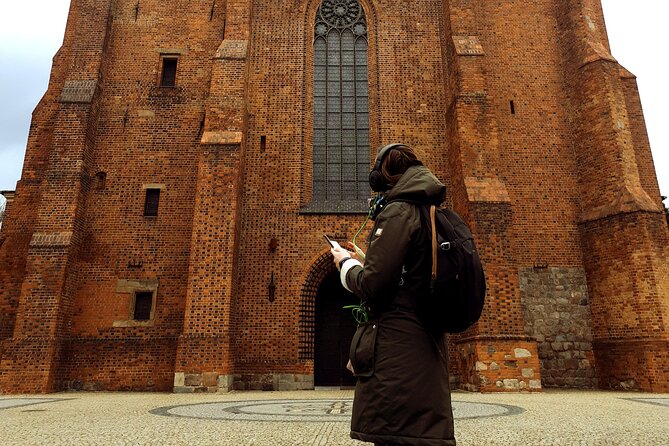
The route then passes Saint Margaret Church. You hear about the church while walking, adding another religious landmark to the district’s story. Because the route places the church after the mural, you get a useful change of mood: modern public art, then a much older place of worship.
I like this mixture. It keeps the tour from becoming a parade of similar churches. You move between archaeology, religious buildings, urban art, bridges, and defensive structures. The walk feels varied even though it stays within a small part of Poznań.
Brama Poznania, the modern museum stop
The next major sight is Brama Poznania, also called the Porta Posnania Heritage Center. This state-of-the-art museum opened in 2014 and focuses on Cathedral Island and Śródka.
The museum gives the area a modern interpretive center. If the audio walk makes you curious about the island’s past, Brama Poznania is the natural place to continue with a longer visit. The tour explains what the museum is about, but the admission price is not part of the $8.99 fee.
That separation is important when you plan your day. The audio tour is an orientation walk. It helps you understand why the district matters and shows you where the main sights are. Museum entry is an extra decision, not a surprise included in the ticket.
You might choose to take the audio tour first, then return to Brama Poznania if you want more exhibits and a fuller presentation. Or you can use the tour as a short introduction on a day when you do not have time for a museum visit.
The Cathedral Lock and Prussian fortifications
The route then passes the Cathedral Lock, a 19th-century part of the Prussian fortification system. This is a valuable reminder that Poznań’s story did not end with its earliest cathedral or medieval districts.
Fortifications can be easy to overlook, especially beside more famous churches and museums. The narration gives the lock a place in the wider story of military planning and urban defense. You may find it especially useful if you want to understand how later rulers reshaped the city.
This stop also adds a different kind of physical setting. Earlier sections focus on palaces, churches, and neighborhood streets. Here, the subject is infrastructure built for defense. The route keeps showing how the island served different purposes across the centuries.
Genius Loci and a thousand-year-old wall
The walk passes Genius Loci, a modern museum built around the remains of the borough’s one-thousand-year-old walls. It also uses 3D immersive films to present the site.
The museum combines physical archaeology with modern presentation. That pairing may appeal to you if old foundations alone feel difficult to interpret. Seeing a wall fragment can be powerful, but films and visual reconstructions often help explain how the original settlement fit together.
Again, admission is not included. The audio tour identifies the museum and explains why it matters, while you decide if you want to pay for a closer visit.
This is one of the route’s best final stops because it brings the whole walk back to its earliest subject. You have heard about Mieszko’s palace, visited the cathedral area, crossed into a once-independent district, and passed later fortifications. Genius Loci returns your attention to the first settlement and its defenses.
Ending at the Archdiocese Museum and Lubrański Academy
The tour ends in front of the Archdiocese Museum in Poznań, at Jana Lubrańskiego 1, in front of the Lubrański Academy. The museum and its setting connect the walk to a period when this area played an important role in Poznań and Poland from the 1500s through the 1700s.
Ending here gives you a clear endpoint rather than leaving you beside an anonymous street. It also places you near another institution tied to the city’s religious and educational past.
The tour does not include museum admission, food, drinks, or transportation. It is best treated as a walking introduction that finishes at a meaningful cultural stop. You can continue exploring on your own after the narration ends, but the supplied information does not specify museum opening times or ticket prices.
The meeting information lists the route area as open from midnight to 11:59 p.m. every day during the stated operating period. That refers to the tour’s meeting-point availability, not guaranteed opening hours for the museums and churches along the route.
What $8.99 buys you
At $8.99 per person, this is inexpensive for a private audio experience. You receive lifetime access in English, so the value is not limited to one afternoon. If you like to revisit a walk, share the route with someone in your group, or listen again after seeing the sights, that long access period helps.
The price also buys flexibility. You do not need to match a guide’s departure time, and you can stop whenever you like. A low-cost audio walk can be a good fit after a train or bus arrival, when your schedule is still changing.
The trade-off is clear. You do not receive entrance tickets, transportation, refreshments, a smartphone, or headphones. You are paying for the route, narration, and app access, not a packaged sightseeing day.
The tour is also booked, on average, five days in advance. That suggests you should not leave the download and setup until the last minute, even though the walk itself is self-guided.
Who should choose this audio walk?
I would choose this tour if you want a short introduction to Poznań’s oldest center and prefer to set your own pace. It suits independent visitors, couples, and small groups who do not want to join a scheduled walking tour.
It is also useful for anyone who likes history but does not want to spend several hours inside museums. In one compact route, you get early Polish statehood, church history, bridges, urban art, Prussian defenses, archaeological remains, and a modern heritage center.
You should be comfortable using a smartphone and listening through headphones. The app usually guides you by GPS, but the experience depends on your phone locating you correctly. One technical problem was reported in the supplied feedback, while another user had a download glitch that support resolved within minutes. That makes preparation important, and it also shows why you should keep the support email, [email protected], available if something goes wrong.
The tour is offered in English only. Most people can participate, and the activity is described as private, with only your group taking part. No special group size or age restriction is given.
Should you book the Poznań Cathedral Island tour?
Book it if you want an affordable, flexible walk centered on the place where Poznań’s earliest political and religious story took shape. The strongest parts are the sequence from Mieszko’s palace remains to the cathedral, the Jordan Bridge crossing, and the shift into Śródka with its mural and separate past.
Skip it if you want a live guide, detailed answers to spontaneous questions, or included access to the museums. You should also avoid booking unless you can bring a working smartphone and headphones.
For $8.99, I think this is a sensible first look at Cathedral Island. Download the route in advance, allow the full 1 hour 15 minutes if you like to stop, and treat the museum visits as optional additions. That approach gives you the best balance of low cost, useful context, and freedom.
FAQ
How long does the audio tour take?
The tour takes approximately 45 minutes to 1 hour 15 minutes, depending on your walking pace and how often you stop.
What language is available?
The tour is offered in English.
Where does the tour start?
It starts in front of the scale model of Cathedral Island at Makieta Ostrowa Tumskiego, Ostrów Tumski 9, 61-109 Poznań, Poland.
Where does the tour finish?
It ends in front of the Archdiocese Museum in Poznań, near the Lubrański Academy at Jana Lubrańskiego 1, 61-003 Poznań, Poland.
What app do I need?
You need the VoiceMap app, which is available for Android and iOS.
Can I use the tour without mobile data?
Yes. The tour includes offline access to the audio, maps, and geodata.
Are museum tickets included?
No. Entrance fees for museums and other attractions along the route are not included.
Do I need to bring anything?
You need your own smartphone and headphones. Food, drinks, and transportation are also not included.
Is this a group tour with a live guide?
No. It is a self-guided private activity using recorded audio, and only your group participates.
Recently added in Poznan
- Poznan Private Vodka Tasting Tour★ 5.0 · 3 reviews
- Poznan: Private Polish Beer Tasting Tour★ 4.6 · 3 reviews
- Poznan Old Town and Croissant Museum Private Walking Tour★ 5.0 · 3 reviews
- Palace, Castle and Ancient Oaks – Rogalin and Kórnik guided tour from Poznan★ 5.0 · 4 reviews
- Discover Poznan: Walk, Take a tram and have a traditional snack★ 5.0 · 4 reviews
- Private 3-hour Poznan Old Town Tour★ 5.0 · 5 reviews
- Poznan: City and Brewery Private Walking Tour with Beer★ 4.6 · 5 reviews
- Poznan: Private Jewish Heritage Tour★ 5.0 · 5 reviews
Poznan Tours, compared.


Private or Public Highlights Tour with a local guide
Read our review →
Poznan Old Town and Top Attractions Private Walking Tour
Read our review →
Poznan Private City Walking Tour from Cathedral Island
Read our review →
Where else this one turns up