
Reviewed · WALKING TOURS
Krakow Walking Tour with Audioguide on Your Smartphone
Krakow’s story unfolds in layers on this walk, from the medieval Barbican and St. Florian’s Gate to Wawel Cathedral, the royal castle, and the Jewish quarter of Kazimierz. The final stops at Ghetto Heroes’ Square and the Jan Karski monument give the route a serious, thoughtful finish.
I like the freedom to pause, rewind, and set your own pace, and I like the low price of $8.27, especially with one year of access. The 26 recordings, landmark illustrations, and offline map give you more structure than simply wandering with a guidebook.
The trade-off is simple: this is an app, not a person. You must download and activate it, carry your own phone and headphones, and pay close attention to the route. Some users found navigation a little awkward when switching between the app and Google Maps.
Key points before you set out
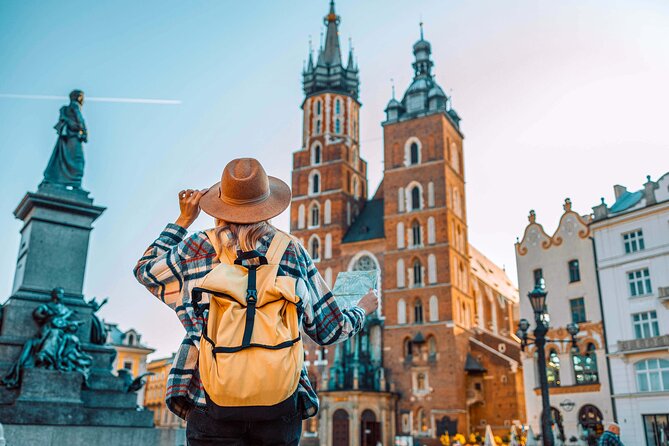
- 26 English recordings: Professional historian narration gives context at major sights without tying you to a group schedule.
- One-year access: You can use the tour at the stated time or later, since the date and time selected at checkout are only approximate.
- A long historical arc: The route connects medieval defenses, royal Poland, university life, Jewish Krakow, and World War II memorials.
- Bring your own equipment: A smartphone and headphones are required, and neither is supplied.
- Mostly an outdoor walk: The route covers streets, squares, and exterior landmarks. Entrance tickets are not included.
- Good value with a navigation caveat: At $8.27, it is inexpensive, but you should download the tour and map before starting.
From the Barbican to St. Florian’s Gate
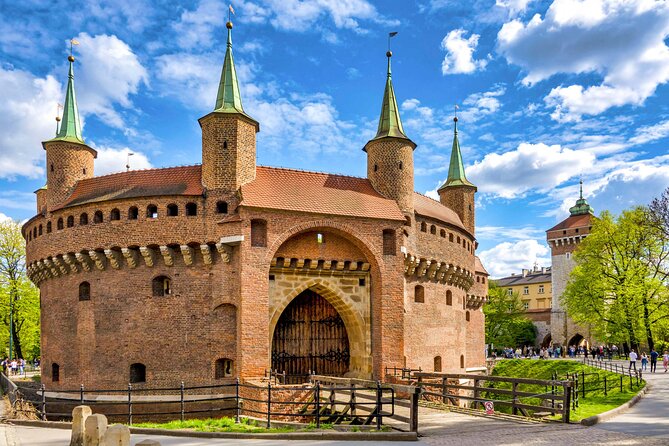
The walk begins at the Krakow Barbican on Basztowa Street, an impressive circular fortress built in the late 15th century. Its thick brick walls and seven turrets once protected the city from attack, and the open courtyard helps you understand how this was more than a pretty landmark. It was a working piece of Krakow’s defenses.
The audio recording is useful here because the Barbican can look like a lone monument unless you understand its role beside the old city walls. The site now hosts exhibitions, historical reenactments, and cultural events, but the tour focuses on the building’s medieval purpose and military design.
From there, you continue to St. Florian’s Gate, the 33.5-meter Gothic tower that once formed a key entrance through Krakow’s defensive walls. Its Baroque roof adds a later flourish to the medieval structure. Walk beneath the gate and you enter the Royal Route, the traditional path toward the center of town.
The suggested stop takes about 10 minutes and has no admission fee. That timing is enough for a look and an audio segment, but you should allow extra time if you want photographs or need to sort out the app at the start.
More Self-Guided Tours in Krakow
- Krakow: Vistula River Sightseeing Cruise with Audio Guide
★ 4.4 · 820 reviews - From Krakow: Auschwitz-Birkenau and Self-Guided Day Tour
★ 4.1 · 576 reviews - Krakow: Sightseeing Cruise on Vistula River with Audio Guide
★ 4.4 · 480 reviews
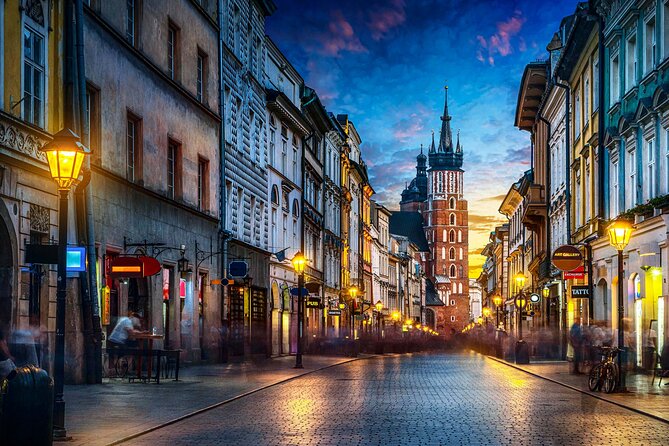
Florianska Street leads into the Main Market Square
Ulica Florianska connects St. Florian’s Gate with Krakow’s Main Market Square. This is one of the easiest sections of the route, with historic townhouses, shops, cafés, and places to stop for a drink. The audio guide helps you look beyond the shopfronts to the older facades and the street’s role in the city center.
I would treat this as a transition rather than a formal sightseeing stop. The listed time is about 10 minutes, but you can slow down here without worrying about missing a group. That flexibility is one of the strongest reasons to choose a self-guided walk.
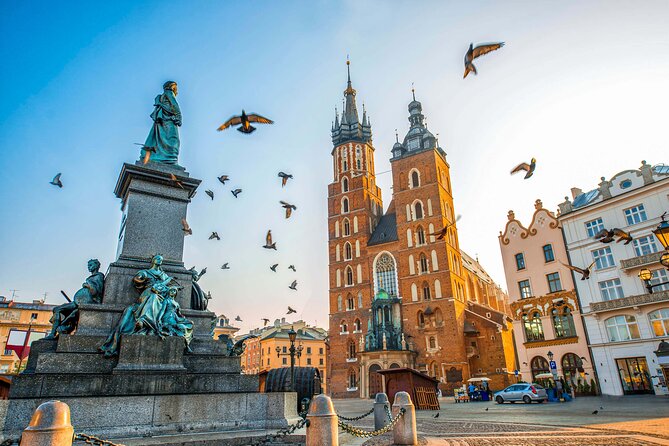
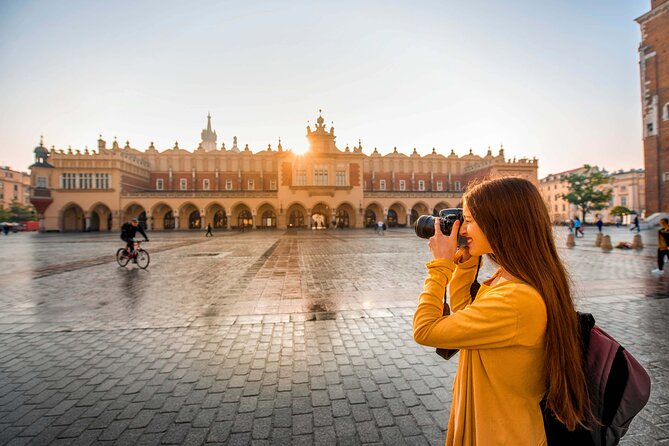
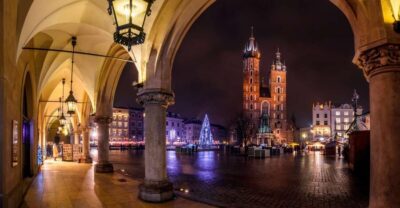
At the end of Florianska Street, the city opens into Market Square, one of Europe’s largest medieval squares. This is the heart of the Old Town, surrounded by the Cloth Hall, St. Mary’s Basilica, and the Town Hall Tower.
The square is also a place to pause and watch daily Krakow unfold. Street performances, market stalls, and outdoor cafés add movement, while the audio narration gives you a reason to look up at the surrounding buildings instead of rushing across the open space.
St. Mary’s Basilica and the city’s best-known sound
St. Mary’s Basilica is one of the major visual highlights of the walk. Its twin towers are deliberately unequal: the taller Bugle Tower is connected with the hourly trumpet call, while the shorter Bell Tower gives the facade its distinctive profile.
Inside, the most important artistic feature is the great wooden altarpiece by Veit Stoss. The basilica also contains stained glass and a richly decorated interior, so this is one place where an exterior-only walk may leave you wanting more.
Entrance tickets are not included, and the tour’s general information says you should expect to pay separately for tickets where required. At the same time, the route is described as a street walk with no required entry fee. In practical terms, you can follow the route without buying admission, but you should not assume that every interior mentioned is included in the $8.27 purchase.
The audio recording can provide useful background before you decide how much time to spend inside. I like that arrangement because you can keep the walk moving on a short visit, or stop longer when a church or museum catches your interest.
The Town Hall Tower and Collegium Maius
The 70-meter Town Hall Tower is the last remaining part of Krakow’s former 14th-century Town Hall. Its winding staircase leads to city views and exhibits about Krakow’s civic past.
This stop is best for people who enjoy old stonework and a physical climb. The tower is not just a lookout. Its surviving architecture and displays help explain how the Main Market Square functioned as the center of public life.
Next comes Collegium Maius, the oldest building of Jagiellonian University. Its medieval arcades and courtyards offer a quieter change of mood after the square. The building preserves lecture halls, a library, professors’ rooms, and a collection of early scientific instruments.
The university was founded in the 14th century and is linked with Nicolaus Copernicus, who studied there. A separate stop covers Collegium Iuridicum and the broader academic tradition of Jagiellonian University, founded in 1364.
The route gives this university area about 10 minutes at the Collegium Iuridicum stop. That is enough for an outside look and a short recording, but the preserved rooms and instruments may call for more time. Since entrance fees are not included, check the current admission arrangements if you want to go inside.
More Walking Tours in Krakow
- Old Town Krakow & Wawel Castle Walking Tour
★ 5.0 · 1,508 reviews - Creepy Krakow: 2-Hour City Walking Tour
★ 4.7 · 1,131 reviews - Krakow: The Old Town Walking Tour
★ 4.8 · 794 reviews - Krakow: Kazimierz Jewish Quarter Walking Tour
★ 4.8 · 571 reviews
Kanonicza Street and the bishop’s palace
From the university quarter, the route moves toward Kanonicza Street, one of Krakow’s most appealing old streets. Its cobbles and carefully preserved Renaissance and Baroque houses create a calmer setting than Florianska Street.
Many of the buildings were once linked with clergy and scholars. The Bishop’s Palace and other restored residences now house museums and cultural institutions, giving the street both architectural appeal and a connection to Krakow’s religious and intellectual life.
The nearby Palace of Bishop Erasmus Ciolek adds an art option. This early 16th-century Renaissance palace belongs to the National Museum and contains Polish medieval sculpture, religious icons, and early modern paintings.
You can appreciate the palace from outside while following the route, then decide if the interior collection suits your schedule. This is a useful feature of the audioguide format: you are not locked into a fixed list of paid entries.
Wawel Cathedral and the royal hill
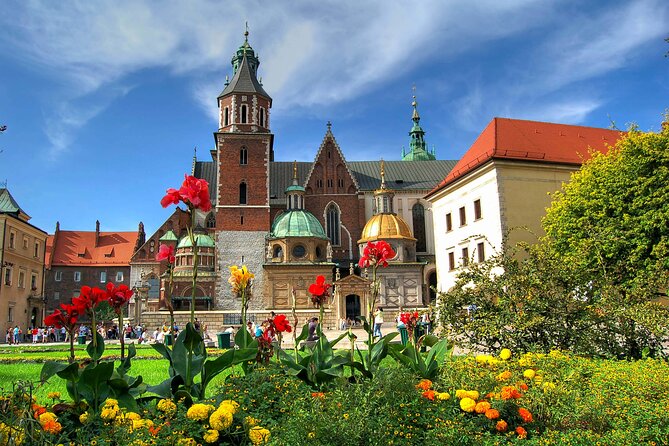
Wawel Cathedral brings the walk into Poland’s royal story. The Gothic cathedral on Wawel Hill was the setting for royal coronations, weddings, and funerals. Inside are royal tombs, decorated chapels, the large Sigismund Bell, sacred objects, and royal regalia.
The cathedral is a place where the audio guide’s historical context matters. Without some explanation, it can be hard to grasp why this building carries such weight in Polish public life. The recording gives you a framework before you examine the chapels and tombs.
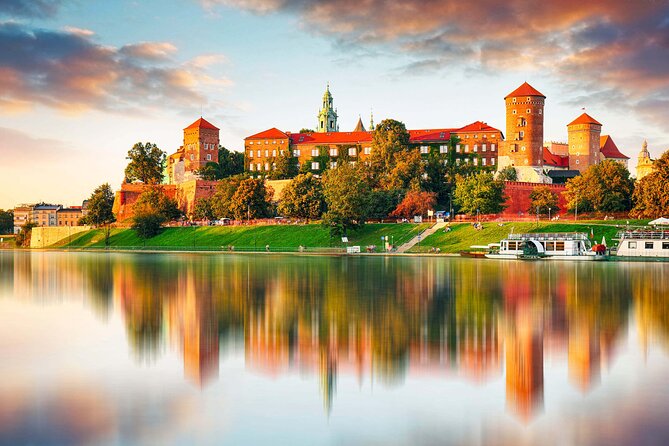
Wawel Castle is next, also on the hill and also a UNESCO World Heritage site. Its complex includes Renaissance courtyards, state rooms, Royal Apartments, tapestries, the Crown Treasury, and the Armory. Views toward the Vistula River add another reason to pause outside.
The castle is too large to treat as a quick stop if you want to see its main interiors. The two-and-a-half-hour estimate makes sense only if you keep the pace brisk and focus on the audio highlights. If you enter several paid rooms, expect the visit to take longer.
This is one of the tour’s practical strengths and limits. The route links the castle and cathedral in a clear sequence, but the app cannot replace the time needed to explore a major historic complex.
Crossing into Kazimierz and the Tempel Synagogue
The walk then shifts from royal Krakow to Kazimierz, the district associated with the city’s Jewish community. At the Tempel Synagogue, you can see Moorish Revival design dating from 1862, with gilded stucco, detailed woodwork, and colorful stained glass.
Tempel was associated with progressive Judaism and remains a place for religious services, concerts, and cultural events. The stop gives you a chance to consider Jewish life in Krakow as more than a museum subject. It points to a living cultural and religious tradition.
Okrąglak offers a more everyday view of Kazimierz. This circular former market hall now attracts people for food stalls, especially zapiekanki, the open-faced Polish sandwiches associated with Krakow street food.
I like this pairing because it keeps the district from feeling like a string of solemn monuments. You get architecture, faith, memory, and a chance to eat something local. Food is not included, so bring money if you want to try a zapiekanka during the walk.
Szeroka Street and the Old Synagogue
Szeroka Street is the cultural center of Kazimierz’s Jewish quarter. The broad street leads you past the Old Synagogue, Remuh Synagogue, and the adjoining cemetery. Cafés, restaurants, Judaica shops, and cultural events give the area a strong connection to both the past and present.
The route allots about 10 minutes here. That works for an introduction, but you may want to pause longer, especially if you plan to enter the Old Synagogue museum or look closely at the Remuh area.
The Old Synagogue dates from the 15th century and is one of Poland’s oldest surviving synagogues. It now operates as a museum, with religious objects, historical documents, and displays about Jewish customs and community life.
This stop carries emotional weight as well as architectural interest. The narration can help you place the building within the long story of Krakow’s Jewish population, while the museum gives more detail if you choose to pay for entry.
Jan Karski and Ghetto Heroes’ Square
The Jan Karski monument offers a quiet moment away from the main sightseeing streets. The statue shows Karski seated on a bench with a book, in Planty Park near the Old Town.
Karski was a Polish World War II resistance fighter and diplomat who reported the Holocaust to the Allied powers. The monument is designed for reflection rather than spectacle. I would slow down here and let the audio recording do its work.
The route then reaches Ghetto Heroes’ Square in Podgórze, the former Krakow Ghetto area. Seventy empty metal chairs mark the absence of the Jewish people who were forced from their homes and deported during World War II.
This is the most sobering part of the walk. The square does not offer a light sightseeing finish, and that is precisely its purpose. The memorial asks you to confront loss and remember the people who lived in this part of Krakow.
The stop is listed at about 10 minutes, but I would not rush it. The chairs are simple and powerful, and the nearby memorial information adds context to the deportations and the suffering of the ghetto’s residents.
The advertised route ends back at the original meeting point near the Krakow Barbican. Because the final memorial is in Podgórze, pay close attention to the app’s map and return instructions. The supplied information describes the activity as a walking route and does not include transportation, so you should not count on a vehicle transfer between sections.
How the app works in real conditions
You receive access to an audio guide app for iPhone and Android, with 26 recordings narrated by a professional historian. Landmark illustrations help you identify the correct building, while the offline map uses GPS to show the route.
Download the app and the tour before you start. One user found it cumbersome to move between the app and Google Maps, and the provider specifically recommends downloading the tour and activating GPS. Doing this on a reliable connection should make the first few minutes much easier.
You can pause and restart the recordings, which is useful at busy squares, inside churches, or during a food stop. You can also listen again if you miss a detail. The app includes special framed photo options, according to the supplied user feedback, which adds a small souvenir feature.
The biggest operating mistake would be arriving at the Barbican expecting a guide with a sign. No human guide will be waiting at the meeting point. You start the experience yourself, follow the map, and use your own headphones.
The stated maximum is 20 people, but this does not mean you are joining a conventional 20-person group. It refers to the activity capacity, while the experience itself remains self-guided.
Is $8.27 good value for Krakow?
At $8.27 per person, this is a low-cost way to put Krakow’s main districts into a sensible order. You get a year of access, 26 recordings, route illustrations, and an offline map. That is good value if you want historical explanation but do not need a live guide.
The value is strongest for a first visit to the Old Town. The route connects the Barbican, Royal Route, Main Market Square, Jagiellonian University, Kanonicza Street, Wawel, Kazimierz, and the World War II memorials in one broad outline.
It is less valuable if you want detailed help inside Wawel Castle, St. Mary’s Basilica, or the synagogues. Entrance tickets are not included, and a phone recording cannot answer follow-up questions or adjust the explanation to your interests.
The two-and-a-half-hour estimate should also be treated as a brisk walking time. Photos, food, paid interiors, weather, and app setup can all stretch the day. In very cold weather, the format becomes less pleasant because you are handling a phone and headphones outdoors. At minus 14 degrees Celsius, one user could not make full use of the walk, which is a fair warning for a winter booking.
Who should choose this walk?
I would recommend it to independent visitors who like to explore alone, want a clear route, and prefer a modest price. It also suits people who may need to stop often, since you can pause and continue without holding up a group.
It works well for a short orientation visit, especially if you plan to return later to selected interiors. The Old Town sections are easy to combine with your own café, shopping, and museum choices.
I would choose a human-led tour instead if you want conversation, local recommendations, help with navigation, or detailed answers about Poland’s complex past. The app gives you structure, but all decisions remain yours.
Free cancellation is available if you cancel at least 24 hours before the local start time. Inside that window, the payment is not refunded, so check your plans before activating the experience.
Should you book the Krakow smartphone audioguide?
Book it if you want a cheap, flexible introduction to Krakow and are comfortable managing your own phone. The best features are the 26 recordings, the offline map, the ability to pause, and the broad route from medieval defenses to Jewish Krakow and Holocaust memorials.
Skip it if you need a guide waiting at the start, dislike phone navigation, or want admission to the major interiors included. For most independent visitors, $8.27 is a sensible price for orientation, provided you download the map first, bring headphones, and leave extra time beyond the advertised two hours and 30 minutes.
FAQ
Is this a guided tour with a person?
No. This is a self-guided tour delivered through an iPhone or Android app. No human guide will meet you at the Krakow Barbican.
How long does the walking tour take?
The approximate duration is two hours and 30 minutes. The route can take longer if you stop for photos, food, paid entrances, or additional time at Wawel Castle and the museums.
What is included in the tour?
You receive one year of access, 26 English audio recordings narrated by a professional historian, an audio guide app, landmark illustrations, and an offline GPS route map.
Do I need to bring my own phone and headphones?
Yes. Smartphones and headphones are not included. You need to download the app, activate your purchase, and bring your own listening equipment.
Are entrance tickets included?
No. Entrance fees and tickets are not included. You can follow the street route without paying for an entry, but optional visits inside sites such as Wawel Castle, St. Mary’s Basilica, or museums may require separate admission.
Where does the tour start and finish?
It starts at the Krakow Barbican on Basztowa Street, Krakow, Poland. The activity information says it ends back at the meeting point. Pay close attention to the app map, especially after the route reaches Ghetto Heroes’ Square in Podgórze.
Recently added in Krakow
- Auschwitz-Birkenau and Krakow Private Car Trip from Katowice★ 4.3 · 3 reviews
- Wawel Castle, Old Town with St. Mary’s Church Guided Tour★ 5.0 · 3 reviews
- From Krakow: Chocholow Thermal Hot Springs (hotel pick up)★ 5.0 · 3 reviews
- Private tour to Zakopane and Thermal Baths from Krakow★ 5.0 · 3 reviews
- Wawel Castle, Cathedral, Rynek Underground Tour with Lunch★ 5.0 · 3 reviews
- Legends of Cracow ROBOTIC SHOW★ 4.0 · 3 reviews
- From Krakow: Zakopane and Thermal Pools Guided Trip★ 5.0 · 3 reviews
- Guided Beer Tour in Krakow★ 4.5 · 3 reviews
Walking Tours, compared.




Gdańsk City Sights & History Guided Walking Tour in English
Read our review →


Where else this one turns up