
Reviewed · OLD TOWN TOURS
Private Krakow City Tour, Old Town and Jewish District Tour
Krakow’s story is packed into a walk from medieval gates to Wawel Castle, then onward to the former Jewish district and the remnants of the wartime ghetto. This private tour gives you a guide’s full attention, with Chris, Andrew, or Kristof able to adjust the pace and explain the city beyond the usual postcard views.
I like the hotel pickup and the way the route links the Old Town with Kazimierz rather than treating them as separate sights. I also like the personal style described by past guests, especially Chris’s family connections to Krakow’s past. The main drawback is simple: four to five hours on foot is a lot, and entrance fees are not included.
Key points to know before booking
- Private from start to finish: Only your group takes part, so you can ask questions and request a little more time at places that interest you.
- Two Krakows in one walk: The route covers the medieval center, Wawel Hill, Kazimierz, and the former ghetto area.
- Strong guide-led history: Chris, Andrew, and Kristof are praised for clear explanations, humor, patience, and personal knowledge of the city.
- Mostly exterior sightseeing: Many churches, synagogues, and monuments are explained from outside, with admission tickets costing extra.
- A serious walking commitment: The tour lasts about four to five hours and includes many stops across central Krakow.
- Useful early orientation: Hotel or apartment pickup helps you begin without finding a meeting point in an unfamiliar city.
A long walk through Krakow’s story
This is not a quick parade of famous buildings. It is a private city orientation built around Krakow’s changing identity: royal city, university town, Jewish center, Nazi ghetto, and modern cultural destination.
You meet your English-speaking licensed guide at your Krakow hotel or apartment. From there, the tour moves on foot through a dense central area. The listed stops are short, often five to 20 minutes, but the value comes from the explanation tying them together.
The route has an ambitious reach. It begins north of the Main Market Square, crosses the medieval Old Town, continues to Wawel, and then heads into Kazimierz and the former ghetto district. You should expect plenty of standing, walking, and conversation rather than long indoor visits.
That format works best if you want to understand how the city fits together before exploring on your own. It is less suitable if you prefer museum interiors, a slow café stop, or a tour with little walking.
More Old Town Tours in Krakow
- Old Town Krakow & Wawel Castle Walking Tour
★ 5.0 · 1,508 reviews - Krakow: Bike Tour of Old Town, Jewish Quarter and the Ghetto
★ 4.9 · 1,155 reviews - Krakow: The Old Town Walking Tour
★ 4.8 · 794 reviews
From Matejko Square to the medieval gates
The opening stops around Matejko Square give you a useful sense of Krakow beyond its postcard center. The square is named for Jan Matejko, one of Poland’s best-known historical painters, and it sits beside the Grunwald Battle Memorial.
The monument recalls the 1410 Battle of Grunwald, a major Polish and Lithuanian victory over the Teutonic Knights. Your guide uses the memorial and surrounding square to set up the political and military story behind medieval Poland.
Next come the Barbican and St. Florian’s Gate. The Barbican is a round defensive structure that once guarded the approach to the city. St. Florian’s Gate, along with the remaining fragments of the medieval walls, shows how Krakow controlled entry into its inner center.
These stops are brief, about ten minutes each. That is enough for an explanation and photographs, though not enough for a detailed architectural study. Admission is free for the listed outdoor visits, which keeps the opening portion easy and flexible.
Florianska Street and the Main Market Square
Ulica Florianska leads you into the heart of the Old Town. It forms part of the historic route toward Krakow’s Main Market Square, where the city’s grandest public buildings gather around a broad open space.
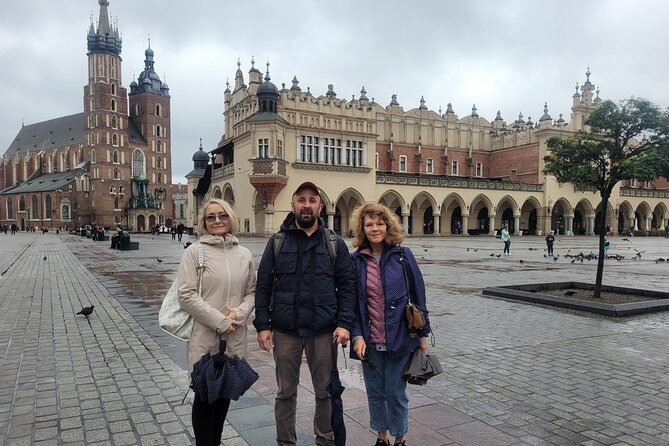
You receive about 20 minutes at Rynek Glowny, followed by explanations of St. Mary’s Church from outside. The church is famous for its two uneven towers and the hourly trumpet call from the taller tower. Since this visit is exterior only, you will not see the interior or hear a full account of its artwork unless you return later.
The Cloth Hall, or Sukiennice, occupies the center of the square. Its name recalls the medieval trade in cloth and other goods. Today it remains one of the clearest symbols of Krakow’s commercial past, and your guide can help you read the building as part of the square rather than as an isolated photo stop.
The Town Hall Tower is also explained from outside. The short visits here are useful for orientation, but keep your expectations clear: this is not a ticketed tour of the Cloth Hall museum, St. Mary’s Church, or the tower.
University lanes and Krakow’s oldest core
The route then turns toward the Jagiellonian University quarter. Collegium Maius is the university’s oldest building and one of the most atmospheric stops in the center. Collegium Novum, the university headquarters, gives the tour a second look at Krakow as a place of scholarship and public life.
You also visit the Franciscan Church from outside, then walk along Grodzka Street, part of the old Royal Route. This is one of the city’s most important north-south paths, linking the market area with Wawel Hill.
The tour includes the Jesuits’ Church and a church described as the oldest in Krakow. Both are exterior explanations, so you may want to mark them for a later return if religious art or interiors matter to you.
Kanonicza Street is another small but worthwhile section of the walk. Its historic buildings lead naturally toward Wawel and help you see the transition from merchant Krakow to the royal quarter. With a private guide, you can pause to ask why this short street matters instead of simply moving past it with a crowd.
A different kind of day in Krakow:
- From Krakow: Auschwitz-Birkenau Guided Tour & Hotel Pickup
★ 4.5 · 33,358 reviews - From Krakow: Auschwitz-Birkenau Guided Tour & Hotel Pickup
★ 4.5 · 29,340 reviews - Krakow: Auschwitz Guided Tour with Optional Hotel Pickup
★ 4.5 · 15,280 reviews - Krakow–Zakopane: Cable Car, Chocholow Baths, Cheese & Vodka
★ 5.0 · 10,720 reviews
Wawel Hill, the castle courtyard, and the dragon
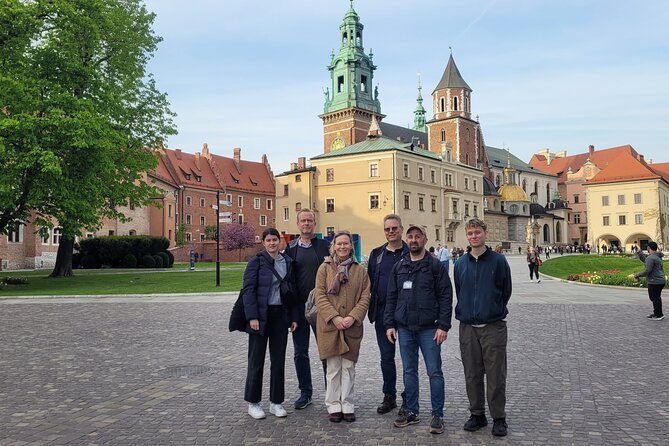
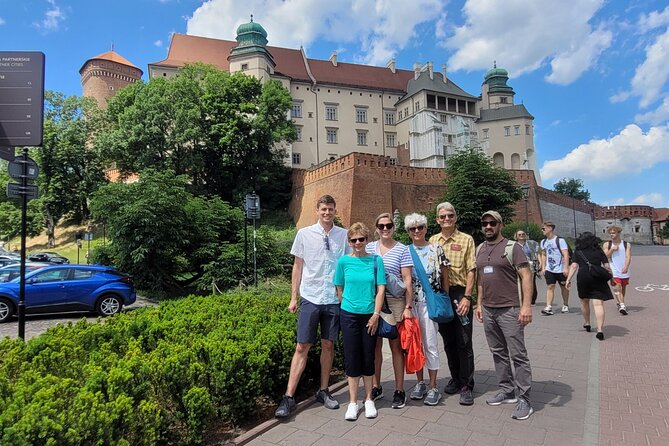
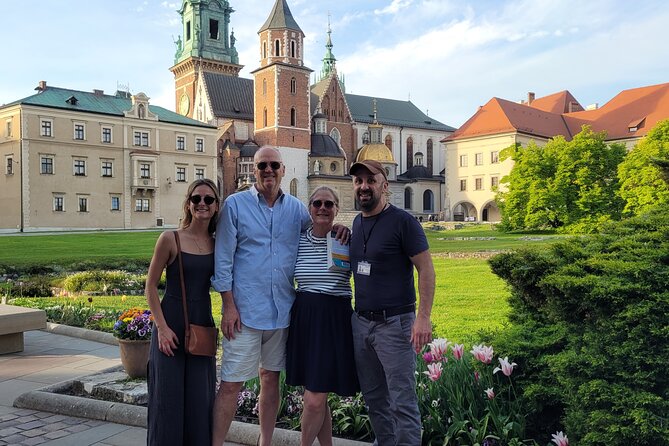
Wawel Royal Castle is the geographic and emotional center of the route. The tour includes the castle courtyard and about 15 minutes of explanation, followed by an exterior account of the cathedral.
That distinction matters. You are not buying admission to the castle apartments, treasury, cathedral interior, or other paid rooms. The guide gives you the setting and the main story, then you can decide if a separate return visit deserves part of your schedule.
The cathedral is closely tied to Polish kings, national ceremonies, and important figures. The courtyard, meanwhile, gives you a compact view of the castle complex without requiring a ticket. The Dragon Statue adds a lighter moment after the royal and religious material, recalling one of Krakow’s best-known legends.
I see Wawel as one of the strongest parts of the tour because it joins architecture, national history, and folklore in one place. The 15-minute explanation is enough to get your bearings, though history fans may wish for more time here.
Kazimierz and the former Jewish district
After Wawel, the tour turns to Kazimierz, the former Jewish district. This is where the character of the walk changes. Instead of royal power and medieval defenses, you encounter Jewish religious life, community buildings, wartime memory, and the film locations connected with Schindler’s List.
The Market Square in Kazimierz is described as a center for trade. From there, the route reaches Mrs. Dresner’s courtyard and stairs, a location associated with the film. The stop can interest movie fans, but the guide’s broader context is more important than the film connection alone. You are looking at a real neighborhood shaped by Jewish life and then fractured by Nazi persecution.
The Izaak Synagogue, Reformed Tempel Synagogue, Jewish Community Center, and Kupa Synagogue create a useful sequence. Some are seen from outside, and the tour includes explanations rather than guaranteed interior access. You should plan a separate visit if you want to enter a synagogue or spend time with its displays.
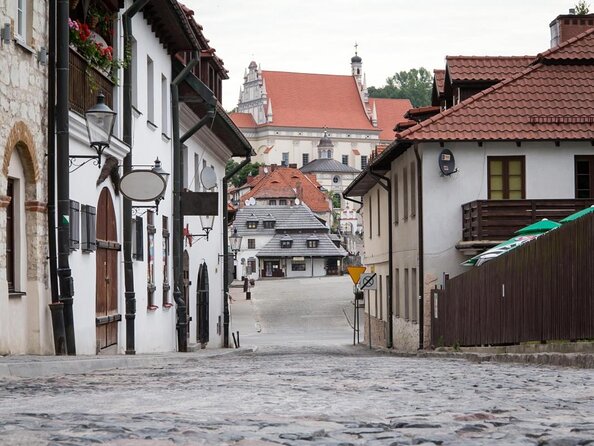
The route continues along Szeroka Street, identified as the oldest part of Krakow’s Jewish quarter. The street and nearby synagogues help you picture the area as a working community, not simply a historic district for sightseeing.
You also see the Wolf Popper Synagogue, the Helen Rubinstein family house, another 15th-century synagogue from outside, and the High Synagogue. These stops may feel repetitive if you have little interest in religious architecture, but they are valuable if you want to understand the scale and variety of Jewish life in prewar Krakow.
A private guide is especially useful here. You can ask about the differences between the synagogues, the role of the streets, and what happened to the local community. The tour does not reduce Kazimierz to restaurants and movie scenery.
Ghetto Square and the wall fragments
The final section moves into the former ghetto area. Plac Bohaterow Getta, or Heroes of the Ghetto Square, contains a memorial made from empty chairs. The image is stark and easy to understand: homes were emptied, families were forced out, and ordinary household objects became symbols of absence.
The tour then reaches fragments of the ghetto wall. Only a small portion remains, so do not expect a large preserved complex. Its power comes from the physical reminder that this persecution was imposed through walls, checkpoints, and forced confinement within the city.
This ending gives the tour a serious final note. After the churches, university buildings, royal courtyard, and Jewish quarter, you finish with the 20th-century destruction of Krakow’s Jewish community. A good guide can help you connect the sites without turning the subject into a list of dates.
What the private format adds
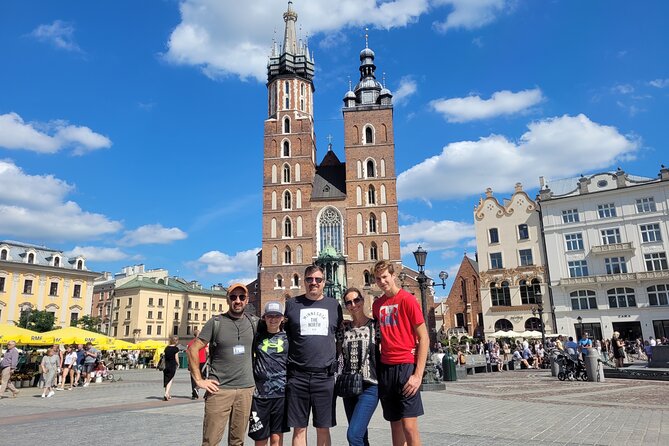
The biggest advantage is control. If your group wants more time at Kazimierz, asks many questions about wartime Krakow, or needs a short drink break on a warm day, the guide can respond more easily than a large group tour.
Chris is described as keeping conversation going for the full five hours and bringing family experience into the city’s wartime story. Andrew is noted for politeness, humor, and strong command of Krakow’s past. Kristof is praised for a thorough route and for allowing drink stops on a warm day.
Those details suggest the experience depends heavily on the individual guide. That is normal for a private walking tour, and it is also why the guide’s personality matters as much as the route. You should expect an active exchange, not a recorded commentary.
The tour can also be customized to your interests. One past account describes help with purchases at a local flea market, while another notes that the guide adjusted the walk to the group’s preferences. That flexibility is a real benefit when you are traveling with family or friends who do not all want the same thing.
Price, walking, and what is included
At $132.16 per person, the value depends on group size. For one person, it is a costly walking tour. For a family or small group, the private guide service can make more sense because the price buys personal attention rather than a seat on a standard group outing.
The price includes a private licensed English-speaking guide. It does not include entrance tickets. That is not a major problem for this route because many stops are outdoor views, but you should budget separately if you want to enter churches, synagogues, museums, or the castle rooms.
The duration is about four to five hours. You should wear comfortable shoes and plan for a substantial amount of walking. Most travelers can participate, and service animals are allowed, but the supplied information does not promise a specific accessibility route or vehicle transfer.
Pickup from your hotel or apartment is helpful, especially on your first morning in Krakow. Since the experience is entirely on foot, pickup means the tour begins with a personal meeting rather than transport to the sights.
It is booked, on average, 69 days ahead. I would not treat that as a strict rule, but it is a useful reason to reserve early if your dates are fixed. The tour is offered in English and has a 4.9 rating from 43 reviews, with 100 percent recommending it, so availability may matter during busy periods.
Free cancellation is available up to 24 hours before the start time. Changes or cancellations inside that window are not accepted for a refund.
Who should book this Krakow walking tour?
I would choose this tour if you want a serious first look at Krakow and prefer asking questions to following a large flag through the streets. It suits couples, families, and small groups who want the Old Town, Wawel, Kazimierz, and the ghetto memorials in one outing.
It is also a strong choice if you care about context. The best parts are not only the famous buildings, but the links between them: the Royal Route, the university quarter, Jewish community streets, film locations, and the remains of the ghetto wall.
I would think twice if your group cannot walk for four to five hours, wants extensive indoor sightseeing, or prefers a short highlight tour. You will need separate entrance tickets and extra time if you want to explore the interiors properly.
For most first-time visitors who want a private, history-led introduction, I would book it. Go in ready to walk, bring questions, and treat the tour as your Krakow framework. Then return to Wawel, St. Mary’s, a synagogue, or a museum with a clearer idea of what you are seeing.
FAQ
Where does the tour begin?
Your guide meets you at your hotel or apartment in Krakow.
Is this a private tour?
Yes. Only your group participates in the activity.
How long does the tour last?
The tour lasts approximately four to five hours.
Is the tour conducted in English?
Yes. It is offered with a private English-speaking guide.
Is transportation included during the tour?
No. This is a walking tour.
Are entrance tickets included?
No. Additional entrance costs are not included. Many listed stops are exterior visits with free admission.
Which parts of Krakow does the tour cover?
It covers Krakow’s Old Town, Wawel Royal Castle area, Kazimierz, the former Jewish district, Heroes of the Ghetto Square, and fragments of the ghetto wall.
Can most people participate?
Yes. The information states that most travelers can participate, and service animals are allowed.
Can I cancel for a full refund?
Yes, if you cancel at least 24 hours before the experience start time. Cancellations made less than 24 hours in advance are not refunded.
Recently added in Krakow
- Auschwitz-Birkenau and Krakow Private Car Trip from Katowice★ 4.3 · 3 reviews
- Wawel Castle, Old Town with St. Mary’s Church Guided Tour★ 5.0 · 3 reviews
- Private tour to Zakopane and Thermal Baths from Krakow★ 5.0 · 3 reviews
- Wawel Castle, Cathedral, Rynek Underground Tour with Lunch★ 5.0 · 3 reviews
- From Krakow: Chocholow Thermal Hot Springs (hotel pick up)★ 5.0 · 3 reviews
- Legends of Cracow ROBOTIC SHOW★ 4.0 · 3 reviews
- From Krakow: Zakopane and Thermal Pools Guided Trip★ 5.0 · 3 reviews
- Guided Beer Tour in Krakow★ 4.5 · 3 reviews
Old Town Tours, compared.




Bike Tour of Old Town, Jewish Quarter and the Ghetto
Read our review →

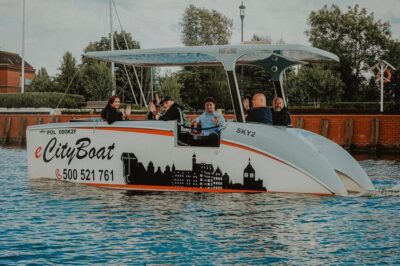
Sightseeing EcoCruise around the Old Town of Gdansk
Read our review →
Where else this one turns up