
Reviewed · JEWISH QUARTER & KAZIMIERZ TOURS
Kraków old town and jewish quarter®
Kraków’s story makes sense only when you connect its grand royal center with the Jewish quarter across the river. This three-hour Spanish-language walk does just that, moving from medieval walls and the Market Square to Wawel and then into Kazimierz, where Jewish and Catholic life shaped one another for centuries.
I like the route for two clear reasons: it covers the city’s essential sights without charging museum-style prices, and it uses history to explain what you are seeing rather than simply naming buildings. Guide Luis has been praised for lively explanations supported by photos and drawings. The main drawback is pace. Old Town, Wawel, and Kazimierz are a lot to cover in three hours, so some stops will be viewed from outside and the walk may feel short if you want long visits inside each site.
Key points to know before booking
- Three major Kraków districts in one walk: Old Town, the Wawel Hill complex, and Kazimierz all appear on the route.
- History comes first: A graduate guide in Geography and History explains how events in Kraków connect with Poland’s wider past.
- Spanish-language guiding: The activity is conducted in Spanish, with Luis named in the strongest feedback.
- Strong visual teaching: Photos, drawings, and a map to the meeting point can make complex history easier to follow.
- A serious look at Kazimierz: The route covers Jewish settlement, Catholic coexistence, occupation, Holocaust memorials, and surviving synagogues.
- Good value at $16: Food and drinks are not included, but the low fee buys a broad introduction to central Kraków.
Why this route gives Kraków a useful shape
Kraków can feel like a collection of beautiful buildings until someone explains how the pieces fit together. The Old Town was the political and commercial heart, Wawel was the seat of royal and religious power, and Kazimierz developed as a separate district with a major Jewish population.
That connection is the real value here. You are not only looking at the Basilica of Saint Mary or the old defensive walls. You are hearing why the city grew in those places, how its communities lived alongside one another, and how war and occupation changed everything.
The tour is led by a graduate guide in Geography and History. It is available in Spanish only, so this is a particularly useful choice if you want detailed explanations in that language. Luis is specifically praised for making the subject easy to follow, using photos and drawings rather than relying on a long stream of dates.
The route is wheelchair accessible, although the exact ease of each section can depend on street conditions and the pace of the group. The meeting point is identified by the guide carrying a gray umbrella, a simple detail that matters in a busy central square.
More Old Town Tours in Krakow
- Old Town Krakow & Wawel Castle Walking Tour
★ 5.0 · 1,508 reviews - Krakow: Bike Tour of Old Town, Jewish Quarter and the Ghetto
★ 4.9 · 1,155 reviews - Krakow: The Old Town Walking Tour
★ 4.8 · 794 reviews
Starting among Kraków’s medieval defenses
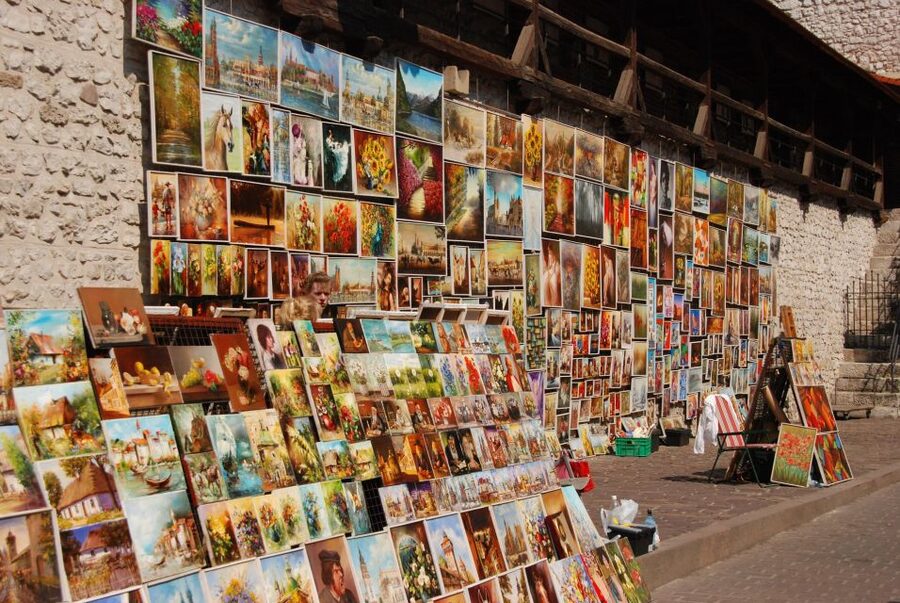
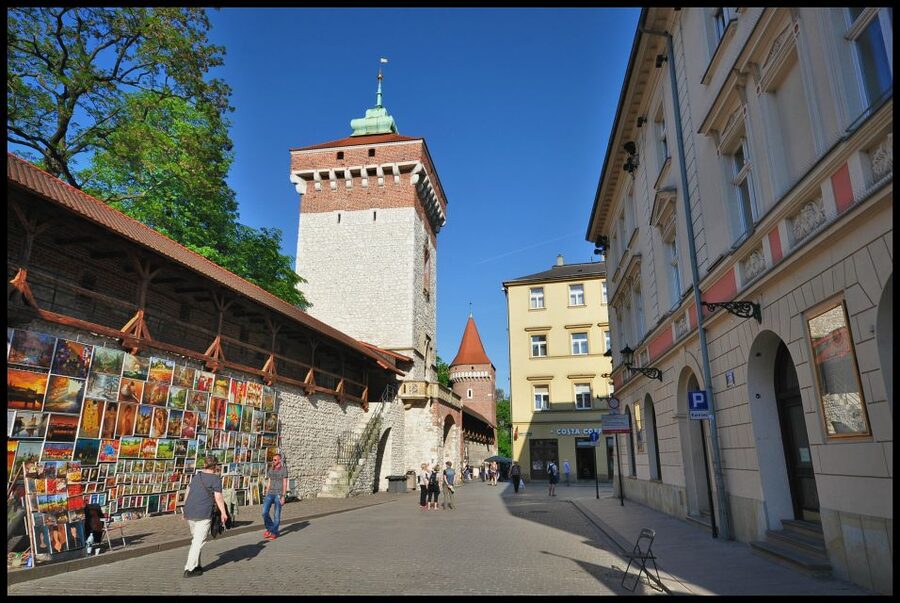
The walk begins in the downtown area near the old defensive edge of Kraków. You will see the Juliusz Słowacki Theater, medieval walls, the Barbican, and St. Florian’s Gate.
These first sights help you picture Kraków as a fortified medieval city. St. Florian’s Gate was one of the main entrances through the city walls, while the Barbican protected the approach from outside. The theater adds a later cultural layer, showing that the route is not limited to one period of history.
I like this opening because it gives you a physical sense of the city’s boundaries before you enter the center. Instead of appearing as an isolated monument, the gate becomes part of a defensive system. The limitation is that the tour moves on quickly, so anyone fascinated by military architecture may want to return later for a slower look.
From here, the route leads toward the Marketplace, Kraków’s broad central square. This is the natural place to pause and understand the city’s public life.
Reading the Market Square one building at a time
The Market Square brings together several of Kraków’s most recognizable sights: the Basilica of Saint Mary, Sukiennice, the old town hall tower, the Church of Saint Adalbert, the Adam Mickiewicz Monument, and the Eros Bendato sculpture.
The guide’s job here is to explain the square’s monumental load, not just point toward it. Saint Mary’s Basilica dominates one side, while Sukiennice, the historic cloth hall, recalls the square’s commercial role. The old town hall tower is a surviving fragment of civic power, and Saint Adalbert’s Church represents the much older religious layer beneath the city’s later grandeur.
The Adam Mickiewicz Monument adds a national dimension. Mickiewicz is one of Poland’s best-known poets, and his presence shows how the square also serves as a stage for Polish identity. Eros Bendato, with its large reclining head, gives the setting a modern and slightly playful contrast.
This part can be crowded, and you should expect to stand outdoors while listening. Still, the concentration of important sights makes the square one of the most efficient parts of the tour. A guide helps you avoid treating it as a photo stop and move on without understanding what you saw.
The university quarter and Kraków’s intellectual life
Next comes the university neighborhood, including Collegium Maius. This area introduces Kraków as a center of learning, not only a royal city.
The route connects the university with figures such as Nicolaus Copernicus and John Paul II, both of whom received academic training here. That connection gives the university quarter a wider meaning. Copernicus links Kraków with the history of science, while John Paul II links it with Poland’s religious and modern political story.
You should not expect a full indoor university visit during this walk. The strength of this stop is the explanation of people and institutions in their urban setting. If you have time afterward, you can explore the university area more slowly on your own.
The tour also points out the Archbishop’s Palace and the Basilica of the Franciscans. These buildings help explain the importance of Kraków’s religious institutions and connect the university district with the city’s church history.
Other Jewish Quarter and Kazimierz walks:
- Krakow: Jewish Quarter and Former Ghetto Tour
★ 4.9 · 1,441 reviews - Krakow: Kazimierz Jewish Quarter Walking Tour
★ 4.8 · 571 reviews - Krakow: Kazimierz, Schindler’s Factory & Ghetto Guided Tour
★ 4.8 · 460 reviews - Krakow: Bike Tour of the Old Town, Kazimierz, and the Ghetto
★ 4.9 · 350 reviews
Wawel Hill and the symbols of Polish power
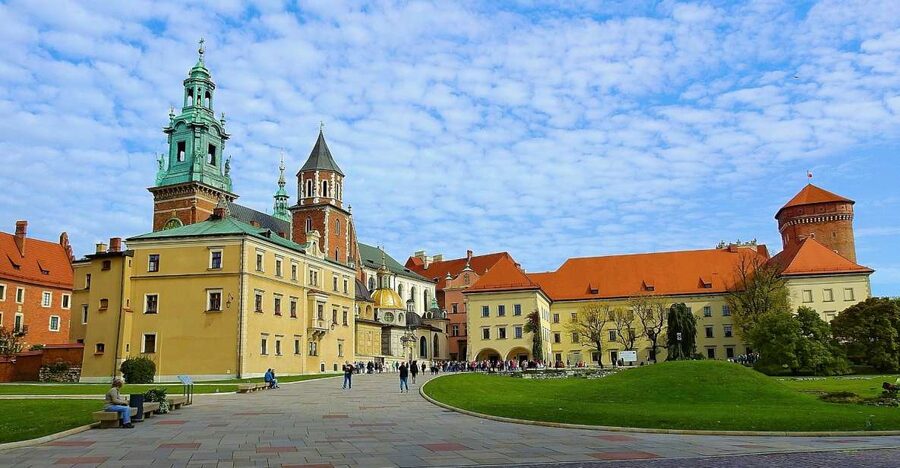
Wawel is the route’s grandest section. You will ascend the hill to examine the Wawel complex, including the cathedral and the buildings gathered around it.
Wawel is important because it brings royal, religious, and national history into one compact place. The cathedral is not simply another church on a sightseeing list. It is part of the symbolic center of Poland, and the wider complex shows how Kraków developed as a seat of authority.
A good guide can make Wawel less confusing. The complex contains several buildings and architectural periods, so a short explanation helps you understand why the hill matters before you decide which interiors deserve a separate visit.
The tradeoff is time. Wawel deserves hours if you want to visit its museums and rooms, but this three-hour route treats it as an outdoor historical introduction. You will study the complex and cathedral from the route rather than receive an exhaustive interior tour.
The dragon sculpture is a lighter stop. It connects the hill with Kraków’s famous dragon story and gives the group a break from royal and wartime history. It is a small detail, but it helps keep the walk from becoming too solemn.
Crossing into Kazimierz’s Jewish past
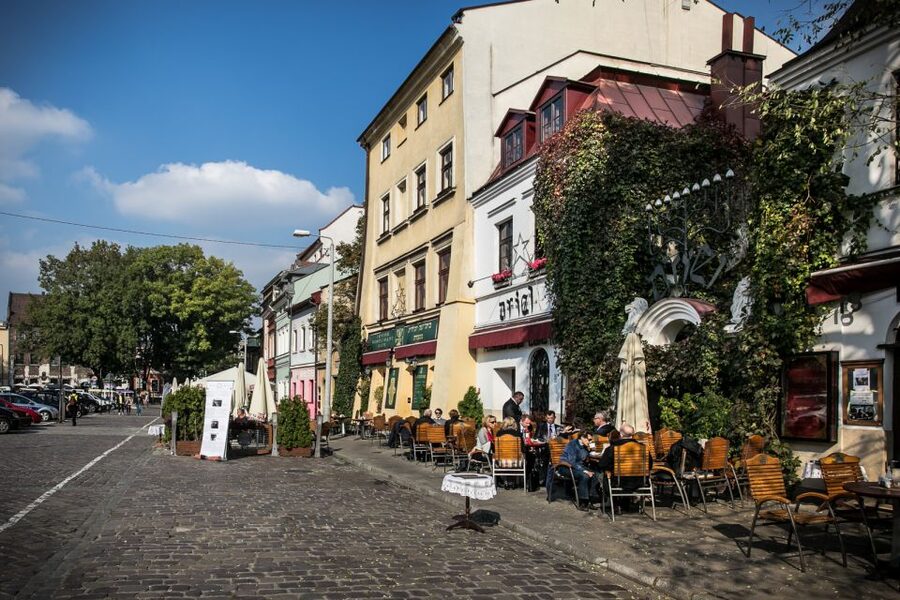
The move into Kazimierz changes the tone of the tour. This district was home to the first Jewish communities that settled in Kraków, and the guide explains why Jewish residents established themselves here and how Jewish and Catholic communities interacted.
This is where the route becomes especially useful. Kazimierz is often presented as a photogenic neighborhood of cafés, old walls, and religious buildings. You will get more from it if you understand the people and institutions that gave the district its identity.
The itinerary includes Tempel Synagogue and the Old Synagogue, two important reminders of Jewish religious life. It also includes the old Jewish cemetery, New Square, the medieval square of Kazimierz, and sections of the district walls.
The Old Synagogue is tied to the long history of Jewish settlement in the district, while Tempel Synagogue reflects a different phase of Jewish religious and communal life. Seeing both in the same walk helps you notice that Kraków’s Jewish community was not a single, unchanging group.
New Square adds an everyday neighborhood setting. It is less formal than Wawel or the Market Square, and that contrast matters. You begin to picture Kazimierz as a lived-in district rather than a museum of the past.
The walk also addresses coexistence between Jewish and Catholic residents. That subject needs care, and the guide’s historical training is valuable here. The story includes cooperation, separation, conflict, and the pressures that later made the Jewish experience in Poland both central to European history and deeply painful.
Occupation, Holocaust memorials, and the limits of a short tour
Kazimierz’s most difficult sites include the Monument to the Victims of the Holocaust, the Monument to the Righteous Among the Nations, and the Monument to Polish Victims during the occupation.
These memorials shift the tour from medieval settlement to twentieth-century destruction. You will learn about the impact of occupation on both Jewish residents and Polish victims, while the monument to the Righteous Among the Nations points to people who helped Jews during the Holocaust.
This section is one reason I would choose a historian-led route rather than a simple sightseeing walk. Memorials can lose their meaning when you see them without context. The guide provides a framework for understanding who is remembered, what happened, and why the subject remains sensitive.
You should also know what three hours cannot do. The tour can introduce the history of Kazimierz and identify its key sites, but it cannot provide a full study of the Holocaust, the occupation, or postwar Polish-Jewish relations. Treat this section as a serious orientation, then set aside more time if you want to visit museums or memorial sites in depth.
The subject matter may feel heavy, especially after the lighter opening sights. That is appropriate to the place, but it also means this is not simply a casual architecture walk.
What the teaching style adds
The strongest practical detail about the guide is the use of photos and drawings. History becomes easier to grasp when you can compare an old view with the street or building in front of you.
The pace also receives special praise. The route changes places often enough to keep the explanations moving, while the guide links each district to the next. One winter group continued listening through cold and snow, which suggests that the presentation can hold attention outdoors. Still, you should dress for the weather because the experience takes place on foot and does not include refreshments.
Guide Luis is named in the most enthusiastic feedback, but guide assignments can change. The confirmed feature is a Spanish-speaking graduate guide in Geography and History. The language matters: if Spanish is your preferred language for complex historical subjects, you will get more from the walk than from a guide who only offers brief facts in a second language.
Is $16 a fair price for three hours?
At $16 per person, this is inexpensive for a three-hour guided introduction to Kraków’s central historic areas. You are paying for a broad route, live Spanish commentary, and historical interpretation rather than admissions to museums or meals.
That distinction is important. Food and drinks are not included, and the route does not promise entry to every church, synagogue, or Wawel building. If you want a long indoor visit at each stop, the price will not change that limitation.
For a first day in Kraków, I think the value is strong. You can use the walk to learn the city’s layout, note places to revisit, and get practical advice for making the most of your remaining time. The guide also offers help and suggestions for exploring the city after the tour.
The route is ambitious, so value depends on your goal. It is excellent for orientation and historical context. It is less suitable if you prefer slow photography, extended museum time, or a small number of carefully studied sites.
Who should book this Kraków walk?
I would choose this tour if you want Kraków explained in Spanish and you prefer history tied to real streets and buildings. It suits first-time visitors, couples, families with older children, and anyone who wants to connect Old Town with Kazimierz in one outing.
It is also a good fit if you enjoy asking follow-up questions and returning later to the places that catch your attention. The route gives you a useful map of priorities: the Market Square for civic life, Wawel for royal and religious power, and Kazimierz for Jewish history and wartime memory.
You may want a different format if you cannot walk for three hours, though the activity is listed as wheelchair accessible. You should also think twice if your main aim is indoor sightseeing. The route focuses on seeing and interpreting many places, not on spending long periods inside them.
Free cancellation up to 24 hours before the start and reserve-now, pay-later booking make it easier to fit into a changing trip plan. The meeting point is marked by the guide’s gray umbrella, and a map is provided to help you reach it.
Should you book it?
Book this walk if you want a low-cost, Spanish-language introduction that links Kraków’s royal center with Kazimierz’s Jewish quarter. The best reason to go is the historical connection between the stops, supported by a guide who explains with photos and drawings rather than rattling off names.
Allow extra time afterward for any place that captures your interest. Three hours is enough to understand Kraków’s structure, but not enough to fully visit Wawel, study every synagogue, or absorb the memorial sites at length. For a focused first look, this is a sensible and unusually broad choice at $16.
FAQ
How long does the Kraków Old Town and Jewish Quarter tour last?
The walking tour lasts three hours.
What language is the tour conducted in?
The live tour guide speaks Spanish. The activity information identifies the guide as a graduate in Geography and History, and Luis is specifically named in the tour feedback.
How much does the tour cost?
The price is $16 per person.
Which main areas of Kraków does the route cover?
The route covers Kraków’s historic center, the Wawel complex, and the Jewish quarter of Kazimierz.
Is the tour wheelchair accessible?
Yes, the activity is listed as wheelchair accessible.
Are food and drinks included?
No. Food and drinks are not included in the tour price.
What identifies the guide at the meeting point?
The guide carries a gray umbrella. A map is also provided to help you reach the meeting point.
Recently added in Krakow
- Auschwitz-Birkenau and Krakow Private Car Trip from Katowice★ 4.3 · 3 reviews
- Wawel Castle, Old Town with St. Mary’s Church Guided Tour★ 5.0 · 3 reviews
- Private tour to Zakopane and Thermal Baths from Krakow★ 5.0 · 3 reviews
- Wawel Castle, Cathedral, Rynek Underground Tour with Lunch★ 5.0 · 3 reviews
- From Krakow: Chocholow Thermal Hot Springs (hotel pick up)★ 5.0 · 3 reviews
- Legends of Cracow ROBOTIC SHOW★ 4.0 · 3 reviews
- From Krakow: Zakopane and Thermal Pools Guided Trip★ 5.0 · 3 reviews
- Guided Beer Tour in Krakow★ 4.5 · 3 reviews
Jewish Quarter & Kazimierz Tours, compared.
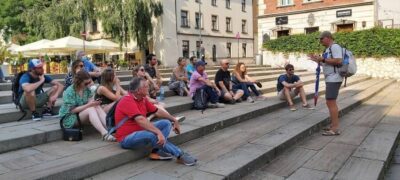

Bike Tour of Old Town, Jewish Quarter and the Ghetto
Read our review →
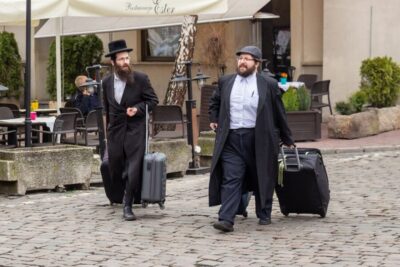
Kazimierz, Schindler’s Factory & Ghetto Guided Tour
Read our review →
Bike Tour of the Old Town, Kazimierz, and the Ghetto
Read our review →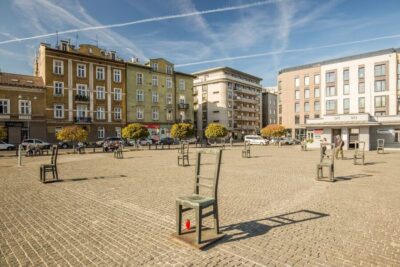

Jewish Quarter and Ghetto Electric Golf Cart Tour
Read our review →
Where else this one turns up