
Reviewed · GDANSK TOURS
TriCity Tour (Gdansk, Gdynia, Sopot) – PRIVATE (8h)
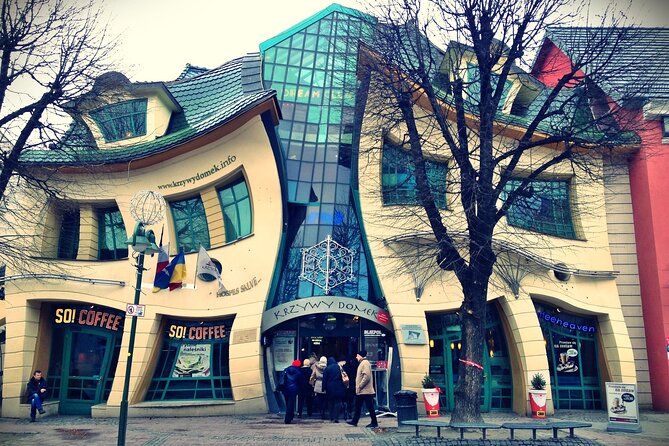
Gdansk, Gdynia, and Sopot give you three very different views of Poland’s Baltic coast in one day. Gdansk brings the medieval drama, with ornate merchant houses, a huge brick church, and the old port Crane. Gdynia feels younger and more maritime, while Sopot is a polished resort town built around its long wooden pier.
I like the private vehicle and hotel pickup, since you avoid spending your day figuring out regional transport. I also like the human touch from guides such as Andrzej Falkowski and Peter, who are described as friendly, flexible, and able to explain local history without burying you in facts. The main catch is the pace: seeing three cities in eight hours means you get a strong overview, not a slow, museum-heavy visit.
Key points to know before booking
- Three cities, three moods: Gdansk is historic and ornate, Gdynia is modern and naval, and Sopot is a seaside resort.
- Private transportation: Hotel pickup and drop-off come in an air-conditioned vehicle for your group alone.
- Best for first-time visitors: The route covers the major sights without requiring you to plan several separate excursions.
- A strong local guide matters: Andrzej Falkowski and Peter are named in the available guide feedback, with praise for clear explanations and an easygoing manner.
- Most admission is optional: The listed tour price covers guiding and transport, but entry fees are not included.
- Allow for a full day: The experience is scheduled for about eight hours, with several walking stops and time beside the Baltic Sea.
Why this private Tri-City route works
The great strength here is efficiency. Gdansk, Gdynia, and Sopot form one connected urban area, but they do not feel like the same place. Instead of choosing one city and missing the others, you get a useful first look at all three.
A private tour also changes the rhythm of the day. You meet your guide in your hotel lobby, ride in an air-conditioned vehicle, and travel with only your own group. That matters in a region where the highlights are spread across separate city centers. You can focus on the streets and waterfront rather than train schedules, parking, or directions.
The guide is especially important because Gdansk’s appearance alone does not explain its complicated past. The city has been shaped by Polish, Prussian, and German rule, as well as periods of autonomy. It was once a major Hanseatic port and, in the early modern period, one of Poland’s wealthiest and largest cities. A good guide can turn grand facades and old harbor machinery into a readable story.
This is not an attraction-by-attraction admission package. The emphasis is on walking, seeing the major sights from outside, and learning the story of each place. The Crane is listed with an admission fee not included, and other optional entries may also cost extra.
A few more Gdansk half days to consider
- Gdansk: City Cruise on Historical Polish Boat
★ 4.8 · 2,913 reviews - Gdańsk: Sunset Cruise on a Historic Polish Boat
★ 4.9 · 977 reviews - Gdańsk City Sights & History Guided Walking Tour in English
★ 4.8 · 876 reviews
Gdansk: begin with Poland’s Baltic showpiece
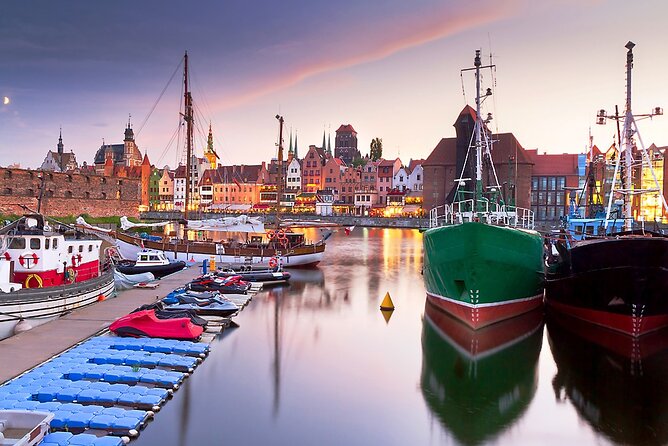
Plan on roughly three hours in Gdansk, including the historic center and its key sights. This is where the day has its strongest concentration of architecture, symbolism, and old port character.
The area called Old Town in the tour description is part of Gdansk’s wider historic center. That distinction matters because the city’s most famous streets are often grouped together under the broad label of Old Town, even though the historic center contains several separate areas. You will walk cobblestoned streets and reach the waterfront, where the city’s medieval trading past becomes easy to picture.
Gdansk was an important port and shipbuilding town in the Middle Ages. It belonged to the Hanseatic League in the 14th and 15th centuries, linking it to a major trading network around northern Europe. The old city’s scale and decorative houses make more sense once you know that merchants here had money, influence, and reasons to build for display.
The route then moves along Dluga Street and Dlugi Targ, the two connected stretches known as the Royal Route. Polish kings once passed this way during formal processions. Today, the pedestrian streets are lined with facades rebuilt in historical styles, especially the ornate look associated with the 17th century.
Look closely at the upper sections of the houses. Crests, symbolic figures, and images of ancient heroes reflect the wealth and ambition of the former patrician residents. The street begins at the Golden Gate, passes the Town Hall and Neptune’s Fountain, and finishes at the Green Gate beside the Motlawa River.
You get about 45 minutes in this area, which is enough for an explanation and photographs, but not enough for a slow examination of every facade. If you like architecture, keep your eyes up and resist spending the whole stop taking pictures of the central fountain.
Neptune’s Fountain and the story of a city symbol
Neptune’s Fountain has been in front of Artus Court since 1633 and is one of the clearest symbols of Gdansk. The bronze figure was designed by Abraham van den Blocke and cast in Augsburg in 1615 by Peter Husen and Johann Rogge. The base later received a Rococo makeover, including added sea creatures.
The fountain is a quick stop, about 15 minutes, but it gives your guide a useful chance to explain Gdansk’s connection to the sea. The familiar coin-toss tradition adds a light moment to a place otherwise surrounded by civic and commercial history.
Artus Court nearby was once a meeting place for the city’s merchants. Its role helps explain why the Royal Route is more than a pretty street. This was a center of civic life, business, ceremony, and public display.
Because the stop is short, you should treat it as part of the walking route rather than a full visit to the building. Admission is not included, and the tour information describes entry fees as optional.
St. Mary’s Basilica: allow time for the scale
St. Mary’s Basilica receives about 30 minutes. Even a short visit gives you a sense of its size. It is described as the largest brick church in the world, with construction running from 1343 to 1502.
The numbers are striking. The church measures 344 feet in length, its vaults rise about 95 feet above the floor, and the main tower reaches 255 feet. From outside, the broad brick mass feels sturdy and restrained. Inside, the height and open space make the building feel far larger than the surrounding streets suggest.
The church contains medieval and Baroque works, including a stone Pietà from around 1410, a copy of Hans Memling’s The Last Judgement, and a 15th-century astronomical clock made by Hans Düringer over seven years. The clock is a particularly useful reminder that medieval religious buildings were also places where engineering, art, astronomy, and public life met.
The tour does not include an admission charge for this stop, but the schedule is tight. You will receive an introduction and time to look around, not a long art-history session. If church interiors are central to your interests, ask your guide how much time can be given here within the private schedule.
A different kind of day in Gdansk:
- Gdansk: Firearm Shooting Experience with Instructor
★ 4.8 · 866 reviews - Gdansk: Guided Round-Trip Cruise to Westerplatte
★ 4.3 · 865 reviews - Gdańsk: Sightseeing EcoCruise around the Old Town of Gdansk
★ 4.6 · 719 reviews - Main Town Gdańsk Walking Tour
★ 5.0 · 644 reviews
The medieval Crane and the Motlawa waterfront
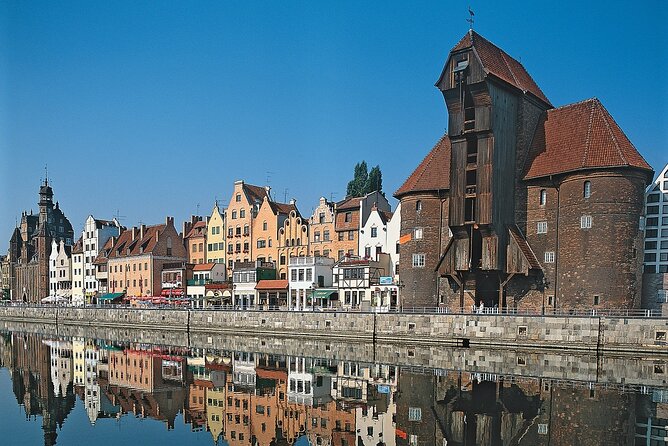
The Crane is one of Gdansk’s most memorable sights because it looks both architectural and mechanical. Built in the first half of the 15th century between the pylons of the Wide Gate, it served as a port crane for moving goods and raising ship masts.
It could lift four tons to a height of 36 feet. Workers powered it by walking inside two large tread wheels. That detail makes the old port feel surprisingly physical. Medieval trade depended not only on ships and merchants, but also on people providing the muscle for every heavy load.
The Crane is now part of the National Maritime Museum. Admission is not included, so you should think of this stop in two ways: as an excellent exterior landmark included in the walking route, or as an optional museum visit if time and interest allow.
Only about 15 minutes are assigned here. That is enough to see the structure and hear its story. It is not enough for a leisurely museum visit, especially when Gdynia and Sopot remain on the schedule.
Gdynia: Poland’s modern harbor city
After historic Gdansk, Gdynia feels like a sharp change of era. The city was constructed in the 1920s around a newly built modern harbor. Its identity is tied less to medieval streets and more to ships, naval power, migration, and Poland’s emergence as a modern maritime state.
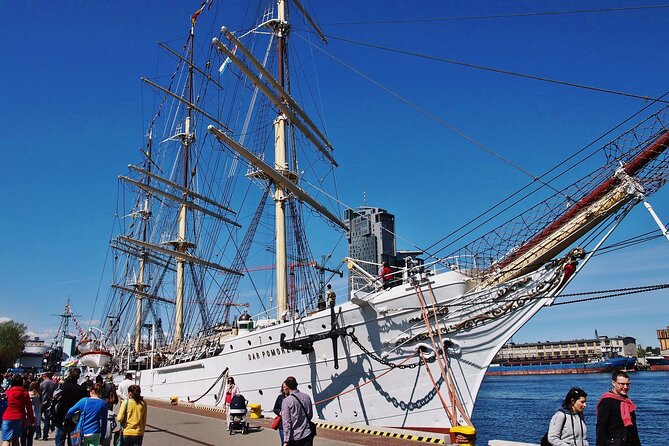
The harbor promenade is the main focus, with about two hours assigned to Gdynia. Historical vessels dock here, including the ORP Blyskawica, a 1930s destroyer described as the oldest preserved ship of its class in the world, and the sailing frigate Dar Pomorza.
Seeing these ships from the harbor gives you a clear sense of Gdynia’s purpose. This is not simply an old port kept for decoration. It is a city shaped by the sea and by Poland’s efforts to build a major harbor in the 20th century.
Gdynia also offers several possible museums. The Naval Museum covers the history of the Polish navy. The Emigration Museum, located in the former Maritime Station, follows 200 years of Polish emigration from the 19th century to modern times. The Gdynia Aquarium focuses on underwater life.
The tour does not promise admission to these attractions, and the available information lists entry fees as optional. With only two hours, you are more likely to see the harbor and learn the city’s story than to make a full museum visit. If one museum is your priority, confirm with the guide how it fits into the day.
Gdynia is a good reason to choose this three-city route rather than a Gdansk-only excursion. You see how the region moved from medieval trade to modern shipping and naval history within the same day.
Sopot: finish beside Europe’s longest wooden pier
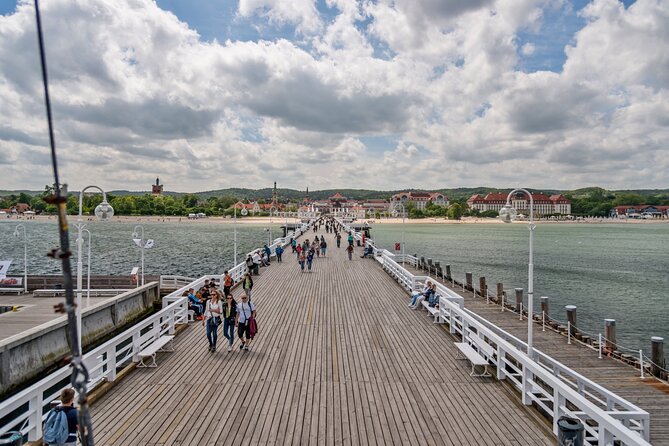
Sopot closes the route with a completely different mood. It is a luxury seaside resort, event town, and shopping center rather than a historic port city. Its best-known feature is the wooden pier, which reaches 560 yards into the sea and is described as the longest wooden pier in Europe.
The pier is not just a photo stop. It gives you open views over the Baltic and a chance to feel the resort’s purpose. At the end, the concentration of iodine is said to be twice the amount found along the shoreline, and walks there are promoted as beneficial to health. You can take that as part of the local seaside tradition rather than a reason to skip your doctor’s advice.
More than 100 vessels can moor along the pier at one time. On land, the pier leads into Plac Zdrojowy, Sopot’s central square. A lighthouse offers a panoramic view, and a nearby outdoor concert hall hosts music during the summer.
Two hours in Sopot gives you more breathing room than the shorter Gdansk stops. You can walk along the pier, look over the water, and get a feel for the resort town without turning the afternoon into a rushed dash. Still, the tour schedule does not guarantee time inside the lighthouse or attendance at a concert. Treat those as optional possibilities, not included activities.
Sopot is also the most relaxed ending to the day. After Gdansk’s dense architecture and Gdynia’s ships, the pier provides a simple change of pace.
What the $351.49 price means
At $351.49 per person, this is not a bargain sightseeing bus. The price makes the most sense for people who place a high value on privacy, hotel-to-hotel transport, and a guide focused only on their group.
The cost includes hotel pickup and drop-off, private transportation, an air-conditioned vehicle, and a professional local guide. It does not include optional admission fees. If your group is large enough to use a group discount, the per-person value may improve.
The comparison is not simply private tour versus public transit. You are paying for a full day of coordination across three cities, plus the ability to ask questions and adjust the emphasis within the available schedule. That is useful if you have limited time in the Gdansk area or want a broad orientation before exploring on your own.
The price is harder to justify if you prefer long museum visits, independent wandering, or a low-cost public transport day. You may see more detail by choosing one city and spending the full day there. This tour is about range and convenience.
The guide can shape the whole day
The available guide information names Andrzej Falkowski and Peter. Andrzej is described as especially strong on the history of the area and the background behind lesser-known sights. Peter is described as a police officer who also guides tours, with a calm style and a willingness to adjust the day.
Those details suggest two useful things to look for. First, ask questions. A private format gives you the chance to connect Gdansk’s port history with your own interests, whether that means churches, naval history, architecture, or emigration.
Second, tell the guide early if you want to enter a museum or spend longer at a particular stop. The route contains more material than eight hours can fully cover. A guide who knows the area can help you decide what to see from outside and where an optional admission fee is worth paying.
The strongest praise attached to this experience centers on clear historical explanations, friendliness, and flexibility. Those qualities matter more here than a rehearsed speech because the three cities require different kinds of context.
Who should book this day trip
I would recommend this tour to first-time visitors staying in Gdansk who want to understand the whole Tri-City area quickly. It also suits couples, families, and small groups who prefer a private vehicle to arranging several separate journeys.
It is a good fit if you enjoy seeing major landmarks, hearing the story behind them, and keeping your day moving. The route has enough walking to feel active, but transportation connects the three cities and removes much of the logistical work.
I would be more cautious if your main goal is detailed museum study. The Crane, Naval Museum, Emigration Museum, Aquarium, and other possible interiors cannot all fit comfortably into the schedule. You should also expect the day to feel full, especially if you want to walk every part of Sopot’s pier.
Pickup is arranged at your hotel lobby, where the guide waits with your name. You should be ready on time, since delays in the first city reduce time at the end. Most people can participate, and the tour is offered in English. Confirmation is provided at booking, and free cancellation is available if you cancel at least 24 hours before the start time.
Should you book the Gdansk, Gdynia, and Sopot tour?
Book it if you want a well-organized first look at all three cities and value a private guide more than the lowest possible price. The mix is genuinely worthwhile: Gdansk gives you medieval power and port history, Gdynia shows modern Poland’s maritime ambitions, and Sopot supplies a classic Baltic resort finish.
Skip it if you want to spend half a day inside one museum, wander without a schedule, or keep costs low. For everyone else, the tour offers a sensible way to get your bearings fast, ask direct questions, and decide which city deserves a longer return visit.
FAQ
How long does the Tri-City tour last?
The tour lasts approximately eight hours.
Which cities are included?
The route includes Gdansk, Gdynia, and Sopot.
Is hotel pickup included?
Yes. Hotel pickup and drop-off are included, and the guide waits in the hotel lobby with your name.
Is the tour private?
Yes. Only your group participates in the private activity.
What language is the tour offered in?
The tour is offered in English.
What type of transportation is provided?
Private transportation is provided in an air-conditioned vehicle.
Are admission fees included?
No. Entry or admission fees are optional and are not included in the tour price. The Crane is specifically listed with admission not included.
Can most people participate?
Yes. The available information states that most people can participate and that the tour is near public transportation.
What is the cancellation policy?
You can cancel up to 24 hours before the experience starts for a full refund. Cancellations or changes made less than 24 hours before the start time are not accepted for a refund.
Recently added in Gdansk
- Szymbark: Kashubian Switzerland 5-Hour Private Tour★ 3.7 · 3 reviews
- Segway Tour Gdańsk: Shipyard Tour – 1,5-Hour of Magic!★ 5.0 · 3 reviews
- Stutthof Concentration Camp and Museum of WWII: Private Tour★ 4.7 · 3 reviews
- Sopot Sunset Cruise with Welcome Drink★ 3.5 · 3 reviews
- Gdansk: Basic Bike Tour★ 4.3 · 3 reviews
- Gdansk: Bubble Football with Hotel Transfers★ 5.0 · 3 reviews
- Artus Court and Gdansk Old Town Private Tour with Tickets★ 4.7 · 3 reviews
- Gdansk: Oliwa Zoo with Tickets and Roundtrip Transportation★ 5.0 · 3 reviews
Gdansk Tours, compared.

Gdańsk City Sights & History Guided Walking Tour in English
Read our review →
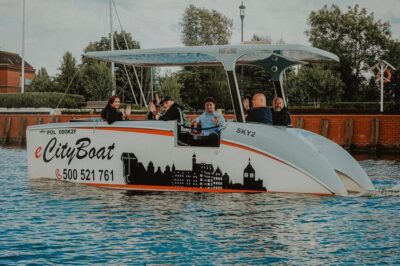
Sightseeing EcoCruise around the Old Town of Gdansk
Read our review →

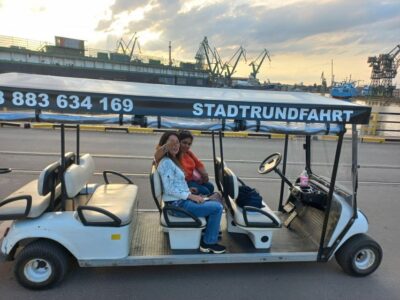
City Sightseeing Tour by Golf Cart/Buggy Guided Tour
Read our review →Where else this one turns up