
Reviewed · GOLF CART & SEGWAY TOURS
Krakow: Regular Extended City Sightseeing Tour By Golf Cart
Krakow’s past comes into focus quickly on this 135-minute golf-cart ride, which links three very different districts: the medieval Old Town, Jewish Kazimierz, and Podgorze, the former ghetto area. You cover a lot of ground without spending two hours on hard pavement.
I like the mix of multilingual audio and live driver commentary. The audio gives you a steady explanation in your chosen language, while drivers such as Jakub add extra facts and point out details close to the vehicle. I also like the route’s broad sweep, from Planty and the Barbican to Wawel, synagogues, Ghetto Heroes Square, and Schindler’s story.
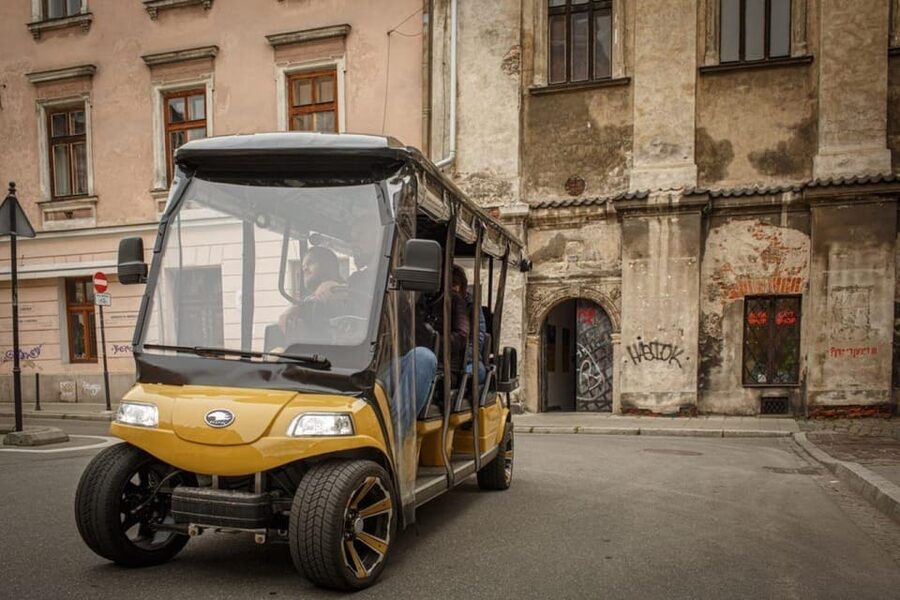
The main caution is the viewing angle. Some golf carts have a solid roof, and tall buildings may be harder to photograph or see from your seat. Seating is assigned, and a group of up to 13 may not sit together.
Key points before you book
- Three major Krakow districts in one ride: Old Town, Kazimierz, and Podgorze are tied together in a single route.
- A driver plus audio system: You receive recorded commentary in many languages, with live guiding in Polish or English.
- A practical break for your feet: The cart covers long distances while you remain seated.
- Up to 13 people per vehicle: This is a shared group outing, not a private tour.
- A strong focus on Jewish Krakow and the former ghetto: Synagogues, old streets, Ghetto Heroes Square, the ghetto wall, and Schindler’s story all appear.
- A possible roof problem: Check your view before settling in, especially if taking photos matters to you.
Why a golf cart makes sense in Krakow
Krakow is easy to explore on foot, but the main sights are spread across more ground than a first-time map may suggest. The Old Town, Kazimierz, and Podgorze each have a different feel and historical role. Walking between them can take energy away from the places themselves.
I like the cart for a first look at the city. You get a moving introduction rather than a long list of isolated monuments. The route shows how the central districts connect, and the recorded narration helps fill in the gaps as you pass from one area to the next.
This is not the same as getting out at every stop for a full visit. The strength is coverage. You see many landmarks from the street, learn why they matter, and can return later to the places that catch your interest.
The vehicles carry up to 13 people, with rows designed for as many as three people. The driver assigns seats, so you cannot count on sitting beside every member of your party. That matters for families and couples who expect a private-feeling ride.
More golf cart and segway routes in Krakow:
- Krakow: City Sightseeing Tour by Electric Golf Cart
★ 4.5 · 3,264 reviews - Krakow: City Sightseeing Tour Eco Electric Buggy Golf Cart
★ 4.7 · 3,143 reviews - Krakow: Extended City Sightseeing Tour – Eco Buggy Golf Cart
★ 4.7 · 794 reviews
Starting with Planty, the city walls, and the Barbican
The Old Town section begins with a general explanation of Krakow, followed by Planty, the green belt that traces the line of the old city fortifications. This is a useful opening because it gives you the basic shape of historic Krakow before the monuments start coming quickly.
You pass the Church of St. Cross and the Juliusz Słowacki Theater, then reach reminders of the former city walls. The Barbican and Jan Matejko Square help explain how the city was protected and where the old defensive ring met the streets beyond it.
The Church of St. Florian follows, along with Sławkowska Street and the Czartoryski Museum. This part of the ride works best as an orientation lesson. You hear the names and see the setting, then you can decide which interiors deserve your own time later.
The cart’s low, open street-level position is handy here. You are close to the facades and can watch the city pass at a relaxed pace. The tradeoff is that you may not get a clean view of every upper story, especially if the roof blocks part of your sightline.
The Old Town’s main sights, from St. John’s Street to Wawel
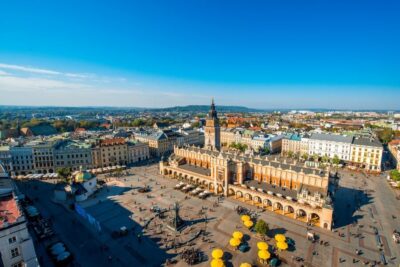
The route continues along St. John’s Street and past St. John’s Church before reaching Krakow’s Main Square. This is the city’s grand central room, framed by historic buildings and filled with landmarks that are easy to miss when you are busy finding your way.
You also pass Plac Szczepanski, the Palace of Art, St. Anne’s Church, the Town Hall, and the Franciscan Church. Each stop adds another piece to the city’s religious, civic, and artistic story.
Wawel Castle is one of the major highlights. Even from a vehicle, its position above the river and its importance to Polish royal history make it a useful anchor for the route. The audio commentary helps you understand why Wawel belongs in any first tour of Krakow.
I would not treat this section as a substitute for visiting Wawel Castle or the churches inside. The value is seeing where these places sit in relation to the rest of the city. If Wawel is high on your list, use the cart ride to get your bearings, then schedule a separate visit.
Kazimierz, where streets carry several layers of history
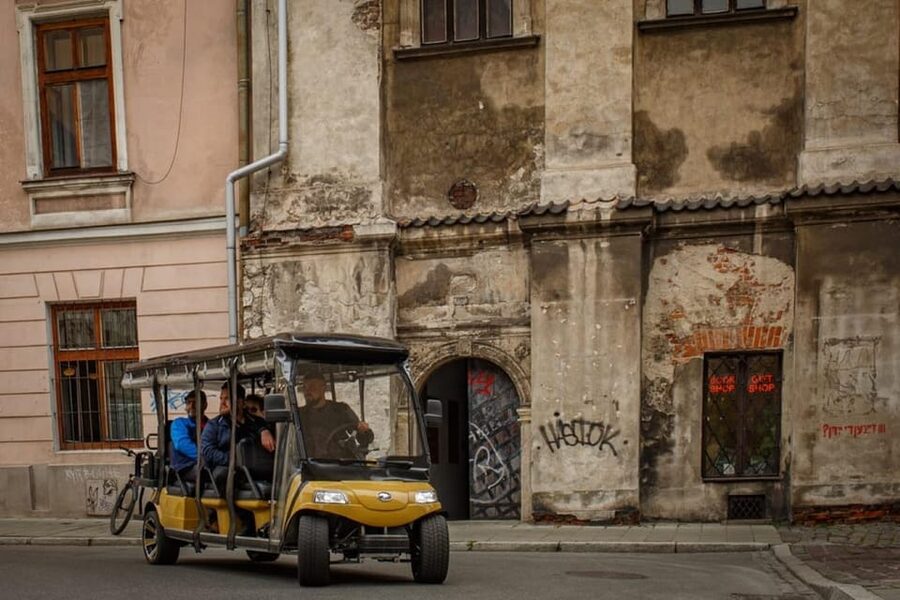
The route then shifts to Kazimierz, the former Jewish district. The change in atmosphere is one of the most useful parts of the trip. You pass Skałka Church, St. Catherine’s Church, and Wolnica Square, once the center of the Jewish city and home to its former city hall.
The Church of Corpus Christi comes next, followed by the Tempel, Kupa, and Isaac synagogues. You also pass Ciemna Street, the Old Synagogue, the Popper Synagogue, and the former family home of Helena Rubinstein.
This is a section where the audio guide earns its place. A synagogue facade or a narrow street can look like just another stop unless you know what happened there and how the district changed over time. The route gives you a framework before you return on foot.
The Remuh Synagogue and old cemetery are especially important landmarks. The nearby memorial stone for the Nissenbaum Family Foundation and the old Jewish shops add smaller details to the route. I like these details because they keep Kazimierz from being reduced to a handful of famous buildings.
You should expect to view these places from the vehicle rather than spend extended time inside them. The tour is best for context, location, and a first pass through the district. It is less suited to anyone who wants long periods for prayer, museum visits, or close study of architectural details.
A few more Krakow half days to consider
- From Krakow: Auschwitz-Birkenau Guided Tour & Hotel Pickup
★ 4.5 · 33,358 reviews - From Krakow: Auschwitz-Birkenau Guided Tour & Hotel Pickup
★ 4.5 · 29,340 reviews - Krakow: Auschwitz Guided Tour with Optional Hotel Pickup
★ 4.5 · 15,280 reviews - Krakow–Zakopane: Cable Car, Chocholow Baths, Cheese & Vodka
★ 5.0 · 10,720 reviews
Podgorze and the former ghetto
The final major section crosses into Podgorze, identified here as the former ghetto area. The shift is serious and the commentary matters. You pass Ghetto Heroes Square, the Pharmacy under the Eagle, and the former residence of Tadeusz Pankiewicz.
The pharmacy is tied to Pankiewicz and the wartime life of the ghetto. The route also explains Oskar Schindler’s story, daily life in the ghetto, and the surviving ghetto wall. These are not decorative sights. They require a pause in your attention, and the audio guide helps provide that pause while the cart moves through the streets.
Ghetto Heroes Square is one of the most direct memorial spaces on the route. The former pharmacy and wall add human scale to the broader story. I find this part valuable because it connects major historical names to ordinary places where people lived, worked, and faced forced displacement.
The Church of St. Joseph closes the listed route. By this point, you have moved from royal Krakow to Jewish Krakow and then to one of the city’s most painful wartime chapters. The sequence gives the tour a clear shape rather than presenting the city as a random collection of monuments.
Audio languages and the live guide
The live tour is offered in Polish and English. The audio system covers a much longer list: English, Chinese, Croatian, Czech, Danish, Finnish, French, Greek, Spanish, Dutch, Japanese, Korean, Lithuanian, German, Norwegian, Polish, Portuguese, Russian, Romanian, Serbian, Slovak, Swedish, Turkish, Ukrainian, Hungarian, and Italian.
That range is a real advantage if you do not want to follow a tour in English. You can listen in the language that feels easiest for dates, names, and historical details. The system also means the group does not need to share one spoken language.
The best version of the experience uses both parts well. The audio gives consistent information, while the driver handles the road and may add comments along the way. Jakub, one named driver-guide, is noted for being courteous and attentive and for adding information in both Polish and English beyond the recording.
Do not book this expecting a fully private conversation with a guide. In a group vehicle, the pace is fixed and the driver has to manage the route. Still, the combination is stronger than a recording alone.
What the seats and roof mean for sightseeing
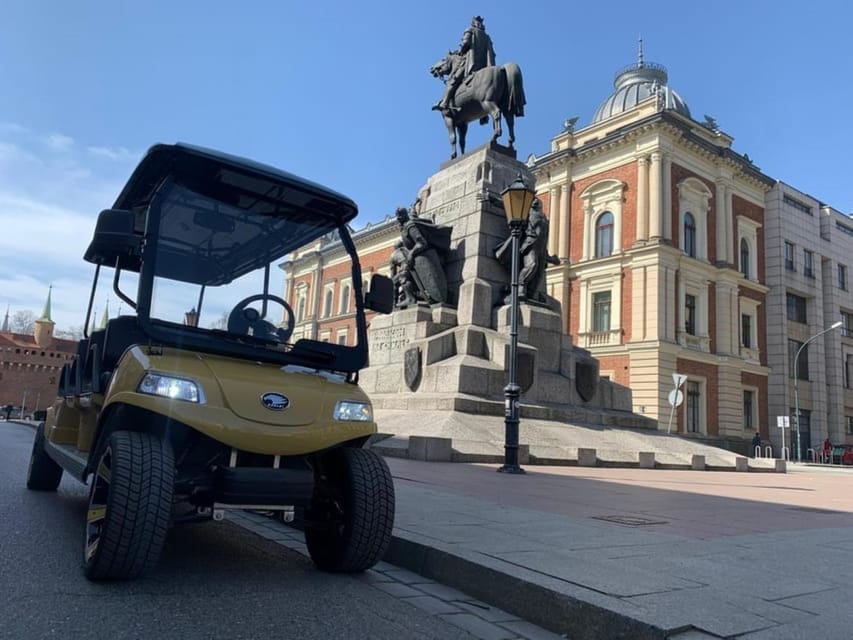
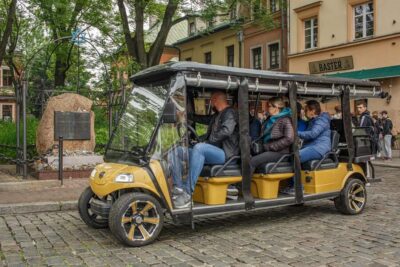
The cart design is comfortable for covering distance, but it shapes what you can see. You are seated low, and the vehicle may have a roof that is not transparent. Tall buildings can be difficult to frame in a photograph, and you may need to wait for a clearer angle.
One person specifically noted having to take a picture outside the cart to show a companion what a building looked like. That is a small issue, but it is worth knowing if photography is central to your plans. Another cart seen on the route had a transparent Perspex roof, but you should not assume your assigned vehicle will have that design.
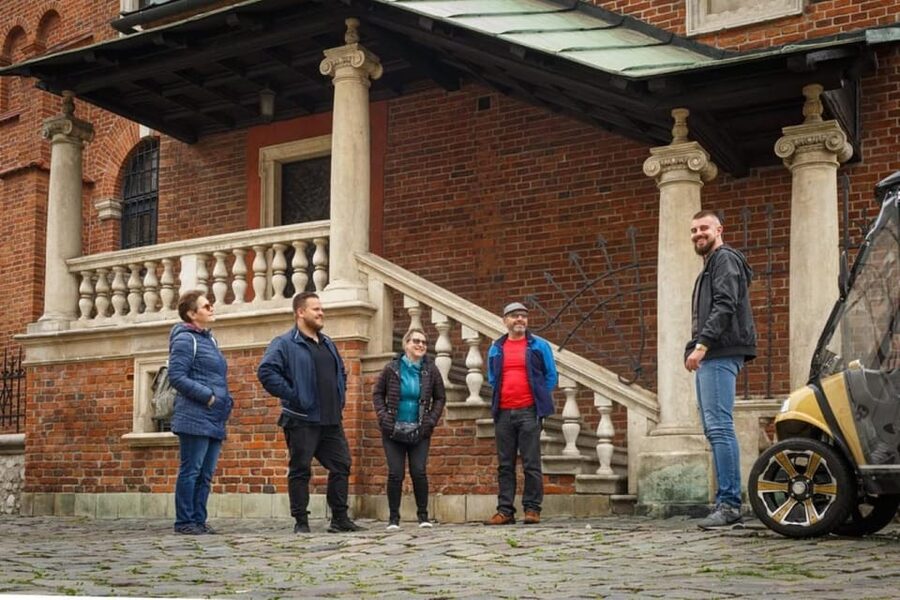
The driver assigns seats, and the company does not guarantee that people booking together will sit side by side. Arrive ready for a shared arrangement. The cart is designed for up to 13 passengers, with three people possible in each row.
The vehicle is listed as wheelchair accessible. Large bags, luggage, oversize items, pets, smoking, alcohol, drugs, weapons, and sharp objects are not allowed. The rules also prohibit jumping and explosive substances. These restrictions are straightforward, but the luggage rule matters if you are heading to or from a hotel with bags.
Is $55 a fair price for 135 minutes?
At $55 per person, this is not the cheapest way to see Krakow. You are paying for a fixed route, a driver, the vehicle, and a multilingual audio system. Food and drinks are not included, and this is a shared ride rather than a private car.
The value improves if you want to cover all three districts without spending the day walking. The route includes a large number of named sights, and the ride can help you decide where to spend more time afterward. It also has practical value for visitors who tire easily or want an easy first outing after arriving in Krakow.
The price is harder to justify if you already know the city well, prefer slow walking, or want to enter several museums and religious buildings. The cart gives you exterior views and explanation, not a series of long interior visits.
Free cancellation up to 24 hours before departure and the option to reserve now and pay later reduce the risk of committing too early. Check the available starting times before booking, since the ride lasts 135 minutes.
Who will get the most from this city ride?
I would choose this for a first visit, a short stay, or a day when your feet need a break. It suits families, older visitors, and anyone who wants a broad introduction before exploring on foot.
It is also a good fit if your group speaks different languages. The audio system supports many languages, while the live guide operates in Polish and English. You can follow the main explanation without asking the whole group to use one language.
History-focused visitors may find the Kazimierz and Podgorze sections especially useful. The route includes synagogues, the old cemetery, Jewish shops, Ghetto Heroes Square, the pharmacy, the ghetto wall, and Schindler’s story.
I would be more cautious if you need quiet, private guiding or excellent photo access at every stop. The vehicle is shared, seating is assigned, and the roof may obstruct views of tall buildings. Wear comfortable shoes anyway, since you may want to walk back to the places that interest you most.
Small ways to make the ride better
Get some sleep before the tour and eat breakfast, as the route runs for more than two hours. Wear comfortable shoes for any walking before or after the ride.
Keep your expectations focused on seeing and understanding rather than entering. Make a note of the Main Square, Wawel, the Old Synagogue, Remuh Synagogue, Ghetto Heroes Square, and the Pharmacy under the Eagle if you want to return later.
If you are booking with friends or family, accept that the driver controls seating. If photography matters, ask at the meeting point about the roof and choose your seat with the clearest available view, though a particular seat may not be guaranteed.
Should you book this Krakow golf-cart tour?
Book it if you want a wide first look at Krakow with minimal walking and a clear historical route. The strongest points are the coverage of Old Town, Kazimierz, and Podgorze, the many audio languages, and the chance to hear extra comments from an attentive driver such as Jakub.
Skip it if your main goal is detailed interior sightseeing, private guiding, or uninterrupted photography. At $55, it earns its price through range and convenience, not through long stops.
For many visitors, the smartest use is early in a Krakow stay. Take the ride, mark the places that catch your attention, then return on foot to the churches, synagogues, museums, and memorials you want to experience slowly.
FAQ
How long does the Krakow golf-cart tour last?
The activity lasts 135 minutes.
Which Krakow districts does the route cover?
It covers the Old Town, Kazimierz, the Jewish district, and Podgorze, the former ghetto area.
Is a live guide included?
Yes. Live guiding is available in Polish and English.
Which languages are available through the audio guide?
The audio guide is available in English, Chinese, Croatian, Czech, Danish, Finnish, French, Greek, Spanish, Dutch, Japanese, Korean, Lithuanian, German, Norwegian, Polish, Portuguese, Russian, Romanian, Serbian, Slovak, Swedish, Turkish, Ukrainian, Hungarian, and Italian.
How many people can the golf cart carry?
The vehicles are designed for up to 13 passengers, with each row accommodating up to three people.
Can people in the same booking sit together?
Not necessarily. The driver assigns seats, and seating beside other members of your party is not guaranteed.
Is the tour wheelchair accessible?
Yes, the activity is listed as wheelchair accessible.
Can I cancel for a full refund?
Yes. You can cancel up to 24 hours in advance for a full refund.
Recently added in Krakow
- Auschwitz-Birkenau and Krakow Private Car Trip from Katowice★ 4.3 · 3 reviews
- Wawel Castle, Old Town with St. Mary’s Church Guided Tour★ 5.0 · 3 reviews
- Private tour to Zakopane and Thermal Baths from Krakow★ 5.0 · 3 reviews
- Wawel Castle, Cathedral, Rynek Underground Tour with Lunch★ 5.0 · 3 reviews
- From Krakow: Chocholow Thermal Hot Springs (hotel pick up)★ 5.0 · 3 reviews
- Legends of Cracow ROBOTIC SHOW★ 4.0 · 3 reviews
- From Krakow: Zakopane and Thermal Pools Guided Trip★ 5.0 · 3 reviews
- Guided Beer Tour in Krakow★ 4.5 · 3 reviews
Golf Cart & Segway Tours, compared.
Extended City Sightseeing Tour – Eco Buggy Golf Cart
Read our review →
City Sightseeing Tour by Golf Cart/Buggy Guided Tour
Read our review →
Krakow Old Town Segway Tour 2hr with Training, Safety Gear, Guide
Read our review →
Jewish Quarter and Ghetto Electric Golf Cart Tour
Read our review →
Krakow Grand City Tour by golf cart – All 3 districts
Read our review →
Where else this one turns up